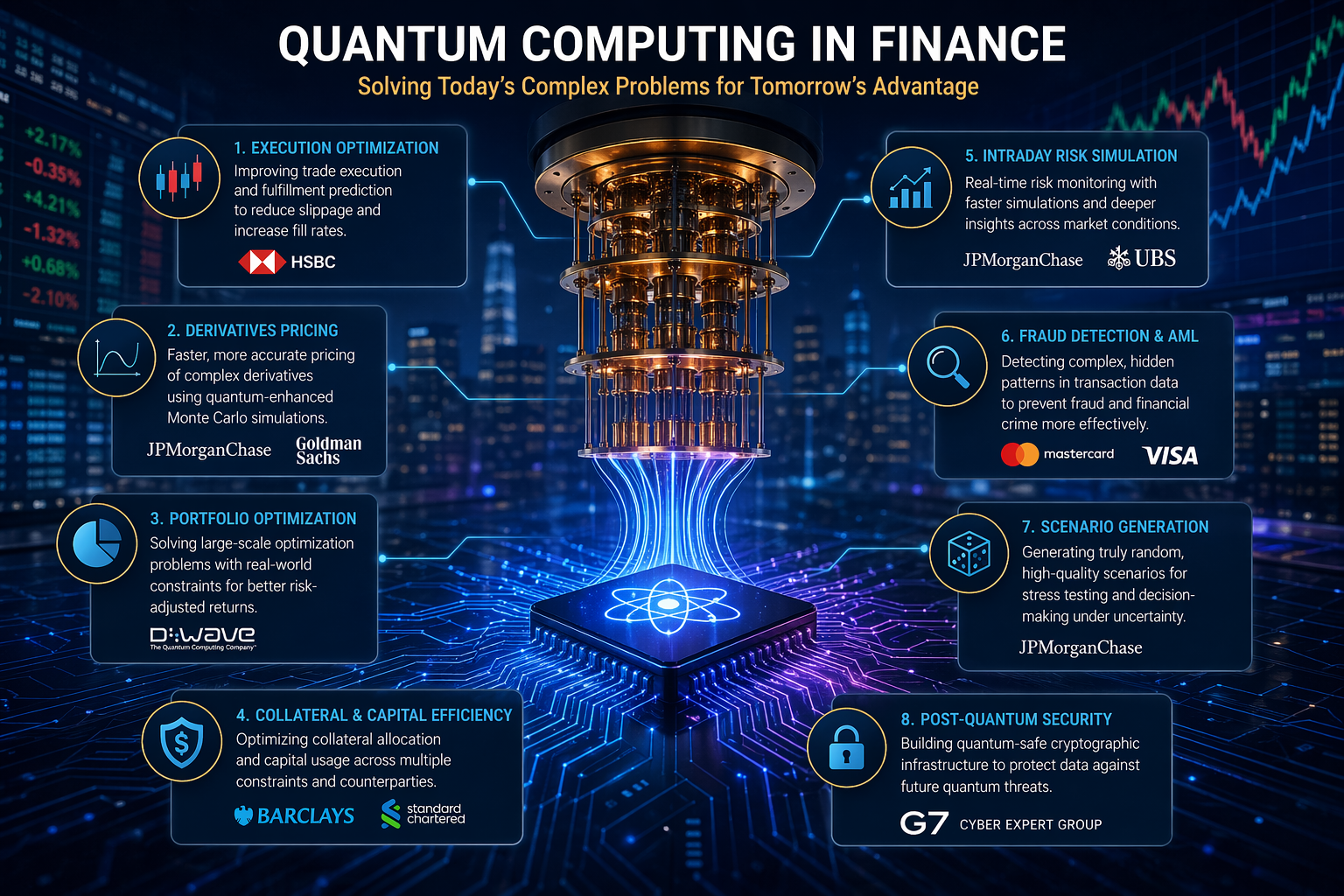
Quantum Computing in Finance: Where Real Value Is Emerging
Not a revolution everywhere, but a decisive edge in the few places that matter most.
--
Quantum computing in finance has entered a new phase. The conversation is no longer about long-term disruption, but about targeted, measurable advantage.
What distinguishes 2026 from prior years is not just technical progress — it is clarity of application. Financial institutions have identified specific problems where quantum methods outperform classical approaches, not universally, but decisively.
These are not experimental curiosities. They are early indicators of structural advantage.
1. Execution Optimization: The Hidden Source of Trading Alpha
One of the most advanced real-world applications of quantum computing is in trade execution, not prediction.
A notable milestone came when HSBC, using hardware from IBM, demonstrated a 34% improvement in predicting bond trade fulfillment.
This signals a shift in how quantum is used in markets:
- Not forecasting prices
- But optimizing how trades are executed
Why it matters:
Execution inefficiencies — slippage, partial fills, timing delays — erode returns. Even marginal improvements here translate directly into higher realized P&L.
Key insight:
Quantum computing is emerging as a tool for alpha preservation, not alpha generation.
2. Derivatives Pricing: Precision Under Complexity
Pricing complex derivatives remains one of the most computationally intensive tasks in finance.
Institutions such as Goldman Sachs and JPMorgan Chase are advancing quantum-enhanced Monte Carlo methods to address this.
What changes with quantum:
- Faster convergence in simulations
- More accurate estimation of tail risks
- Better handling of high-dimensional problems
Why it matters:
- Pricing becomes more responsive to market changes
- Risk adjustments can be incorporated in near real-time
Deeper insight:
The advantage is not raw speed — it is decision timing. Better pricing, delivered faster, changes how trades are structured and executed.
3. Portfolio Optimization: From Theory to Real Constraints
Portfolio optimization is fundamentally a combinatorial problem. Classical methods often rely on simplifications to remain tractable.
Quantum approaches — particularly via D-Wave Systems — are being applied to more realistic formulations that include:
- Transaction costs
- Liquidity constraints
- Regulatory requirements
Observed impact:
- Significant reductions in rebalancing time
- Improved handling of complex constraints
Why it matters:
The biggest gap in portfolio performance is often between optimal strategy and actual execution.
Key insight:
Quantum computing helps close that gap by enabling implementable optimization, not just theoretical allocation.
4. Intraday Risk Simulation: From Reporting to Action
Risk systems have traditionally been limited by computational cost, resulting in periodic updates rather than continuous monitoring.
Quantum-enhanced simulation methods are changing that.
New capabilities:
- Faster Monte Carlo simulations
- More detailed tail-risk modeling
- Increased frequency of recalculation
Institutions like JPMorgan Chase and UBS are actively exploring these approaches.
Why it matters:
Risk becomes actionable in real time, particularly during market stress.
Insight:
The shift is from knowing risk to responding to risk as it evolves.
5. Collateral and Capital Efficiency: Unlocking Trapped Value
Collateral allocation across markets, currencies, and counterparties is a complex optimization problem with direct balance sheet impact.
Quantum methods are being explored to:
- Dynamically allocate collateral
- Minimize funding costs
- Optimize across regulatory constraints
Banks including Barclays and Standard Chartered have initiated pilot programs in this area.
Why it matters:
Even small improvements in allocation efficiency can unlock significant capital savings.
Insight:
This is one of the least visible — but most financially impactful — applications of quantum computing.
6. Fraud Detection: Identifying Weak Signals
Financial crime detection increasingly depends on identifying subtle, distributed patterns across massive datasets.
Companies such as Mastercard and Visa are exploring quantum machine learning for this purpose.
What quantum adds:
- High-dimensional feature mapping
- Detection of complex, non-linear relationships
Why it matters:
- Improves detection of sophisticated fraud schemes
- Reduces false negatives in compliance systems
Insight:
Quantum is most valuable where patterns are too weak or complex for classical models to detect reliably.
7. Scenario Generation: Beyond Historical Thinking
Traditional stress testing relies heavily on historical scenarios or predefined shocks.
Quantum introduces a fundamentally different capability: true randomness.
Work by JPMorgan Chase on certified quantum randomness highlights this shift.
What changes:
- Generation of more diverse and unbiased scenarios
- Exploration of previously unconsidered risk configurations
Why it matters:
Financial crises often emerge from unanticipated combinations of events, not known scenarios.
Insight:
Quantum enables a move from testing known risks to discovering unknown ones.
8. Post-Quantum Security: The Urgent Imperative
While many quantum applications focus on opportunity, security is about necessity.
The work of the G7 Cyber Expert Group and global regulators has accelerated the transition toward post-quantum cryptography.
Key drivers:
- The risk of “harvest now, decrypt later” attacks
- Regulatory mandates for quantum-safe systems
What’s changing:
- Migration to quantum-resistant encryption
- Emphasis on crypto-agility across systems
Why it matters:
Security is becoming a systemic risk factor, not just an IT concern.
Insight:
In a quantum era, trust infrastructure becomes a competitive advantage.
The Underlying Pattern
Across all these use cases, three consistent themes emerge:
1. Precision over scale
Quantum is applied to specific bottlenecks, not entire systems.
2. Hybrid integration
Classical systems remain dominant; quantum enhances targeted components.
3. Economic relevance
Every successful use case ties directly to revenue, cost, or risk.
Final Takeaway
Quantum computing is not transforming finance uniformly. It is selectively reshaping the most complex and consequential decisions.
The edge it creates is subtle but powerful:
- Better execution
- More accurate pricing
- Faster risk insight
- More efficient capital use
Not a new financial system — but a more precise one.
The institutions that win will not be those that adopt quantum broadly, but those that apply it exactly where complexity limits classical thinking.