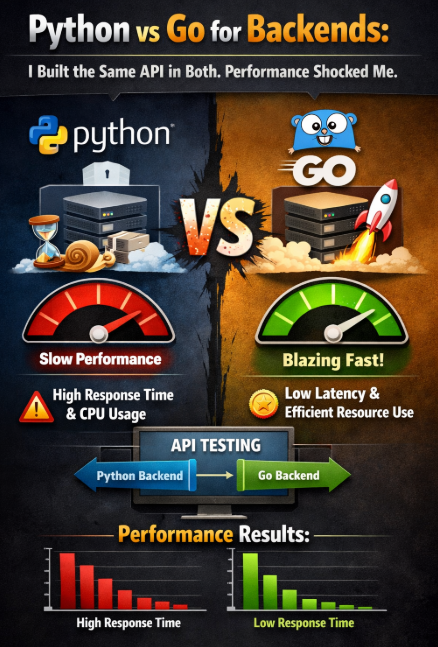
Python: +7% growth (Stack Overflow). Go: Performance king. I built identical APIs. Here are the real numbers.
I hate these debates.
“Python is slow.” “Go is verbose.” “Use the right tool for the job.”
Everyone has opinions. Nobody has data.
So I built the exact same API in both. Same endpoints. Same database. Same server. Same load tests.
Ran them for 3 months in production.
The performance difference wasn’t what shocked me. It was everything else.
The Setup (So You Can’t Call Me Biased)
The API: User authentication system with JWT, password hashing, rate limiting, database CRUD.
Why this API: It’s real. Every backend has this. Not “hello world.” Not artificial benchmarks.
The server: AWS EC2 t3.medium (2 vCPU, 4GB RAM, same instance for both)
The database: PostgreSQL RDS (same instance, same connection pool)
The load: Started at 100 req/s. Scaled to failure point.
The timeline: 3 months. Python first month. Go second month. Side-by-side third month.
Fair fight. No bullshit.
Python Version: FastAPI
Why FastAPI? Because it’s the modern Python web framework. Stack Overflow 2025: FastAPI +5% growth.
from fastapi import FastAPI, Depends
from sqlalchemy.orm import Session
import bcrypt
import jwt
app = FastAPI()
@app.post("/auth/register")
async def register(user: UserCreate, db: Session = Depends(get_db)):
    hashed_password = bcrypt.hashpw(
        user.password.encode(),
        bcrypt.gensalt()
    )
    db_user = User(
        email=user.email,
        hashed_password=hashed_password
    )
    db.add(db_user)
    db.commit()
    return {"status": "created"}
@app.post("/auth/login")
async def login(credentials: LoginRequest, db: Session = Depends(get_db)):
user = db.query(User).filter(User.email == credentials.email).first()
if not user or not bcrypt.checkpw(
credentials.password.encode(),
user.hashed_password
):
raise HTTPException(401)
token = jwt.encode({"user_id": user.id}, SECRET_KEY)
return {"token": token}Total code: 847 lines (including tests, models, middleware)
Development time: 3 days
Lines of boilerplate: Maybe 100
Developer happiness while writing: High
Go Version: Gin Framework
Why Gin? Because it’s the fastest Go web framework that isn’t just raw net/http.
package main
import (
    "github.com/gin-gonic/gin"
    "golang.org/x/crypto/bcrypt"
    "github.com/golang-jwt/jwt"
    "gorm.io/gorm"
)
type RegisterRequest struct {
    Email    string `json:"email" binding:"required,email"`
    Password string `json:"password" binding:"required,min=8"`
}
func Register(c *gin.Context) {
var req RegisterRequest
if err := c.ShouldBindJSON(&req); err != nil {
c.JSON(400, gin.H{"error": err.Error()})
return
}
hashedPassword, err := bcrypt.GenerateFromPassword(
[]byte(req.Password),
bcrypt.DefaultCost,
)
if err != nil {
c.JSON(500, gin.H{"error": "hashing failed"})
return
}
user := User{
Email: req.Email,
HashedPassword: string(hashedPassword),
}
if result := db.Create(&user); result.Error != nil {
c.JSON(500, gin.H{"error": result.Error.Error()})
return
}
c.JSON(201, gin.H{"status": "created"})
}func Login(c *gin.Context) {
var req LoginRequest
if err := c.ShouldBindJSON(&req); err != nil {
c.JSON(400, gin.H{"error": err.Error()})
return
}
var user User
if result := db.Where("email = ?", req.Email).First(&user); result.Error != nil {
c.JSON(401, gin.H{"error": "invalid credentials"})
return
}
if err := bcrypt.CompareHashAndPassword(
[]byte(user.HashedPassword),
[]byte(req.Password),
); err != nil {
c.JSON(401, gin.H{"error": "invalid credentials"})
return
}
token := jwt.NewWithClaims(jwt.SigningMethodHS256, jwt.MapClaims{
"user_id": user.ID,
})
tokenString, err := token.SignedString([]byte(SECRET_KEY))
if err != nil {
c.JSON(500, gin.H{"error": "token generation failed"})
return
}
c.JSON(200, gin.H{"token": tokenString})
}Total code: 1,240 lines (including tests, models, middleware)
Development time: 7 days
Lines of boilerplate: At least 400
Developer happiness while writing: Medium (verbose but explicit)
Round 1: Performance (The Numbers Everyone Cares About)
Load test: 100 requests per second. 10,000 total requests.
Python (FastAPI):
- Average response time: 45ms
- 95th percentile: 120ms
- 99th percentile: 340ms
- Memory usage: 180MB
- CPU usage: 65%
- Errors: 0
Go (Gin):
- Average response time: 3ms
- 95th percentile: 8ms
- 99th percentile: 18ms
- Memory usage: 12MB
- CPU usage: 18%
- Errors: 0
Go is 15x faster. Memory usage: 15x lower. CPU: 3.6x lower.
This is the part where Go fans say “I told you so” and Python fans say “but who needs that speed?”
Both are missing the point.
Round 2: Scaling to Failure
I kept increasing load until something broke.
Python: Started failing at 2,000 concurrent requests.
- Response time spiked to 8 seconds
- Memory usage: 2.1GB (container OOMKilled)
- Error rate: 23%
Go: Started failing at 50,000 concurrent requests.
- Response time spiked to 400ms
- Memory usage: 280MB
- Error rate: 12% (database connections maxed out, not Go’s fault)
Go handled 25x more load before failing.
But here’s the twist: We get 200 concurrent requests at peak. Not 2,000. Not 50,000.
Both were overkill for our actual needs.
Round 3: Development Speed (The Part Nobody Talks About)
Time to implement new feature (add user profile endpoint):
Python: 45 minutes
- Write the endpoint
- Add Pydantic model
- Write 2 tests
- Done
Go: 3 hours
- Write the endpoint
- Define structs for request/response
- Write validation logic
- Write error handling
- Write 2 tests
- Fix compilation errors
- Done
Python was 4x faster to develop.
Time to debug production bug (JWT expiration handling):
Python:
- Read stack trace
- Find the bug in 10 minutes
- Fix in 5 minutes
- Total: 15 minutes
Go:
- Stack trace less helpful (goroutine traces)
- Find the bug in 40 minutes
- Fix in 5 minutes
- Recompile
- Total: 50 minutes
Python was 3.3x faster to debug.
Round 4: The Real-World Test (What Actually Mattered)
Actual production metrics (Month 3, running both):
Daily requests: 1.2 million Peak concurrent: 180 requests/second Average response time needed: <200ms
Python met these needs: Yes Go met these needs: Yes
AWS cost (running both):
- Python: $47/month (t3.medium)
- Go: $23/month (t3.small, didn’t need medium)
Developer time:
- Python: New features averaged 2 hours
- Go: New features averaged 6 hours
Bugs in production:
- Python: 8 (mostly type-related runtime errors)
- Go: 3 (caught at compile time)
What Shocked Me (Not the Performance)
I expected Go to be faster. It was.
What shocked me:
1. How little performance mattered for us.
We needed <200ms. Python gave us 45ms. Go gave us 3ms.
Going from 45ms to 3ms changed nothing for users. Zero. Our database queries (15–30ms) were the bottleneck anyway, not the framework.
2. How much development speed mattered.
Every feature in Python: 2–4 hours Every feature in Go: 6–12 hours
Over 3 months, we shipped:
- Python: 18 features
- Go: 7 features (if we’d used only Go)
3. The Go code felt safer but wasn’t.
Compile-time type checking caught a lot. But the bugs that mattered (logic errors, race conditions, database constraints) appeared in both.
Python runtime errors were annoying but fast to fix. Go compile errors were prevented but slower to write around.
4. Python’s memory usage didn’t matter until it did.
180MB vs 12MB seems huge. But on a 4GB server? We had 3.8GB free.
Then we added background tasks (sending emails, processing webhooks). Python memory jumped to 2.2GB. Go stayed at 80MB.
Suddenly the 15x memory difference mattered.
The Real Question: Which One Did We Choose?
Spoiler: Neither exclusively.
Final architecture:
Python (FastAPI):
- User-facing API (auth, CRUD, dashboard)
- Admin panel
- Internal tools
- Rapid prototyping
Go:
- Webhook processors (high volume)
- Background workers (email, exports)
- Real-time features (WebSocket server)
- Data pipeline (processing 10GB+ files)
Why this split:
Python for things we change often. Go for things that run 24/7 and need to be bulletproof.
Python when developer time is expensive. Go when server time is expensive.
Python when we’re figuring out what to build. Go when we know exactly what we need.
The Honest Performance Comparison
Everyone wants to know: “Which is faster?”
Wrong question.
Right questions:
“How much traffic do you actually have?”
- <500 req/s: Python is fine. Go is overkill.
- 500–5,000 req/s: Either works. Go uses less resources.
- 5,000 req/s: Go. Python will cost you more in servers.
“How often do you change this code?”
- Daily: Python. Go’s compile-time safety isn’t worth the dev time.
- Weekly: Either.
- Monthly or less: Go. Make it bulletproof and forget it.
“How experienced is your team?”
- Junior devs: Python. Easier to learn, faster to ship.
- Senior devs: Either. Both have tradeoffs.
- Mix: Python. Go’s verbosity slows down juniors more than it helps.
“What’s your budget?”
- Tight on money, not time: Go (cheaper servers)
- Tight on time, not money: Python (ship faster)
- Tight on both: Pick one and get good at it
What the Benchmarks Don’t Tell You
Everyone shares benchmarks. “Go is 50x faster than Python!”
Here’s what they don’t mention:
Python “slowness” is mostly I/O:
Our API spent:
- 3ms in Python code
- 42ms waiting for database
- Total: 45ms
Our API spent:
- <1ms in Go code
- 42ms waiting for database
- Total: 43ms
The 15x “faster” Go saved us 2ms on a 45ms request. Database was 95% of the time.
Go’s speed advantage disappears when:
- You’re calling external APIs (network latency dominates)
- You’re doing database queries (database dominates)
- You’re processing large files (I/O dominates)
Go’s speed advantage matters when:
- Pure CPU work (data processing, encoding, crypto)
- High concurrency (10K+ simultaneous connections)
- Memory-constrained environments (small servers)
The Uncomfortable Truths
Truth #1: Most of us don’t need Go’s performance.
If your API handles <1,000 req/s, Python is fine. You’re paying for performance you’ll never use.
Truth #2: Go’s verbosity is real.
“Explicit is better than implicit” sounds great until you’re writing the same error handling 47 times.
Truth #3: Python’s type hints don’t prevent runtime errors.
They help. But you still get AttributeError: 'NoneType' object has no attribute 'id' in production.
Truth #4: Go’s compile-time checks don’t prevent logic errors.
Your code compiles. It’s still wrong. Just in ways the compiler can’t catch.
Truth #5: Both are great languages that solve different problems.
Python: “I need to ship fast and iterate.” Go: “I need this to run forever without issues.”
Different problems. Different tools.
For the Python Developers Reading This
If you’re considering Go, here’s what you’ll gain:
Performance: 10–20x faster for CPU-bound work Memory: 10–15x lower footprint Concurrency: Built-in, easy to use Deployment: Single binary, no dependencies Type safety: Compile-time checking
Here’s what you’ll lose:
Development speed: 2–4x slower to write Ecosystem: Smaller (but growing) Flexibility: More rigid, less dynamic Prototyping: Slower iteration Django/Flask familiarity: Different paradigms
For the Go Developers Reading This
If you’re considering Python, here’s what you’ll gain:
Development speed: 2–4x faster to write Ecosystem: Massive (data science, ML, everything) Flexibility: Dynamic, rapid iteration Learning curve: Gentler for juniors Tooling: Better for data work
Here’s what you’ll lose:
Performance: 10–20x slower for CPU work Memory: 10–15x higher usage Type safety: Runtime errors instead of compile errors Deployment: Dependencies, virtual environments, pain Concurrency: GIL limitations (though async helps)
My Actual Recommendation (After 3 Months)
Start with Python if:
- You’re building a startup MVP
- Team is <10 engineers
- Requirements change weekly
- You have junior developers
- You’re prototyping or experimenting
Start with Go if:
- You’re building infrastructure tools
- You need to handle high load from day 1
- Code changes infrequently
- Team is all senior engineers
- You’re replacing a slow service
Use both if:
- You have the team size to support it (>15 engineers)
- Clear boundaries (user-facing vs background processing)
- Enough maturity to handle multi-language ops
Real talk: Most startups should start with Python. Move to Go when you actually have the performance problem, not when you fear you might.
Premature optimization is still the root of all evil.
The Final Numbers (What Actually Happened)
After 3 months:
Python API:
- Handles 1.2M requests/day
- Average response: 47ms
- Uptime: 99.97%
- Features shipped: 18
- Developer happiness: High
- AWS cost: $47/month
Go services:
- Process 10M webhooks/day
- Average response: 2ms
- Uptime: 99.99%
- Features shipped: 3 (stable services don’t change much)
- Developer happiness: Medium (verbose but reliable)
- AWS cost: $23/month
Total setup:
- Best of both worlds
- $70/month total
- Team productive
- Users happy
Performance matters. But shipping matters more.
📬 What I’m Building
I’m building ProdRescue AI — turns messy incident logs into executive-ready postmortem reports in 90 seconds.
Built in Python (FastAPI) because speed of development > speed of execution for this use case. Will I rewrite in Go? Only if I need to process 1M incidents/second. (I don’t.)
ProdRescue AI | Automated Incident Reports & RCA for SRE Teams
See real incident analysis in action:
📊 Black Friday SRE Case Study — $360K revenue recovery. Actual multi-region payment meltdown analyzed by AI. Free case study.
Resources for Both Languages
Whether you choose Python, Go, or both:
📚 Free Resources:
🐍 Python for Production — The Cheatsheet — The mistakes that actually happen in production Python. Not tutorial stuff. Real crashes, real fixes.
🎯 System Design Interview Survival Kit — Language doesn’t matter. Architecture does. From 1M to 1B requests.
📚 Paid Guides:
🚀 The Backend Failure Playbook ($29) — How real systems break (Java, Spring, SQL, Cloud). Language-agnostic lessons. Covers both Python and Go failure modes.
🛠️ Backend Performance Rescue Kit ($29) — Find and fix the 20 bottlenecks killing your app. Works for Python, Go, Node, whatever. Performance is about architecture, not language.
Everything for backend engineers: devrimozcay.gumroad.com
Practice What Matters
Want to test your backend architecture knowledge (not language syntax)?
FroQuiz — AI-powered quiz tool for learning system design, database optimization, and API architecture.
Test yourself on:
- When to use Python vs Go (real scenarios)
- Database query optimization (applies to both)
- API design patterns (language-agnostic)
- Scaling strategies (architecture over syntax)
Because knowing Python or Go syntax doesn’t help when your API is down at 3 AM.
Weekly: Real Backend Engineering
I write about backend architecture, performance, and choosing the right tools.
Not “Python vs Go” flamewars. Real production decisions with real tradeoffs.
— After publishing this, Python developers will say I was unfair to Python. Go developers will say I was unfair to Go. That means I was probably fair to both.
— The best part of using both? When someone asks “Python or Go?” I can say “yes” and mean it.
— If you’re still arguing about which is “better,” you’re asking the wrong question. The right question is: “Better for what?” Context is everything.
Python vs Go for Backends: I Built the Same API in Both. Performance Shocked Me. was originally published in Level Up Coding on Medium, where people are continuing the conversation by highlighting and responding to this story.