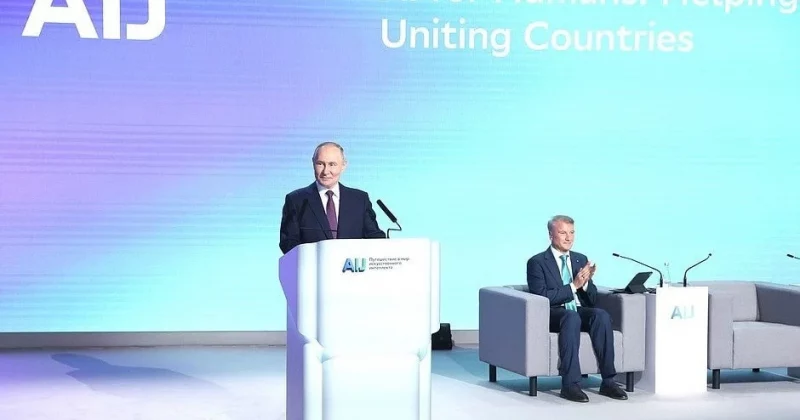
Putin announces international AI alliance to enhance cooperation in AI development and infrastructure
The BRICS+ AI Alliance aims to build shared computing infrastructure and challenge Western technological dominance, though crypto integration remains notably absent.
Share
Add us on Google by Editorial Team May. 28, 2026Russia is making its play for AI supremacy, and it’s bringing friends. President Vladimir Putin announced the AI Alliance Network at the AI Journey conference in Moscow, a coalition designed to connect national AI associations and development institutions from BRICS countries and beyond.
The initiative, sometimes referred to as the BRICS+ AI Alliance, aims to pool resources for collaborative AI research, shared computing infrastructure, regulatory standards, and ethical frameworks.
What the alliance actually looks like
The founding members include the core BRICS nations: Brazil, Russia, India, China, and South Africa. Serbia and Indonesia have also joined, with reporting indicating participation from between 20 and 28 countries or entities in total.
Russia has positioned itself as the primary coordinator of the effort.
AdvertisementThe alliance has laid out a concrete timeline. An international foresight session is scheduled for 2025 to establish joint scientific goals and, critically, funding strategies. Further Russia-China AI infrastructure discussions are planned for a May 2026 summit.
On the ethical side, Russia has proposed a Code of AI Ethics that has attracted over 200 signatories. The code promotes unbiased and culturally sensitive algorithms.
The economic ambitions are substantial. Russia’s National Strategy for AI Development targets AI contributing 11.2 trillion roubles to its GDP by 2030.
The geopolitical chess game
Russia’s AI ambitions aren’t new. The country has long integrated AI into its national security and developmental strategies, with major entities like Sberbank and the Russian Direct Investment Fund playing central roles. Sberbank, in particular, has been a driving force behind Russia’s AI research ecosystem and was a key organizer of the AI Journey conference where this announcement was made.
The alliance’s focus on the Global South is strategic. By offering shared computing infrastructure and collaborative research opportunities to developing nations, Russia is essentially building a technology influence network. Countries that might not have the resources to build sovereign AI capabilities independently now have an on-ramp, one that doesn’t route through Washington or Brussels.
What this means for crypto and digital assets
The alliance’s discussions have remained strictly within traditional technology and infrastructure fields. No blockchain-based AI compute marketplaces. No tokenized access to shared infrastructure. No decentralized governance for the alliance itself.
The BRICS+ approach appears to favor state-controlled infrastructure over decentralized alternatives. Russia has oscillated between cautious acceptance and outright hostility toward digital assets. China banned crypto trading entirely. The alliance’s architecture suggests centralized, government-managed compute resources rather than open, permissionless networks.
Traders watching this space should pay attention to the 2025 foresight session. If funding strategies include any digital infrastructure components or cross-border payment mechanisms, the narrative around AI tokens could shift quickly.
Disclosure: This article was edited by Editorial Team. For more information on how we create and review content, see our Editorial Policy.