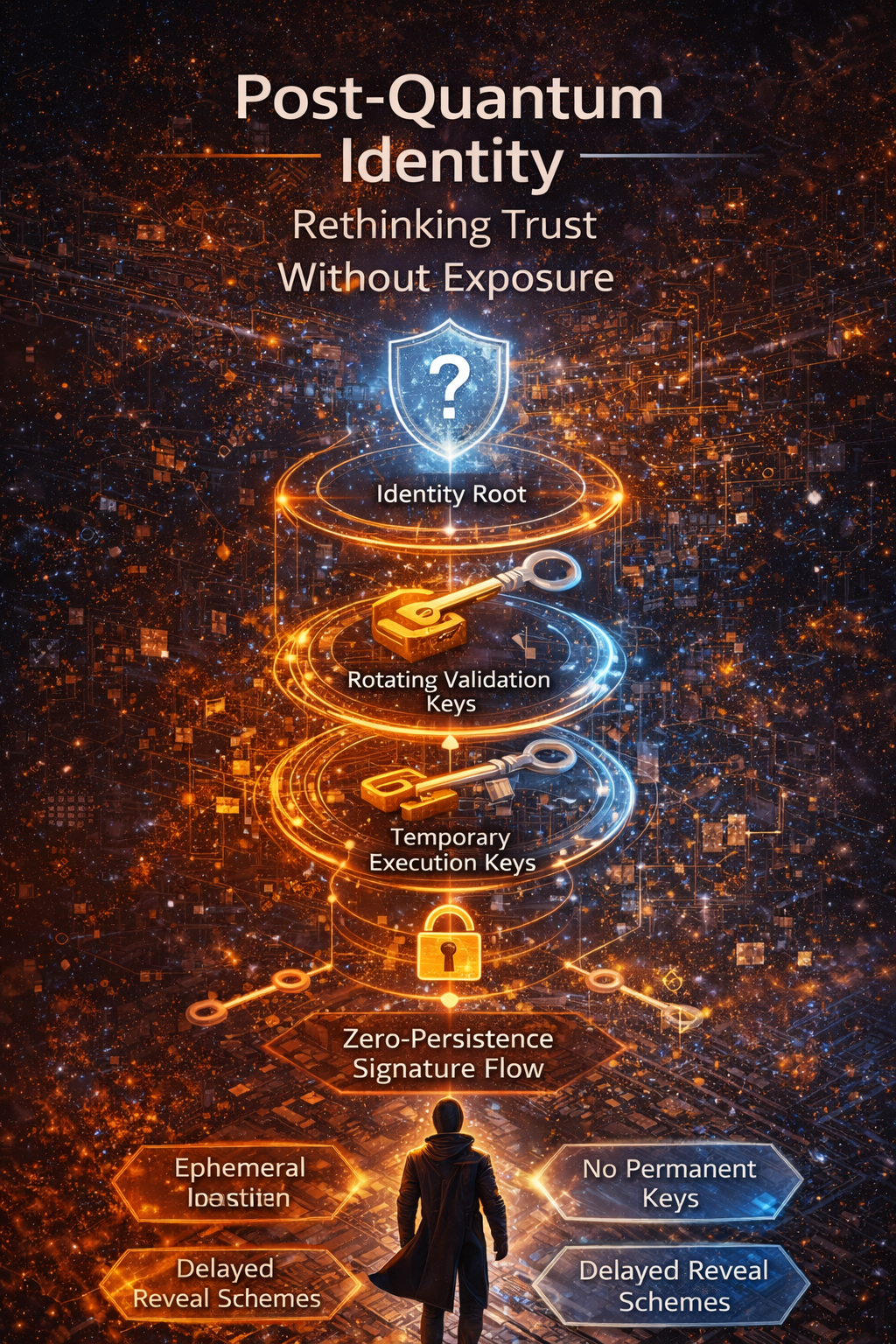
Post-Quantum Identity — Rethinking Trust Without Exposure
--
1️⃣ The Hidden Vulnerability: Identity Binding to Static Keys
Most blockchain identity models bind ownership to:
Public Key → Address → Control
This works under classical assumptions.
However, under quantum threat models:
If a public key is exposed,
future decryption risk increases.
Identity permanently tied to static cryptographic material
becomes a structural liability.
2️⃣ Ephemeral Identity Architecture
A quantum-aware identity layer must:
- Decouple identity from permanent keys
- Support rotating key infrastructure
- Maintain state continuity without static exposure
Possible model:
Identity Root → Rotating Validation Keys → Temporary Execution Keys
The root never signs transactions directly.
Only rotating intermediate keys operate.
This reduces exposure window.
3️⃣ Zero-Persistence Signature Flow
In classical systems:
Transaction reveals public key → Remains on-chain forever.
Quantum-aware design aims to:
Minimize signature surface retention.
Techniques may include:
- Delayed reveal schemes
- Commit-reveal batching
- Hash commitment identity anchoring
- Key destruction enforcement logic
Exposure minimization becomes identity design.
4️⃣ Deterministic Yet Anonymous
The challenge:
Maintain deterministic validation
while preserving minimal identity footprint.
Requirements:
- Stateless verification capability
- Signature validity without identity leakage
- Address refresh without state fork
This requires identity abstraction layer
at protocol depth.
5️⃣ Structural Implication
A network that integrates:
- PQC-native signatures
- Rotational identity model
- Exposure-minimizing transaction design
is not only quantum-resistant.
It is quantum-aware.
6️⃣ Alignment Perspective
If a protocol emphasizes:
- Secure & Anonymous architecture
- Quantum-resistant foundation
- Long-term survivability
then identity-layer abstraction
becomes a logical extension of that design philosophy.
Future security is not just about keys.
It is about exposure geometry.
7️⃣ Final Reflection
In the quantum era,
identity must be dynamic.
Static trust collapses.
Adaptive identity survives.