Perplexity Wants Your Laptop to Do Part of the AI Work—So It Doesn't Have To
The company's new hybrid inference system routes AI tasks between your device and the cloud automatically. Privacy and cost savings are the pitch—and lower server bills.
 By Jose Antonio LanzEdited by Guillermo JimenezJun 3, 2026Jun 3, 20265 min read
In brief
- Perplexity announced "hybrid agentic inference" at Computex 2026, a system that automatically splits AI workloads between a user's local device and cloud-based frontier models—no manual configuration required.
- The feature is coming to Perplexity Computer in July, demoed on Intel Core Ultra Series 3 processors and currently exclusive to the Windows PC app.
- CEO Aravind Srinivas framed the move around cost efficiency: Perplexity's revenue grew fivefold to $500 million while headcount rose just 34%, and offloading inference to user hardware keeps that ratio working.
Perplexity CEO Aravind Srinivas took the stage at Computex 2026 in Taipei on June 2 alongside Intel CEO Lip-Bu Tan to announce what the company calls the first hybrid local-server inference orchestrator. The system, coming to Perplexity Computer in July, automatically decides which parts of an AI task to run on your machine and which parts get routed to more powerful models in the cloud—without asking you to choose.
“Today we're announcing the next step for Personal Computer: the first hybrid local-server inference orchestrator,” Perplexity announced. “It decides what work should run on your device and what work should go to cloud agents, automatically routing each part of a task to the right place”
"The right goal for an AI system is to deliver the most token value per watt, for each user," Perplexity wrote in the official announcement. Three competing pressures make that hard: accuracy demands the most capable models, privacy demands some data never leaves your machine, and cost demands you don't spend a frontier model's computing resources on a task a smaller one can handle.
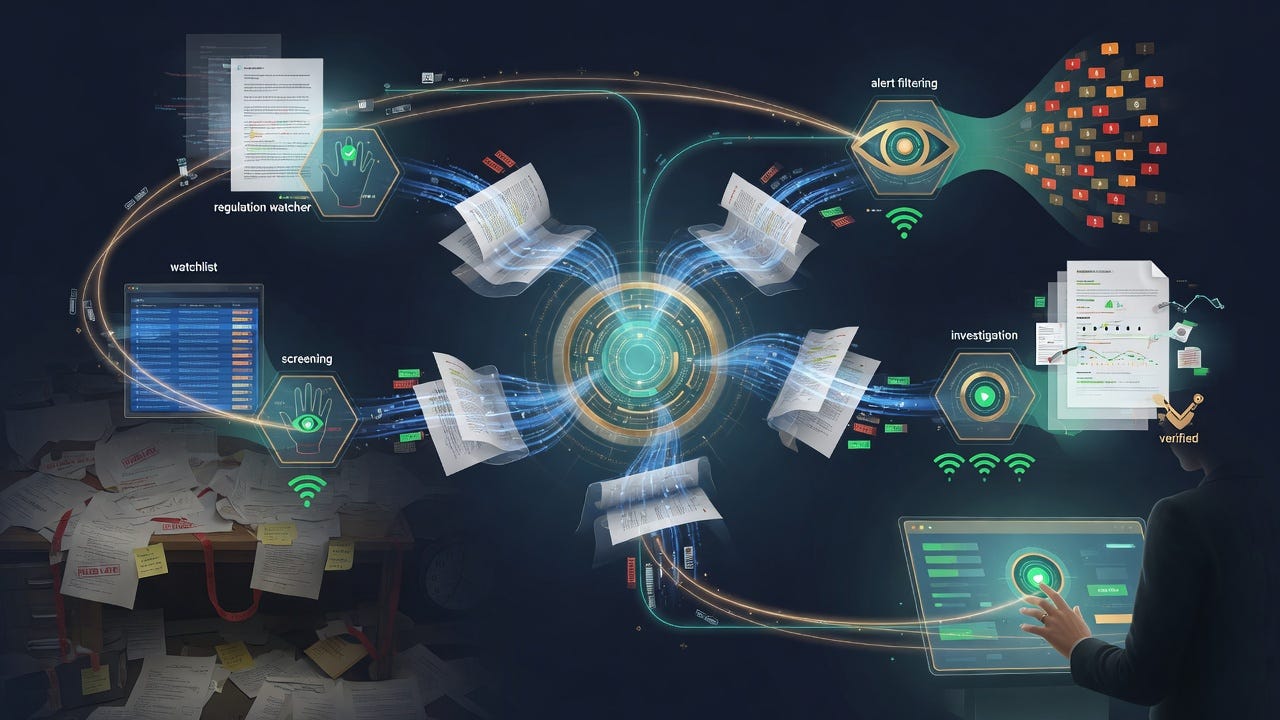
The solution Perplexity calls "hybrid agentic inference" addresses all three at once. A compact model runs locally on your device and acts as a traffic cop—figuring out which information is sensitive enough to stay local and which tasks need the full power of a cloud-based frontier model.
"Hybrid agentic inference is for work that includes sensitive data but needs powerful AI. Things like financial records, health information, and personal files," the company explained. "The compact model runs locally on your device to determine when sensitive data should also be kept locally. Meanwhile, work that needs a frontier model's full capability runs on the server."
Should you care about it?
Inference—the process of running a trained AI model to generate a response—is the computational work that happens every time you send a prompt to a chatbot. Right now, almost all of it happens on remote servers owned by AI companies. That means your financial documents, health queries, and private notes travel to someone else's computer before you get an answer back.
This is why you see “Auto” modes or “low thinking” modes on your chatbot. AI companies will always try to force users into routing interactions in the cheapest mode possible for them.
Srinivas has been direct about this. In a Bloomberg Television interview at Computex, he said the quiet part out loud: "You don't want all your compute centralized in servers and everything running through the largest models. Some people are spending half a billion dollars per month. What you actually want is efficient value per watt per user." Offloading inference work to user hardware reduces those bills—for Perplexity.
Local inference is the best for those companies since it cuts a lot of the costs, but has a major point in favor for AI users: It keeps that data on your machine. The tradeoff has always been power: smaller models that run locally are less capable than the large ones living in data centers.
Perplexity's orchestrator tries to get both. Simple tasks—summarizing a document you've already written, formatting text, lightweight classification—run locally. Complex reasoning gets routed to the cloud, ideally without the sensitive parts of your task attached. The company says this happens automatically, mid-task, invisible to the user. Whether the routing is as reliable in practice as it sounds in a Computex demo is a question the July rollout will answer.
One clarification worth making: this is not Perplexity giving away an open-source local model you control. The local component is a compact model Perplexity deploys as part of its app. The cloud component still routes through Perplexity's servers. Users who want a fully offline, self-hosted setup—the kind projects like MiniCPM5-1B offer—won't find that here.
The numbers give that framing context. Perplexity's revenue grew from $100 million to $500 million while headcount increased just 34%, Srinivas announced in April. A company that routes queries across models it doesn't train has strong incentives to keep compute costs as low as possible. Shifting part of the inference burden to users' devices—billions of PCs already in circulation—is an efficient way to do that. The privacy pitch is real, but it aligns conveniently with the financial one.
Who else is doing this
Every major player in AI is pushing toward on-device or hybrid inference right now. Apple Intelligence runs its most sensitive processing locally on M-series chips. Microsoft's Foundry Local reached general availability in April 2026, enabling full AI inference on Windows, macOS, and Linux without cloud dependency.
Nvidia announced RTX Spark at the same Computex where Perplexity made its announcement, targeting local LLM inference on laptops and desktops. Google's approach, as Decrypt reported, has been more controversial—Chrome was quietly installing a 4GB Gemini Nano model without user consent, and the "AI Mode" button most users actually see doesn't even use it.
Perplexity's differentiation is the orchestration layer. Rather than asking users to pick local or cloud up front, the system decides per task, in real time. Srinivas said the approach is "chip agnostic"—the Computex demo ran on Intel Core Ultra Series 3, but Nvidia processors are also supported. The feature is currently exclusive to the Perplexity for Windows PC app, with a broader rollout timeline not yet confirmed.