What happens when you stop switching between AI tools and let the system figure it out for you.
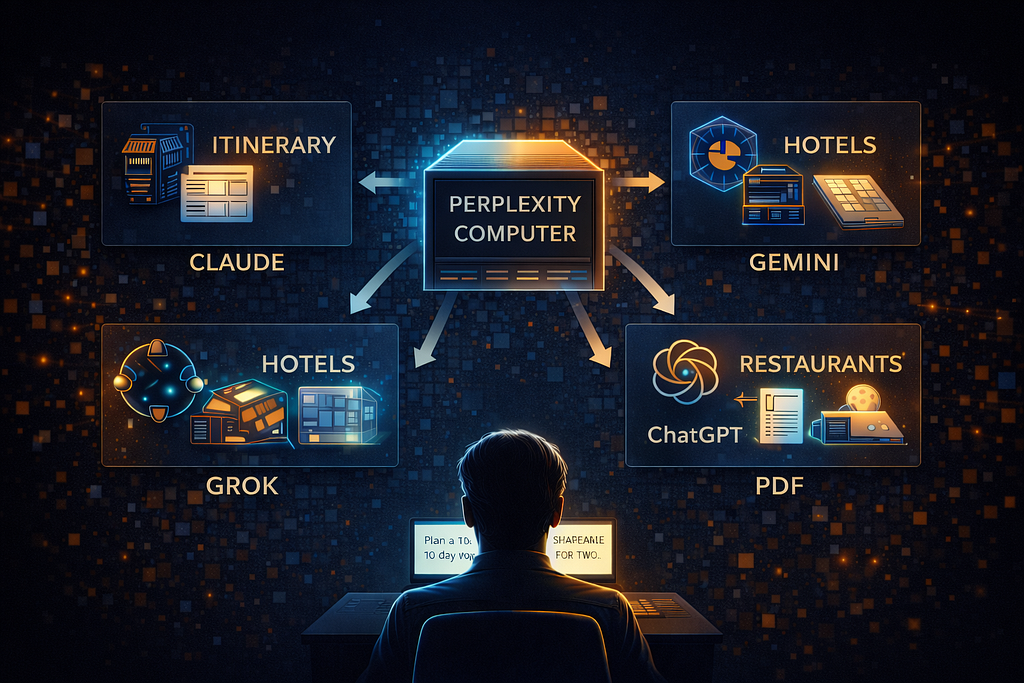
Imagine typing one sentence, ”Plan a 10-day trip to Japan for two, find the best-rated ryokans under $200 a night, build a day-by-day itinerary with restaurant picks, and put it all in a shareable PDF”, and walking away. You come back to find five different AI models have split the work, finished it, and stitched it together for you. No copying between tabs. No deciding which tool does what. That is what Perplexity Computer is promising.
On February 25, 2026, Perplexity AI dropped its most ambitious product yet: Perplexity Computer. And despite the name, it’s not a laptop, a desktop, or any piece of hardware.
It is something more interesting, a cloud-based system that takes a single instruction from you, breaks it into subtasks, assigns each subtask to the best AI model available, and delivers a finished result. No jumping between tools. No babysitting prompts.
If you have been following my articles, you know I like to break things down from first principles. So let’s unpack what Perplexity Computer actually is, how it works under the hood, what it means for the AI landscape, and how it stacks up against alternatives like Claude and OpenClaw.
What Is Perplexity Computer, Really?
Think of how you currently use AI. You open ChatGPT for writing. Switch to Claude for reasoning. Maybe use Midjourney for images. You are the project manager, copying and pasting between tools, deciding what goes where.
Perplexity Computer flips this. You describe the outcome you want, say, “Build me a landing page for my freelance business with copy, a logo, and deployment-ready code” and the system figures out the rest.
Here’s what actually happens behind the scenes with that one prompt. Claude Opus 4.6, the main model at the centre of the entire system, reads your request and breaks it into subtasks. It decides: the website copy needs strong writing, the logo needs image generation, and the code needs a frontend specialist. So it routes accordingly, Claude handles the reasoning and copywriting, Nano Banana generates the logo and visual assets, and a coding-specialized model writes the HTML, CSS, and deployment-ready code. Each subtask runs in parallel, and once they are all done, the system stitches the outputs together into a single deliverable. You gave one prompt. Five models did the work.
Or try a different kind of task: “Research my top 5 competitors in the Indian D2C skincare space, find their best-performing Instagram strategies from the last 6 months, and give me a competitive analysis report with 20 content ideas and scripts.” This time, Claude Opus 4.6 maps out the workflow and splits it differently. Gemini dives into deep research, crawling competitor websites, analyzing product positioning, and pulling together market data with its strength in long-context information retrieval. Grok handles the quick, real-time lookups, scanning social media engagement metrics, trending hashtags, and recent brand mentions. ChatGPT 5.2 takes the research outputs and synthesizes them into a structured competitive analysis report, leveraging its strength in long-context recall and expansive writing. Claude Opus oversees the entire pipeline, checks for consistency, and generates the final content ideas and scripts. Same principle, different specialists, all from one prompt.
Perplexity CEO Aravind Srinivas calls it a “general-purpose digital worker.” In plainer terms, it’s an AI system that does the work, not just advises you on it.
The key mental model here?
Perplexity Computer is an orchestrator, not a single model. It currently coordinates 19+ frontier AI models, each chosen for what it does the best.
How It Works: The Multi-Model Orchestra
This is where it gets technically interesting.
At the centre sits Claude Opus 4.6 as the core reasoning engine. When you submit a task, Claude Opus breaks it down, identifies subtasks, and decides which model handles what. It’s the conductor of the orchestra.
Each subtask runs inside an isolated computing environment with access to a file system, browser, code execution, and 400+ app integrations. The work is asynchronous, you can launch dozens of parallel tasks and walk away while the system coordinates everything.
Perplexity calls this multi-model orchestration. The intuition is simple: no single model is the best at everything, so why force one to do it all? Treat models like specialist tools and let the system choose.
If you remember the Transformer architecture from my previous article, where different attention heads specialize in different patterns, this is that same philosophy scaled to an entire product.
Who Should Care (And Who Shouldn’t, Yet)
Let’s be practical.
Perplexity Computer makes sense if you:
- Regularly juggle multiple AI tools for a single project.
- Need end-to-end execution, not just suggestions.
- Want to offload bounded, well-defined projects that would otherwise take hours of manual coordination
- Are comfortable with usage-based pricing and want control over which models run your tasks.
It’s probably not for you yet if:
- You mostly need quick Q&A or single-turn conversations.
- You are on a tight budget: the Max plan runs $200/month with 10,000 credits, and complex workflows can burn through tokens fast.
- You need full transparency into how decisions are made at each step (multi-agent systems are still opaque in places).
Right now, Computer is available only to Perplexity Max subscribers on the web. Pro and Enterprise rollout is coming soon but has no confirmed date. To sweeten early adoption, Perplexity is offering a one-time bonus of 20,000 credits that expire after 30 days.
What This Means for the AI Landscape
Let’s zoom out, because this launch is significant beyond Perplexity.
- The shift from chatbots to agents is accelerating
For the past two years, the dominant interaction model has been: you type a prompt, the AI responds, you refine. Perplexity Computer represents the next phase, you define an outcome, and the AI handles the process. This is the “agentic AI” paradigm that the industry has been talking about since late 2024, now arriving in a consumer-facing product.
- Multi-model orchestration might be the winning architecture.
While competitors like OpenAI have doubled down on making a single model (GPT) do everything, and Anthropic has invested deeply in making Claude the most capable individual model, Perplexity is betting that coordination between specialized models is the future. It’s an interesting philosophical divergence. The question is whether the overhead of routing and stitching is worth the gains in specialization.
- Per-token billing is coming to consumers.
This is Perplexity’s first consumer product with per-token pricing. It signals that as AI agents run longer, more complex workflows, flat-rate subscriptions may not be sustainable. If you have ever seen an AWS bill, you know the feeling, and Perplexity is bringing that model to AI consumers. Expect others to follow.
- The “model as commodity” risk is real.
Semafor, the global news outlet, raised a sharp point: if the models themselves become interchangeable commodities, does the orchestration layer hold value? Perplexity is betting yes. But if any company can access the same 19 models, then Perplexity’s real advantage is not the models, it’s how well it coordinates them and how easy it makes the experience for users.
My Take
I think Perplexity Computer is the most compelling product launch of 2026 so far, not because it invents new AI capabilities, but because it packages existing ones in a way that matches how people actually want to work. Most of us do not care which model we are using. We care about getting the thing done.
I will be honest, when I first read through how this works, my reaction wasn’t excitement. It was mild panic. If a single prompt can do what used to take me a full afternoon, what does that mean for the skills I am still building? But then I thought about it differently: understanding how these systems orchestrate is the skill now.
The honest caveats: no independent benchmarks have been published yet, multi-model routing adds complexity that can introduce subtle inconsistencies, and long-running agents can drift as context windows fill. These are real limitations, not theoretical ones.
But the direction is clear. AI is moving from “tool you talk to” toward “system that works for you.” And whether Perplexity, Anthropic, or someone else wins this race, the way we interact with AI is about to change fundamentally.
Perplexity Just Launched “Computer” And It Changes How We Think About AI was originally published in DataDrivenInvestor on Medium, where people are continuing the conversation by highlighting and responding to this story.