Pelagos Network: The Execution Layer That Unifies Every Chain
How a $1.25M-funded protocol is quietly solving the most stubborn problem in DeFi — fragmented liquidity across siloed blockchains.
 Wayne8 min read·Just now
--
Imagine executing a DeFi trade that reads a Bitcoin balance, borrows on Ethereum, and settles on Solana — all in a single atomic operation that either completes fully or reverts entirely, with no bridges, no wrapped tokens, and no stuck funds. That is exactly what Pelagos Network is built to do.
Web3 promised an open, interconnected financial system. What it delivered was a patchwork of isolated blockchains — each with its own liquidity pools, its own developer tooling, and its own user experience. Moving value between them requires bridges that have collectively lost billions to exploits, or intent-based systems that introduce solvers, delays, and opacity.
Pelagos Network is staking a different claim: that the fix is not another bridge or another L2, but a universal execution layer that treats every connected blockchain as one unified fabric. Founded in 2025 and already through an $1.25M pre-seed round, the team is building toward protocol mainnet and a flagship product launch in 2026.
- $1.25M Pre-Seed Raised
- ~170ms Median Block Time
- 100K +TPS Target
Pelagos | Atomic Execution Layer
Multichain actions, single result - no bridges, no partial outcomes.
pelagos.network
The Problem Pelagos Is Solving
Every major blockchain today is, in effect, an island. Ethereum holds the dominant DeFi liquidity. Solana leads in throughput and low-cost trading. Bitcoin remains the most trusted store of value. But accessing all three in a single user workflow currently demands bridges, custodians, or complex solver networks — each introducing its own failure mode.
“Web3 was supposed to be a connected world. Instead we have fragmented chains. Developers spend weeks on building infrastructure, users juggle wallets across dozens of networks, and liquidity sits trapped in silos.”
This fragmentation has real costs. Capital that should compound across the best opportunities on any chain stays locked on whichever chain it was deployed to. Developers building cross-chain dApps stitch together unreliable bridges with custom glue code. Users who just want to swap tokens on the best available price end up managing multiple wallets, gas tokens, and bridge wait times.
Introducing Pelagos Network: A Multichain Infrastructure for Developers
Pelagos Network delivers horizontal throughput, cross-chain composability, predictable scaling, and Multi-L1 Restaking…
paragraph.com
What Pelagos Actually Is
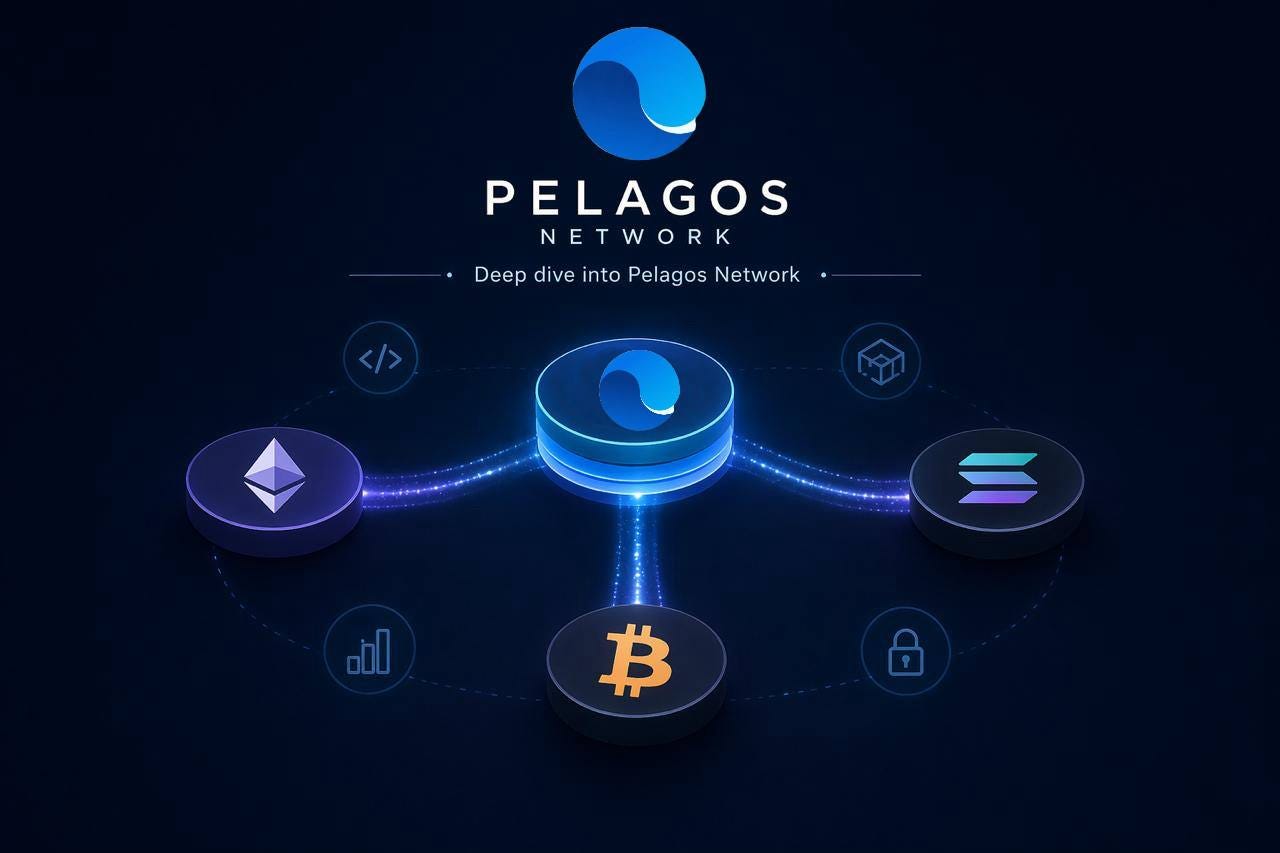
Pelagos describes itself as the first universal execution layer — a protocol that sits across all connected blockchains simultaneously, providing a shared execution environment for any application logic, regardless of which chain the underlying assets live on.
The core abstraction is deceptively simple: write once, deploy everywhere. A developer defines their business logic once — in any language, running on any VM (EVM, SVM, MoveVM, Rust, WebAssembly) — and Pelagos handles all the cross-chain coordination under the hood. To the application, it feels like a standard database. To the user, it feels like a single-chain experience.
- ⚛️ Atomic Cross-Chain Settlement: Transactions involving multiple chains either complete fully or not at all — eliminating partial failures and stuck funds.
- 🔗 No Bridges, No Wrapped Tokens: Assets stay native on their home chains. Pelagos coordinates execution without wrapping or custodying funds.
- 🧩 Any Language, Any VM: Developers deploy Appchains via Docker containers running EVM, SVM, Move, WebAssembly, or custom runtimes.
- ⚡ Reactive Smart Contracts: Contracts automatically respond to events on any connected chain without polling — triggering logic in near real-time.
The Execution Layer for Real Cross-chain Flows
Most cross-chain work still forces apps to stitch together separate steps on separate chains. When one step fails…
paragraph.com
Under the Hood: The Technical Architecture
Pelagos is built around a Directed Acyclic Graph (DAG) consensus layer — a departure from traditional linear blockchain architectures. The DAG writes to immutable, incremental Erigon-like databases and removes the transport layer between sequencing and execution, allowing direct database-to-execution communication. The result is significantly lower latency and higher throughput than conventional chains, with a target of a 0.4-second DAG block and over 100,000 TPS through parallel sharding of Appchains.
The validator network is particularly noteworthy. Rather than trusting a new governance token for security, Pelagos is secured by restaked Bitcoin and Ethereum stakes. Validators who misbehave face slashing — making the economic security of Pelagos comparable to, or higher than, many standalone chains from day one.
Distributed state synchronization uses BitTorrent-like protocols to share immutable chain snapshots globally, creating a persistent “data lake” that gives every Appchain native, real-time visibility into the state of all connected blockchains. This is the architectural reason Pelagos doesn’t need oracles for price data from connected chains — it reads the source directly.
Technological overview | Pelagos Whitepaper
Pelagos provides a business rules execution engine built atop a robust, real-time, multichain data backbone: combining…
docs.pelagos.network
The Alpha Product: Liq Markets
Theory is one thing. In October 2025, Pelagos shipped a live demonstration of Liq Markets — the world’s first cross-chain order book — showing atomic settlement happening in real time across supported chains. No bridges. No wrapped tokens. Unified liquidity from a single interface.
The Alpha Campaign ran with $1,200 in rewards over four weeks, inviting early users to test real cross-chain trading without bridges, solvers, intents, or gossip protocols. In March 2026, the team ran live trading with real capital moving through the platform end-to-end for the first time — testing arbitrage strategies across different underlying assets and validating the core describe → compile → simulate → deploy loop.
What Can Be Built on Pelagos
The architectural primitives Pelagos provides unlock a genuinely new category of application. Here are the most compelling use cases the team has outlined:
- Cross-Chain Flash Loans: Borrow stablecoins on Ethereum, execute a liquidation on another chain, swap seized collateral on the best DEX, and repay the flash loan — all in a single atomic transaction. This enables arbitrage bots and MEV strategies that span the entire DeFi ecosystem.
- Universal Lending Protocol: Collateralize Bitcoin, borrow USDC on Ethereum, stake on Solana for yield — managed as one position. Liquidations tap into every chain’s liquidity simultaneously, targeting zero bad debt.
- Omni-Chain DEX: Source a $1M order from every major DEX across every chain — Uniswap, Orca, Trader Joe, PancakeSwap — working as one unified pool. No slippage from being capped to a single chain’s liquidity depth.
- Enterprise & Regulated Flows: Deterministic execution, auditability, and policy controls for high-value institutional flows — enforced at the protocol level, not bolted on with middleware.
- Native MEV Optimization: MEV optimization as part of native Appchain execution — capturing value that would otherwise leak to external extractors, and returning it to protocols and users.
Traction, Funding & The Road to Mainnet
Pelagos closed a $1.25M pre-seed round in August 2025, announced on their official blog. The team has been shipping steadily: epoch-based consensus with validator rotation, cluster-level chaos testing, an end-to-end Solana SVM read/send path, Avail integration for lower latency, and a private Kubernetes testnet linked to Sepolia, Polygon Amoy, BSC testnet, and Solana devnet — all hitting approximately 170ms median block time.
The 2026 roadmap centers on three pillars: protocol mainnet launch, the flagship product release, and major ecosystem integrations — including the Midnight Network. January 2026 brought a full rebrand and website relaunch that explains how atomic execution works and what developers can build on top of it.
Pelagos Monthly Update: January 2026
In January, we repositioned Pelagos to set the foundation for what's coming in 2026: protocol mainnet, our flagship…
paragraph.com
Why This Matters for the Industry
The cross-chain problem has been called Web3’s hardest unsolved engineering challenge. Most current solutions — canonical bridges, optimistic rollup bridges, intent-based systems with solvers — involve trust assumptions, latency, or capital lockups that limit their practical composability.
What makes Pelagos architecturally interesting is its refusal to move assets at all. Instead of transferring tokens between chains, it coordinates execution across chains natively — submitting real transactions on each target chain as part of a single atomic plan. If any leg of the plan cannot clear, nothing moves. Users see real native transactions on their own chains; Pelagos just acts as the execution coordinator in the middle.
“Pelagos already sits in the middle, watching many chains, tracking events. The guesswork that indexers and cross-chain apps are forced into — that is the part Pelagos can kill.”
This is a fundamentally different architecture from bridge-based or intent-based approaches. It is closer in spirit to a distributed database transaction system than to a messaging protocol — and that framing clarifies both its promise and its complexity.
The Verdict: Still Early, But Architecturally Bold
Pelagos is not yet at mainnet. The team has been transparent about stability issues encountered during live testing and the engineering work required to resolve them. This is normal for infrastructure at its stage, but it is worth noting for anyone evaluating the project today.
What is notable is the architectural ambition and the technical rigor evident in the documentation and monthly updates. The DAG consensus layer, the restaking security model, the reactive contract primitive, the VM-agnostic Appchain architecture — these are not marketing buzzwords but substantive engineering choices with real tradeoffs that the team has clearly thought through.
If Pelagos executes on its mainnet roadmap, it will represent one of the most significant pieces of cross-chain infrastructure to ship in this cycle — not another bridge, not another L2, but a genuine execution environment for the multichain internet Web3 was always supposed to become.
Official References
- Website: pelagos.network
- Documentation: docs.pelagos.network
- Blog: paragraph.com/@pelagos
- X / Twitter: x.com/PelagosNetwork
Thank you for reading.
This article is for informational purposes only. All data and quotes are sourced from official Pelagos Network documentation. Not financial advice.
Our Infrastructure Philosophy
Unlock the Power of Staking with Our Trusted Blockchain Infrastructure Services!
We aim to decentralize the Proof-of-Stake blockchain ecosystem by providing high-performance validation, infrastructure, and automation. Our expertise spans Tendermint-based chains like Cosmos, Kava, and Aura; Ethereum and EVM chains such as Harmony; as well as substrate-based ecosystems like Cardano and Midnight. We’re also actively engaged with next-generation networks including Lido SSV, Story Protocol, Canton Network, Imua, and Canopy. Our global team continuously enhances automation and proactively monitors operations to ensure high availability, resilience, and optimal performance across all supported networks.
Our infrastructure is a hybrid of data centers bolstered with Hardware Security Modules (HSMs), and distributed globally at multiple Cloud providers. Our mission is to help provide a sound infrastructure, share toolings and offer foundational services, so that token holders can stake with confidence while the blockchain ecosystems which we support continues to strengthen. We hope you like our contributions into the ecosystems that we support. To find out more about networks that we support, checkout our website below.
Kysenpool
Unlock the Power of Staking! Deposit, stake, and witness growth in staking rewards hosted by our ironclad…
www.kysenpool.io
Stake with KysenPool
- on Story via Staking Explorer
- on Cardano visible at PoolTool via our Staking Guide
- on Cosmos via Keplr Wallet
- on Harmony via Staking Explorer (upon sign-in)
- on Kava via Keplr Wallet
- on Aura at AuraScan
Our Dapps
- Cosmos Outpost (Analytics): https://cosmosoutpost.io/
Official Channels
- Email: [email protected]
- Website: https://kysenpool.io/
- Twitter: https://twitter.com/kysenpool
- Telegram: https://t.me/kysenpool
- Medium: https://medium.com/kysenpool