Paper Oil vs. Physical Reality: The Dangerous Gamble of Treasury Intervention in Crude Futures
 Persian Gulf Research12 min read·1 hour ago
--
As the US-Iran war triggers one of the largest oil supply disruption in history — with the Strait of Hormuz effectively closed to roughly 20% of global oil flows — the Trump administration has floated an unprecedented scheme to sell synthetic “paper oil” futures in unlimited quantities to artificially hold crude prices below $100 per barrel. This analysis demonstrates why the policy is structurally doomed: financial derivatives cannot substitute for physical barrels, and a sovereign short position taken against genuine scarcity will be overwhelmed by market fundamentals, exactly as the Bank of England’s currency peg was broken in 1992. The inevitable consequence is not lower energy prices but a massive contingent liability borne by US taxpayers when the Treasury is forced to close its short position at whatever price a supply-starved global market ultimately demands.
The Setup: A Crisis Without Precedent
The world is currently experiencing one of the biggest disruption to oil supplies. Before the US and Israel went to war with Iran, a significant amount of oil — about 20% of the world’s seaborne oil trade and 20% of global liquefied natural gas — passed through the Strait of Hormuz. However, since the conflict began, tanker traffic in the area has almost completely stopped. The Strait of Hormuz is a crucial route that connects oil-producing countries in the Middle East to the rest of the world, and it used to handle around 20% of global oil supplies before the US and Israel attacked Iran on February 28.
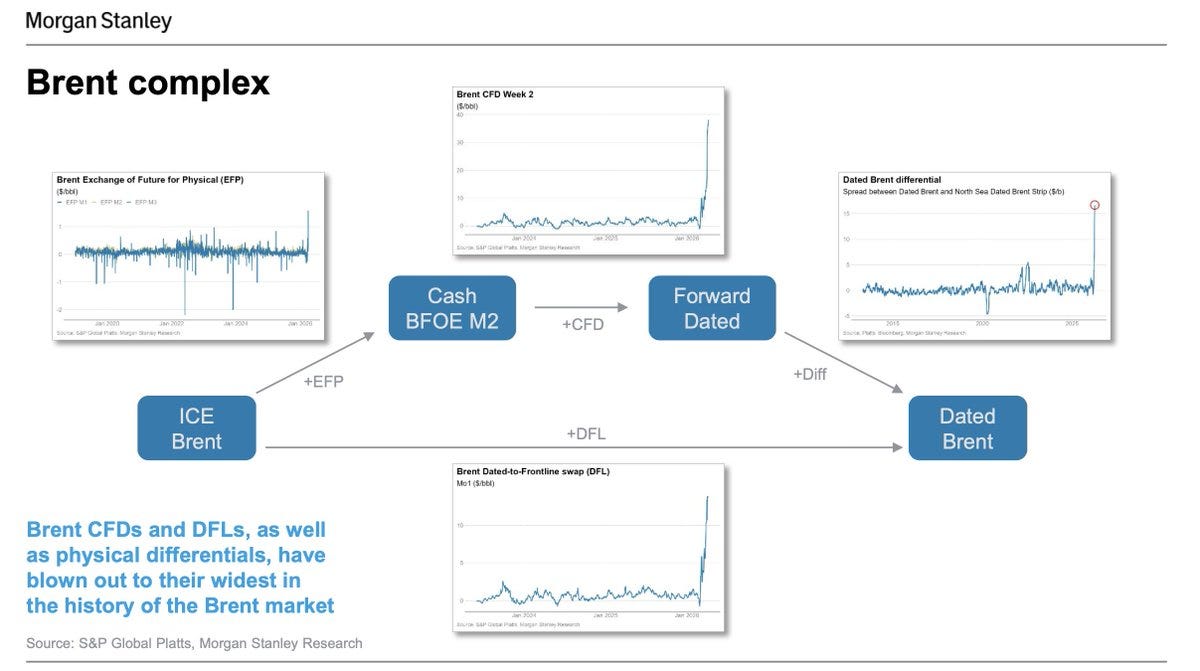
The oil price has dropped sharply and then bounced back quickly. It had gone up to $119 a barrel last month, but then it fell to below $92 a barrel last week. This happened after the US and Iran said they would stop fighting for two weeks. However, when the talks to stop fighting failed and the US said it would block Iran’s ships, the price of oil went up again to over $100 a barrel. On April 13, the price of Brent crude oil rose by about 8% to $102.80 per barrel, and the price of West Texas Intermediate oil jumped by 8.61% to $104.88 per barrel in just one day, according to Al Jazeera and Gotrade.
In a surprising move, the US government is considering a bold plan to control oil prices. The idea is to use the Treasury Department to release a large amount of “paper oil” into the market. This means creating financial contracts that represent barrels of oil, but don’t actually involve any real oil. By doing this, the government hopes to keep the price of oil below $100 per barrel. This is a completely new approach, and it’s never been tried before. The goal is to flood the oil futures market with these synthetic barrels, effectively creating a ceiling that prevents the price from rising too high.
What Is “Paper Oil”?
When we talk about oil in the market, there are two main types: the actual oil we use and the kind that’s just on paper. The real oil is the kind that’s pumped out of the ground, put on big ships, and turned into things like gasoline, diesel, and jet fuel. On the other hand, paper oil is more like a promise to buy or sell oil at a certain price on a specific date in the future — it’s not actually oil you can hold in your hand, but a financial agreement.
Usually, the oil futures market and the real oil market go hand in hand. This is because producers use futures to guarantee a price for the oil they produce, while refiners use them to fix the cost of the oil they need to buy. The price of futures is like a benchmark for the whole world, guiding the price of real oil transactions. The two markets are closely linked, and when a futures contract is about to expire, the seller has to either deliver real oil or buy back the contract at the current price. This connection between the two markets is what keeps them in sync, as they are essentially tied together.
The Treasury was thinking about doing something big to control oil prices. They wanted to sell a huge number of futures contracts, which would create a kind of fake supply of oil on paper. This would make the price of oil go down, even if there are lots of oil tankers just sitting around, unable to move because of a blocked strait. It’s like printing money to prop up a currency, but for oil instead. The goal is to make it seem like there’s more oil available than there really is, which would bring prices down. But it’s not actually changing the fact that there are tankers full of oil just waiting to get through.
The Policy Idea and Why It Was Initially Shelved
A senior White House official said the Treasury Department was expected to announce measures to combat rising energy prices from the Iran conflict, including potential action involving the oil futures market — a move that would mark an unusual attempt by Washington to influence energy prices through financial markets rather than physical oil supplies.
The Trump administration thought about getting the Treasury Department to buy and sell energy futures, but they didn’t think it would make a big difference in the market. According to Bloomberg, officials discussed this idea, but ultimately believed the Treasury Department’s impact would be limited.
Expert opinion was damning from the start. As one analyst put it: “The Treasury’s traditional role focuses on fiscal policy, debt management, and occasional interventions in currency markets through mechanisms like the Exchange Stabilization Fund, but not in commodities like oil.” The same analyst added: “If they go ahead and try to influence futures contracts themselves, it might create a short-term pause or spook some speculative longs, but I’d be surprised if it moves the needle meaningfully beyond a day or two. The oil market is deep, global, and driven by real supply and demand fundamentals.”
That skepticism proved well-founded. Prices continued surging regardless.
Why the Scheme Cannot Work: The Physics of the Problem
The central flaw of paper oil suppression is conceptually simple: you cannot eat a futures contract. Refineries run on physical molecules, not financial instruments. Airlines burn actual jet fuel, not derivatives positions.
The oil market is made up of two main parts: the physical market, where actual oil is bought and sold, and the “paper” market, where financial contracts are traded. These two markets work together to help oil producers and consumers manage their risks. For example, oil producers can sell futures contracts at a price they like, which guarantees them a certain price for their oil when they deliver it. On the other hand, oil consumers can buy futures contracts to ensure they get the oil they need at a price they can afford. This way, both producers and consumers can protect themselves from big changes in oil prices. The Center for Strategic and International Studies, or CSIS, has experts who study how these markets work together. They help us understand how the oil market functions and how it affects the economy. By working together, the physical and financial markets help keep the oil market stable and running smoothly.
When the Treasury sells futures to artificially lower the price, it’s not actually adding any new oil to the market. The real-world supply issue is still a major problem, especially with the Strait of Hormuz closed. As one expert pointed out, “this doesn’t fix the fact that there’s a big disruption to the physical supply of oil, and there’s not a lot of extra oil available outside of the Persian Gulf. If a lot of oil is being kept off the market, trying to manipulate the price through financial means won’t work. Traders are still going to bet that the price will go up, because it should be higher.” According to Yahoo Finance, this is a major concern for the oil market. The experts are saying that the Treasury’s actions are not a long-term solution to the problem, and that the price of oil will likely continue to rise due to the underlying supply issues. This means that traders will keep betting on higher prices, and the market will reflect the reality of the physical supply disruption.
The scale of the physical problem cannot be overstated. Geopolitical strategist Marko Papic of BCA Research estimated that for now, the world has lost 4.5 to 5 million barrels per day of oil due to the war — about 5% of global supply — but warned that number will double by mid-April, becoming the largest loss of crude supply in history.
In conversations with more than three dozen oil and gas traders, executives, brokers, shippers and advisers, one message was repeated over and over: the world still hasn’t grasped the severity of the situation. Many drew parallels with the 1970s oil shock, warning a prolonged closure of the Strait of Hormuz would threaten an even bigger crisis.
The Taxpayer Liability: A Staggering Hidden Risk
This is the point where the plan starts to go terribly wrong and could end up being a financial disaster for many Americans. The way futures markets work is pretty ruthless.
When someone sells a futures contract, they’re basically making a promise. By the time the contract expires, they have to do one of two things:
- The government needs to provide actual barrels, but in this situation, they don’t have any to give.
- Buy back the contract at whatever price the market has moved to.
When experts at the Center for Strategic and International Studies looked at the issue, they found that artificially keeping prices low can actually make it harder for oil producers and consumers to figure out what a fair price is. If someone tries to lower oil prices by selling a lot of oil futures, it could end up costing taxpayers a lot of money. Other central banks have tried to control market prices before, usually for currencies during times of financial crisis, but they often end up losing to the market’s opinion. For example, the Bank of England tried to defend the value of the British pound in 1992, but it had to give up when investors doubted the bank’s plan and the market went against it.
The comparison to Black Wednesday in 1992, when George Soros took on the Bank of England and won, forcing them to give up on the European Exchange Rate Mechanism, is not just a figure of speech — it’s a technically accurate one. This event, which cost British taxpayers a huge amount of money, bears a striking resemblance to the current situation.
The numbers just don’t add up when it comes to oil. If the US Treasury decides to sell futures at $99.99 per barrel, but the actual market price skyrockets to $120, $140, or even higher due to a real shortage, the Treasury will be left with a huge loss — we’re talking $20, $40, or more per barrel. This raises a lot of questions, like what happens if prices just keep going up and the Treasury’s short position gets worse? Will they use the oil they have in storage to try to cover their losses, or will they just keep paying out more money to try to ride out the storm? It’s a pretty tricky situation, and one that could have big consequences.
The Strategic Petroleum Reserve is not even close to being full, with only about 60% of its capacity being used. What’s more, officials are not keen on using the reserve, and for good reason. If they were to launch a campaign to keep prices down, they would have to either use up the reserve’s supplies to actually deliver the oil; which would mean giving up a valuable asset that’s meant for national security, or they would have to take a loss on the market for every contract that’s rolled over or settled in cash, which would be a big risk. This is a problem because the reserve is meant to be a safety net, not a tool for manipulating the market. TrustFinance is likely watching this situation closely, as it could have big implications for the price of oil and the overall health of the economy.
Let’s take a closer look at the numbers. If the Treasury decides to sell futures equivalent to 100 million barrels and the market price moves $30 in the opposite direction, that’s a whopping $3 billion that US taxpayers will have to foot the bill for. And if the price moves $50 against them, we’re talking about a staggering $5 billion. These aren’t just hypothetical scenarios, by the way. Officials from the US government and Wall Street analysts are actually starting to think that oil prices could skyrocket to levels we’ve never seen before. According to Bloomberg, this is a very real possibility. The idea of oil prices surging to unprecedented levels is becoming increasingly plausible, and it’s got everyone from government officials to financial experts taking notice.
The Market Signal Distortion Problem
Beyond the direct financial loss, the policy creates systemic damage to how the oil market functions globally.
Futures prices are not just numbers on a screen. They are signals — information aggregated from millions of market participants about the expected future scarcity of a commodity. When a refinery in South Korea needs to plan its crude purchases six months out, it relies on futures prices to hedge. When a shipping company in Singapore calculates bunker fuel costs for route planning, it looks at futures curves. When a pension fund allocates to commodities, it relies on futures to reflect reality.
Artificially holding futures below the market-clearing price corrupts all of these signals simultaneously. Refiners underestimate their input costs. Producers underinvest in new supply. Consumers fail to reduce demand early enough to avoid shortages. The price cap, in effect, blinds the market at precisely the moment the market most needs to see clearly.
As CSIS noted, to perform its risk-management function effectively, futures contracts need to accurately reflect expectations of supply and demand. Artificial suppression of prices will distort fair values and disrupt oil producers’ and consumers’ ability to accurately establish prices. Center for Strategic and International Studies
This distortion, ironically, makes the eventual price correction worse — not better. By suppressing the price signal that would have triggered demand destruction and alternative supply development, the government delays the market’s natural healing mechanisms and ensures a sharper reckoning when the intervention fails.
The Geopolitical Dimension
There is a further complication that financial analysts sometimes underweight: the US is simultaneously the party attempting to suppress oil prices and the party whose military actions are causing the disruption in the first place.
The narrow sea route is a vital artery that connects Middle East oil producers to global energy markets; tanker traffic has plunged due to the threat of Iranian attacks, triggering one of the largest oil supply disruption in history. CNBC The US Navy’s blockade of Iranian ports — announced after peace talks collapsed — has now added a second layer of disruption on top of Iran’s own effective closure of the strait.
Analysts at JPMorgan Chase, who specialize in commodities, are saying that getting the Strait reopened is now the most urgent issue for the market. They point out that the last oil tanker to pass through the Strait before it was closed is expected to arrive at its destination around April 20. After this date, the oil that was already on its way before the closure will have all been delivered, and the global supply chain will start to feel the effects of the shortage. According to NBC News, this is a critical situation that needs to be resolved quickly.
The government is trying to control oil prices on paper, but at the same time, they’re doing things that hurt the actual supply of oil. This doesn’t make sense — it’s like trying to fix a problem in two different ways that don’t work together. You can’t just use financial tricks to replace the oil that’s not being produced because of military actions. For example, Iran controls a lot of waterways that are important for oil transport, and if those are disrupted, it’s a big deal — we’re talking about 20 million barrels of oil per day. That’s a lot of oil, and you can’t just make up for it with financial derivatives.
Historical Precedents and Their Lessons
The Swiss National Bank’s EUR/CHF Peg (2015): The Swiss National Bank spent years defending a 1.20 cap on the Swiss franc against the euro, accumulating massive foreign currency reserves in the process. When it finally abandoned the peg in January 2015, the franc appreciated 30% in minutes. The SNB incurred tens of billions in losses. The lesson: defending an artificial price ceiling against market fundamentals is unsustainable, and exit is always more painful than entry.
Nixon’s Price Controls (1973–74): Following the Arab oil embargo, the Nixon and Ford administrations imposed price controls on domestic crude oil. The predictable result was that domestic production was discouraged, consumption was artificially maintained, and lines formed at gas stations across America. The lesson: price caps on energy produce shortages, not solutions.
What we see happening in all these situations is the same thing. When market forces are driven by real scarcity, they ultimately prove stronger than any one entity’s financial resources — even those of a sovereign government.
Sources:
Wikipedia: 2026 Strait of Hormuz crisis
Oil prices near $100 as U.S. Navy blockades Iran’s ports after peace talks fail (Apr 12/2026)
Oil prices surge past $103 a barrel after US announces blockade of Iran (Apr 13/2026)
Oil Prices Surge Past $100 as Hormuz Blockade Begins (Apr 13/2026)
Oil falls as U.S. may intervene in futures market, issues waiver for Russian purchases (Mar 04/2026)
US Treasury could unveil measures on oil futures market as energy prices rise
Bloomberg: The Strait of Hormuz Oil Shock Now Heading West (Mar 30/2026)