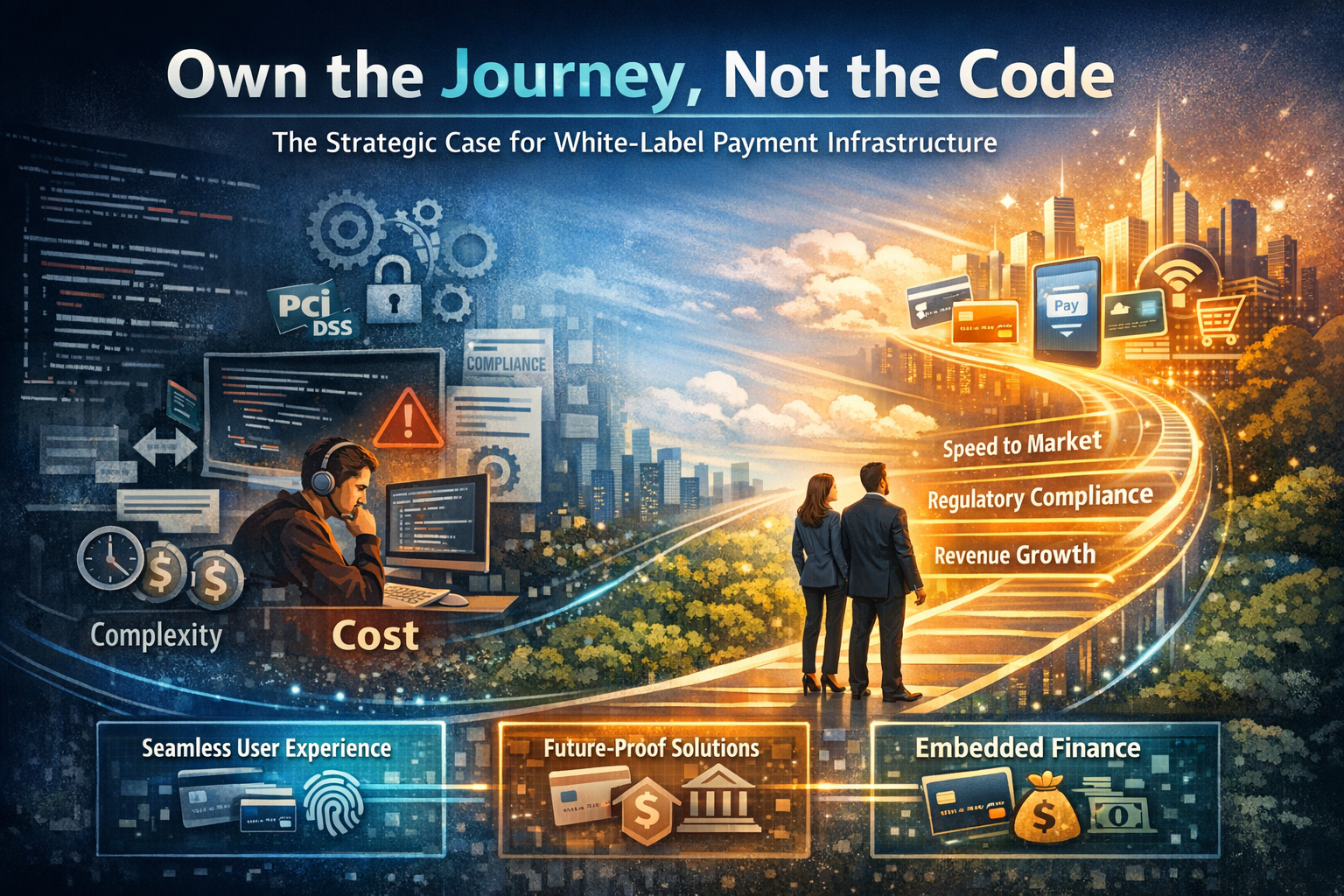
Own the Journey, Not the Code: The Strategic Case for White-Label Payment Infrastructure
--
In the rapidly evolving landscape of digital commerce, the distinction between a company’s core value proposition and its underlying technical stack has never been more critical. For software-as-a-service (SaaS) providers, marketplaces, and fintech innovators, the urge to build every component of their platform from scratch — often driven by a desire for total control — can become a strategic trap. Nowhere is this more evident than in payment processing. While payments are the lifeblood of any commercial platform, the infrastructure required to move money safely, globally, and at scale is a monumental undertaking. The most successful modern enterprises are shifting their philosophy: they are choosing to “own the journey” of their customers while outsourcing the complexity of the code to white-label payment infrastructure.
The Illusion of Control in Building from Scratch
For many CTOs and product leads, the primary argument for building an in-house payment gateway is control. There is a persistent belief that owning the codebase allows for ultimate customization and avoids vendor lock-in. However, this is often a strategic illusion. Developing a proprietary payment engine requires a massive upfront investment in engineering hours, but that is only the beginning. The hidden costs lie in the “perpetual build.”
A self-built system demands constant maintenance to keep up with evolving security protocols, API updates from card networks, and the ever-shifting landscape of global regulations. When a company chooses to build, they aren’t just writing code; they are committing to becoming a payments company. For a business whose primary mission is, for example, medical billing software or a construction management tool, this diversion of engineering talent creates a massive opportunity cost. By the time an in-house system is “finished,” it is often already lagging behind the innovation cycles of dedicated infrastructure providers.
Strategic Agility Through White-Labeling
White-label payment infrastructure offers a “best of both worlds” scenario. It allows a business to brand the payment experience as their own, ensuring a seamless user journey that keeps customers within their ecosystem, while the heavy lifting occurs beneath the surface. This approach provides unparalleled strategic agility. Instead of spending eighteen months building a basic credit card processing feature, a business can integrate a sophisticated, multi-modal payment stack in weeks.
This speed to market is a competitive moat. In a world where consumer preferences shift from credit cards to digital wallets like Apple Pay, or to Buy Now, Pay Later (BNPL) schemes and real-time bank transfers, a white-label partner handles the integration of these new methods automatically. The platform owner can then pivot their strategy based on market demand rather than being bottlenecked by a roadmap of technical debt. Owning the journey means being able to offer your users the latest financial tools the moment they become relevant.
Navigating the Regulatory and Compliance Labyrinth
The regulatory burden of handling money is perhaps the most significant deterrent to the “build” model. Achieving and maintaining PCI DSS Level 1 compliance is a rigorous, multi-month process that requires strict data siloed environments and expensive annual audits. Beyond security standards, the global regulatory environment is becoming increasingly fractured. From the PSD2 requirements in Europe to the complex “money transmitter” licensing laws in the United States, the legal overhead is staggering.
White-label providers function as a regulatory shield. Because they are the ones technically “touching” the sensitive data and moving the funds, they shoulder the vast majority of the compliance burden. By leveraging their licenses and security frameworks, a business can expand into new geographic territories without needing to hire a local team of compliance officers and lawyers for every border they cross. This allows the executive team to focus on growth and customer acquisition, secure in the knowledge that their financial backend is ironclad.
Elevating the User Experience and Brand Trust
In the digital economy, trust is the ultimate currency. When a customer reaches the checkout page, any friction — a slow load time, a redirect to an unfamiliar third-party URL, or a clunky interface — can lead to cart abandonment. White-labeling allows for deep aesthetic and functional integration. The payment UI can be styled to match the platform’s CSS perfectly, creating a high-fidelity experience that reinforces brand authority.
Furthermore, white-label infrastructure often comes with sophisticated “Value Added Services” that would be nearly impossible to build independently. This includes AI-driven fraud detection, automated dispute management, and smart routing — a process where a transaction is automatically sent to the bank most likely to approve it. These backend optimizations result in higher authorization rates and lower fraud losses. To the end-user, the process just feels “magic.” They don’t see the white-label provider; they only see a platform that works flawlessly every time they hit “Pay.”
Monetization: From Cost Center to Revenue Generator
Historically, payments were viewed by businesses as a necessary expense — a “tax” paid to banks to facilitate trade. White-label infrastructure flips this script, transforming payments from a cost center into a significant revenue stream. Through “embedded finance,” platforms can choose to add a small markup to processing fees or offer premium financial services to their users.
For a SaaS platform, this means generating “clip-of-the-ticket” revenue on every dollar that flows through their ecosystem. This recurring, high-margin revenue can often rival the income from software subscriptions themselves. By owning the customer journey and the commercial relationship, the platform becomes the primary financial partner for its users. Because the white-label provider handles the operational overhead, the platform owner enjoys the lion’s share of the profit with minimal incremental effort.
Future-Proofing for the Age of Embedded Finance
We are entering an era where every company is becoming a fintech company. The “Journey” is no longer just about a single transaction; it’s about the entire lifecycle of a user’s financial health. Modern white-label providers are expanding their offerings beyond simple payments to include card issuance, business lending, and insurance products.
By partnering with a robust infrastructure provider today, a company sets the foundation for future expansion. If a platform decides two years from now that it wants to issue branded physical debit cards to its vendors, it won’t need to rebuild its entire system. It simply “turns on” that feature through its existing white-label partner. This level of future-proofing ensures that the business remains at the cutting edge of financial technology without ever needing to write a single line of banking code.
Conclusion: Focus on What Makes You Unique
The strategic case for white-label payment infrastructure is ultimately about focus. In a hyper-competitive global market, the companies that win are those that obsess over their unique value proposition. For most businesses, that value lies in the software they’ve built, the community they’ve fostered, or the physical goods they provide — not in the plumbing of the global banking system.
Choosing to own the journey rather than the code is an act of strategic maturity. It is an acknowledgment that while payments are essential, they are a utility. By delegating that utility to specialists, leaders free their teams to innovate, scale, and provide a world-class experience that keeps customers coming back. The code is a commodity; the journey is where the value lives.
#Fintech #WhiteLabel #SaaSGrowth #EmbeddedFinance #PaymentsInnovation #DigitalTransformation #BusinessStrategy #TechLeadership #CustomerExperience #FinancialTechnology