Optimal Trade Execution Theory
 Simone Menaldo12 min read·Just now
--
Navigating the complex world of financial markets requires more than just predicting price movements; it demands a mastery of execution.
Optimal trade execution, a cornerstone of market microstructure, addresses the challenge of executing large orders without adversely affecting market prices. This article delves into the theoretical foundations of optimal trade execution, exploring the dichotomy between static and dynamic strategies, the role of risk aversion, and the construction of efficient execution frontiers. We will examine how to optimize trade schedules in the presence of time-varying volatility and liquidity, and extend these concepts to multi-asset and portfolio-level execution.
1. Static vs. Dynamic Strategies
At the heart of optimal execution lies the choice between static and dynamic strategies. This decision is pivotal, as it shapes the entire execution trajectory and its associated costs.
Static Strategies
Static strategies are characterized by a pre-determined trading schedule that is not adjusted in response to changing market conditions. The most common example is the Time-Weighted Average Price (TWAP) strategy, where a large order is broken down into smaller, equal-sized trades executed at regular intervals.
The primary advantage of a static approach is its simplicity and predictability. The execution path is fixed, which minimizes the potential for implementation errors. However, this rigidity is also its main drawback. A static strategy cannot adapt to favorable or unfavorable price movements, potentially leading to higher opportunity costs.
Consider an order to sell X shares over a period T. A simple TWAP strategy would execute X/N shares at each time interval Δt=T/N. The execution price for each trade is the market price at that time, and the goal is to match the average price over the period.
Dynamic Strategies
Dynamic strategies, in contrast, adjust the trading schedule in real-time based on observed market dynamics, such as price movements, volatility, and liquidity. These strategies are more complex but offer the potential for significant cost savings by capitalizing on favorable market conditions.
A well-known example is the Volume-Weighted Average Price (VWAP) strategy, which aims to execute trades in proportion to the trading volume in the market. The execution schedule is thus tied to the market’s activity, concentrating trades during periods of high liquidity to minimize market impact.
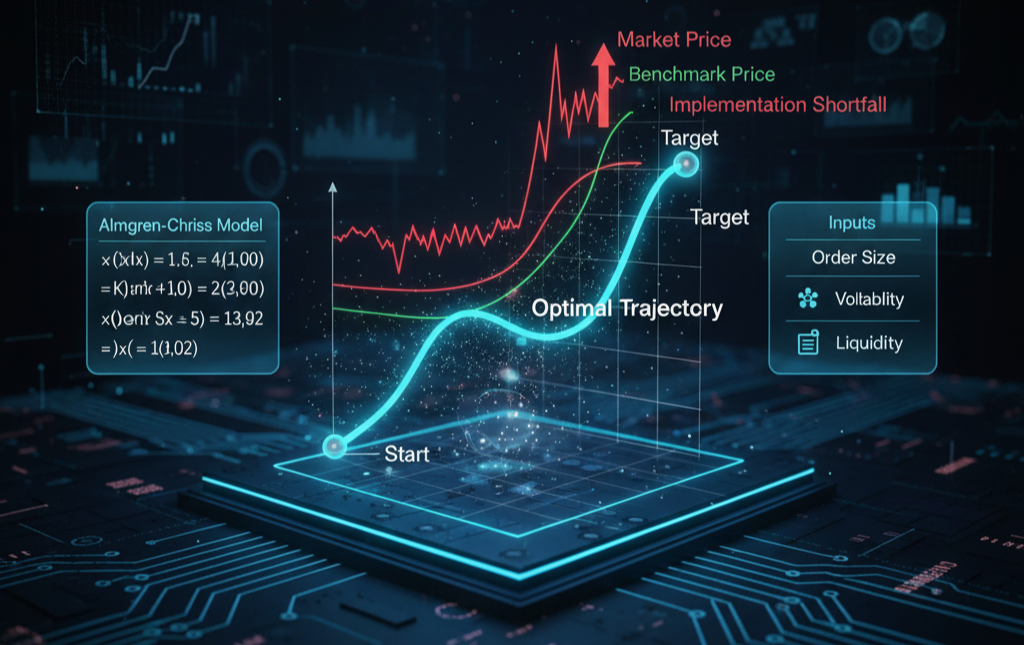
The mathematical formulation of dynamic strategies often involves stochastic control theory. The objective is to minimize a cost function that includes both market impact and opportunity risk. For instance, the Almgren-Chriss model, a foundational framework in this area, seeks to minimize a combination of implementation shortfall and risk. The model balances the trade-off between the cost of rapid execution (high market impact) and the risk of slow execution (price volatility).
The optimal trading trajectory in a dynamic setting can be derived by solving a Hamilton-Jacobi-Bellman (HJB) equation, which provides a policy for the optimal trading rate at any given time, conditional on the current state of the market. While computationally intensive, this approach provides a theoretically sound basis for adaptive trade execution.
2. Risk-Aversion in Execution
The trade-off between market impact and timing risk is a central theme in optimal execution. A trader’s risk aversion plays a crucial role in determining the optimal execution strategy. This is formally captured in the Almgren-Chriss framework through a risk aversion parameter, λ.
The objective is to minimize a cost function that is a linear combination of the expected execution cost and the variance of the execution cost:
where C is the total execution cost, E[C] is the expected cost (primarily from market impact), and Var[C] is the variance of the cost (timing risk). The parameter λ quantifies the trader’s aversion to risk. A higher λ indicates a greater aversion to the uncertainty in execution costs, leading to a faster, more aggressive trading schedule to reduce exposure to price volatility.
- High Risk Aversion (Large λ): A trader with high risk aversion will prioritize certainty. This translates to a faster execution schedule, where the order is completed quickly to minimize the time exposed to market fluctuations. The trade-off is a higher expected market impact cost.
- Low Risk Aversion (Small λ): A trader with low risk aversion is more willing to tolerate uncertainty in pursuit of lower execution costs. This leads to a slower, more passive trading schedule that spreads the order over a longer period, reducing market impact but increasing exposure to price volatility.
- Risk-Neutral (λ=0): In the absence of risk aversion, the objective is simply to minimize the expected execution cost. This would theoretically lead to an infinitely slow execution to minimize market impact. However, practical constraints, such as the need to complete the order within a certain timeframe, prevent this.
The choice of λ is subjective and depends on the specific goals of the trading entity. A portfolio manager with a long-term horizon might have a lower risk aversion compared to a high-frequency trader who needs to manage short-term risk exposures. The ability to tailor the execution strategy to a specific risk profile is a key advantage of modern execution algorithms.
3. Trade Schedule Optimization
Once a risk profile is established, the next step is to determine the optimal trade schedule. This involves defining a trajectory of trades that minimizes the chosen cost function. The Almgren-Chriss model provides an analytical solution for this problem under certain assumptions.
Let X be the total number of shares to be traded over a time horizon T. Let x(t) be the number of shares remaining to be traded at time t, so x(0)=X and x(T)=0. The trading rate is v(t)=−dx/dt.
The model assumes that the stock price S(t) follows a random walk with a drift term that depends on the trading rate, capturing the permanent market impact:
where Wt is a standard Brownian motion, σ is the volatility, and g(v(t)) is the permanent market impact function, often modeled as linear: g(v(t))=γv(t).
The execution cost is also affected by a temporary market impact, h(v(t)), which is a function of the trading rate. A common assumption is a linear temporary impact: h(v(t))=ηv(t).
The total expected cost of execution, or implementation shortfall, is the difference between the value of the portfolio at the start and the end of the trading horizon. Under these assumptions, the expected cost E[C] and variance of cost Var[C] can be expressed as:
The optimization problem is to choose the trading trajectory x(t) (or equivalently, the trading rate v(t)) to minimize the utility function:
subject to the constraints x(0)=X and x(T)=0. This is a classic problem in the calculus of variations, and its solution is given by the Euler-Lagrange equation. The optimal trading trajectory is an exponential curve:
The parameter k represents the urgency of the trade. A larger k (resulting from higher risk aversion, higher volatility, or lower market impact) leads to a more front-loaded trading schedule.
4. Execution Frontiers
The concept of an execution frontier is a powerful tool for visualizing the trade-off between expected cost and risk. Analogous to the efficient frontier in portfolio theory, the execution frontier represents the set of optimal execution strategies for different levels of risk aversion.
For each value of the risk-aversion parameter λ, there is a corresponding optimal trading strategy that minimizes the utility function. By varying λ from zero to infinity, we can trace out a curve in the (variance, expected cost) plane. This curve is the execution frontier.
- Points on the Frontier: Each point on the frontier represents an optimal trade-off. It is not possible to achieve a lower expected cost for a given level of variance, or a lower variance for a given level of expected cost.
- Points below the Frontier: These are unattainable.
- Points above the Frontier: These are suboptimal, as it is possible to improve on either cost or risk without sacrificing the other.
The shape of the execution frontier is typically convex, reflecting the diminishing returns of taking on more risk. As a trader moves along the frontier by accepting more risk (lower λ), the reduction in expected cost becomes progressively smaller.
The execution frontier provides a clear and intuitive way for traders to select an appropriate strategy based on their specific risk tolerance. Instead of choosing an abstract parameter like λ, a trader can select a point on the frontier that aligns with their desired balance of cost and risk. This makes the complex mathematics of optimal execution more accessible and practical for day-to-day trading decisions.
5. Time-Varying Volatility
The assumption of constant volatility, while simplifying, is often unrealistic. Financial markets exhibit well-documented patterns of time-varying volatility, such as intraday “U-shaped” patterns where volatility is high at the open and close of the trading day.
Incorporating deterministic, time-varying volatility, σ(t), into the execution model is a natural extension. The variance of the execution cost now becomes:
This modifies the optimization problem. While an analytical solution is no longer as straightforward as in the constant volatility case, the problem can be solved numerically. The general principle is to trade more slowly during periods of high volatility and more quickly during periods of low volatility to manage risk effectively.
For example, if volatility is expected to be high in the morning and low in the afternoon, the optimal strategy would be to delay a larger portion of the trade until the afternoon, when the risk is lower. This dynamic adjustment of the trading schedule in response to predictable volatility patterns can lead to significant improvements in execution quality.
6. Time-Varying Liquidity
Similar to volatility, market liquidity also exhibits predictable intraday patterns. Liquidity is typically higher at the market open and close, and lower during the middle of the day. Since market impact is inversely related to liquidity, it is advantageous to trade more when the market is more liquid.
We can incorporate time-varying liquidity by allowing the market impact parameters, η and γ, to be functions of time, η(t) and γ(t). The expected cost of execution becomes:
This modification means that the cost of trading at a certain rate varies throughout the day. The optimal strategy will naturally favor trading during periods of high liquidity (low η(t)) to minimize market impact costs.
For instance, the well-known U-shaped volume profile of equity markets suggests that liquidity is highest at the beginning and end of the trading day. An optimal execution strategy would therefore concentrate a larger portion of its trades during these periods. This is the principle behind the VWAP strategy, which implicitly captures the time-varying nature of liquidity by tracking the volume profile.
By incorporating both time-varying volatility and liquidity, execution algorithms can achieve a superior trade-off between market impact and risk, adapting the trading schedule to the dual rhythms of the market.
7. Multiple Assets Execution
The principles of optimal execution can be extended to the simultaneous trading of multiple assets. This is particularly relevant for strategies such as statistical arbitrage or portfolio rebalancing, where the co-movement of asset prices is a key consideration.
The multi-asset execution problem introduces the concept of cross-asset market impact. The trading of one asset can affect the price of another, especially for correlated assets. This cross-impact needs to be incorporated into the model.
The cost function is generalized to a vector form. Let x(t) be the vector of shares remaining to be traded for nn assets, and v(t) be the vector of trading rates. The price dynamics for asset i now depend on the trading rates of all assets:
where Γ is the matrix of permanent cross-impact coefficients. Similarly, the temporary market impact is also described by a matrix H.
The risk component of the cost function is also extended. The variance of the execution cost now depends on the covariance matrix of the asset returns, Σ:
The optimization problem becomes significantly more complex, involving a system of coupled differential equations. The solution provides a set of optimal trading trajectories for each asset that accounts for both their individual market impact and their cross-impacts and correlations.
A key insight from multi-asset execution models is that it is often optimal to trade correlated assets together. For example, when selling a block of shares in two highly correlated stocks, the model might suggest selling them simultaneously to exploit the fact that their price movements are linked. This coordinated approach can lead to lower overall transaction costs compared to executing the trades independently.
8. Portfolio Execution
Portfolio execution is the most general form of the optimal execution problem, where the goal is to transition from a current portfolio to a target portfolio at minimum cost and risk. This is a common task for institutional investors who need to rebalance their holdings periodically.
The portfolio execution problem can be seen as a multi-asset execution problem where the trades are driven by the desire to close the gap between the current and target portfolio weights. The key difference is that the objective is not just to minimize the cost of trading individual assets, but to manage the risk of the overall portfolio during the rebalancing period.
The cost function in portfolio execution includes the transaction costs of all trades, as well as a term that penalizes the deviation of the portfolio’s value from a benchmark. This benchmark could be the target portfolio’s value, or a dynamic benchmark that reflects the market’s movements.
The problem is typically formulated in a dynamic programming framework, where the state variables include the current holdings of each asset and the prevailing market conditions. The solution is a set of trading rules that specify how much of each asset to trade at each point in time, taking into account the entire portfolio context.
An important feature of portfolio execution models is their ability to identify natural hedges within the trade list. For example, if a portfolio rebalancing requires selling one stock and buying another that is highly correlated with it, the model may slow down the execution of both trades, as the price risk is partially hedged. This holistic approach to execution can lead to substantial savings in both direct trading costs and risk-adjusted performance.
Conclusion
Optimal trade execution theory provides a rigorous and quantitative framework for managing the complex trade-offs inherent in the execution of large orders. From the foundational Almgren-Chriss model to its extensions incorporating time-varying market conditions and multi-asset portfolios, the field offers a rich set of tools for financial professionals seeking to minimize transaction costs and control risk.
The key takeaway is that there is no one-size-fits-all solution. The optimal execution strategy depends on a multitude of factors, including the trader’s risk aversion, the characteristics of the asset being traded, and the prevailing market environment. By understanding the theoretical underpinnings of optimal execution, traders can make more informed decisions, whether they are using off-the-shelf execution algorithms or developing their own proprietary models.
As markets continue to evolve, with increasing automation and fragmentation, the importance of optimal execution will only grow. Future research will likely focus on incorporating more sophisticated models of market impact, developing more robust methods for estimating model parameters, and applying machine learning techniques to further enhance the adaptability and performance of execution strategies. The pursuit of the perfect execution is a journey, not a destination, and it is a journey that every serious quantitative finance professional must embark on.
References
- Almgren, R., & Chriss, N. (2001). Optimal execution of portfolio transactions. Journal of Risk, 3(2), 5–39.
- Bertsimas, D., & Lo, A. W. (1998). Optimal control of execution costs. Journal of Financial Markets, 1(1), 1–50.
- Cartea, Á., Sebastian, J., & Penalva, J. (2015). Algorithmic and high-frequency trading. Cambridge University Press.
- Gatheral, J. (2010). No-dynamic-arbitrage and market impact. Quantitative Finance, 10(7), 749–759.
- O’Hara, M. (1995). Market Microstructure Theory. Blackwell Publishing.