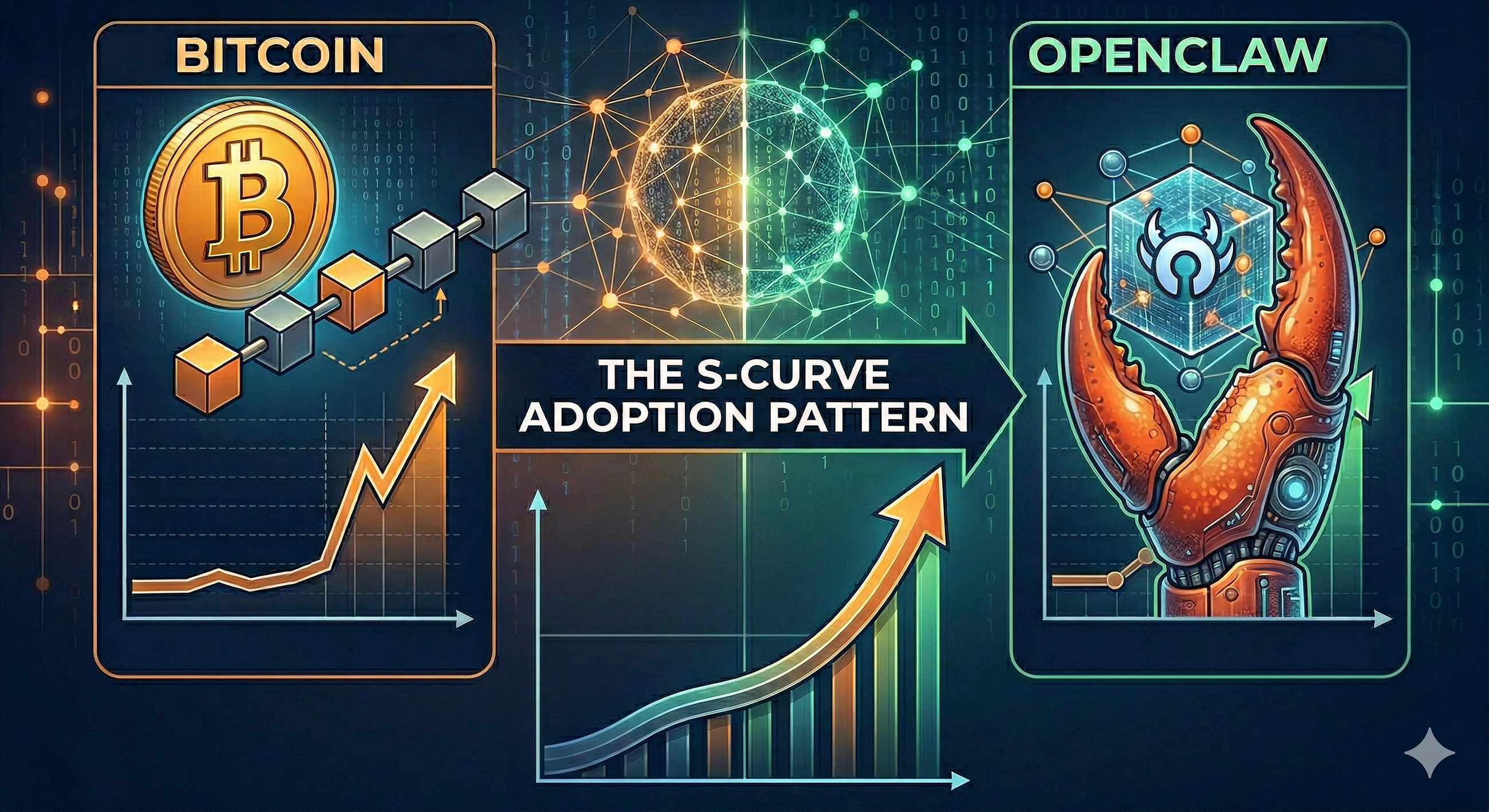
OpenClaw and Bitcoin: The Same Pattern Most People Miss
 J. Scott MacMillan4 min read·1 hour ago
--
The Innovation Nobody Recognizes (Until It’s Too Late)
Satoshi Nakamoto didn’t invent cryptography.
Peter Steinberger didn’t invent artificial intelligence.
And yet both changed everything.
Not because they built something new. Because they showed people something they couldn’t unsee.
The Parts Were Already There
When Steinberger released OpenClaw in November 2025 (originally called Clawdbot), the reaction from developers was pretty predictable:
“This is just an LLM hooked up to messaging apps.”
And honestly? That’s not wrong. OpenClaw is built on existing large language models like Claude and GPT. It uses standard programming languages. It runs locally on your machine. Nothing in that stack is going to win a computer science award.
But within three months, the project had 100,000 GitHub stars. By March 2026, it hit 247,000. Sam Altman personally recruited Steinberger to OpenAI to “drive the next generation of personal agents.”
Not bad for something that was “just a loop.”
Sound familiar?
Satoshi’s Non-Invention
In 2008, Satoshi Nakamoto published a white paper describing Bitcoin. And here’s the thing. None of the technology in it was new:
- Hashing algorithms had existed for decades
- Public-key cryptography was standard
- Peer-to-peer networking powered Napster and BitTorrent
- Proof-of-work was proposed by Adam Back back in 1997
Every single component was available to any computer scientist on the planet. For years.
Nobody put them together.
Until one person (or group) arranged those existing pieces into a system that made people say: “Wait. You’re telling me we don’t need banks?”
That question changed the world. Not the code.
The Same Shift, Different Domain
Before OpenClaw, AI was powerful but passive. You typed a question. You got an answer. You decided what to do next.
The human stayed in the driver’s seat at every step.
OpenClaw changed the relationship. You give it a goal. It figures out the steps. It works across your email, your calendar, your messaging apps, and your file system. And it keeps going until the job is done.
The shift isn’t technical. It’s how you think about it:
Bitcoin showed people that money could work without trust.
OpenClaw showed people AI could work without supervision.
Both are simple ideas built on existing parts. Both are obvious in hindsight. And both were invisible until someone made them real.
Why “Technically Correct” Keeps Missing the Point
When Bitcoin launched, the critics weren’t wrong:
“It’s just code.”
“It has no intrinsic value.”
“These components already exist.”
All true. All beside the point.
We’re hearing the same thing now with AI agents:
“It’s just an LLM in a loop.”
“Autonomous agents were already possible.”
“Nothing here is technically new.”
Again, all true. Again, not the point.
Because revolutions don’t happen at the level of components. They happen at the level of perception. The moment enough people see a new possibility, they can’t go back to the old way of thinking.
After Bitcoin, you couldn’t unsee decentralized finance.
After OpenClaw, you can’t unsee AI that works on your behalf.
The Real Pattern
Both moments follow the same structure:
Step 1: The technology exists, scattered across different domains.
Step 2: One person recombines the pieces into something coherent.
Step 3: A new mental model clicks. People suddenly see what was always possible.
Step 4: The world starts reorganizing around it.
Bitcoin didn’t give us better encryption. It gave us a new answer to: “Who do you trust with your money?”
OpenClaw didn’t give us smarter AI. It gave us a new answer to: “Who handles your work?”
The Window Most People Miss
Here’s the part worth paying attention to.
In both cases, there was a gap between when the shift became visible and when everyone else caught up. Bitcoin’s whitepaper dropped in 2008. Most institutions didn’t take it seriously until 2017 or later. That gap was where early conviction paid off the most.
We’re sitting in that same kind of gap right now with AI agents.
Most people still use AI the old way. Ask a question, get an answer, do the work yourself. But the people paying attention are already handing over entire workflows. Not because AI got dramatically smarter this year. Because the model for how to use it finally clicked.
The technology was ready. The way people thought about it wasn’t.
The Bottom Line
Satoshi didn’t invent the parts. He revealed a system.
Steinberger didn’t invent the parts. He revealed a way to use them.
In both cases, the real innovation wasn’t the technology. It was the idea that changed what people believed was possible.
The parts were always there. The seeing is what was new.