Written by Marcel Pechman,Staff Writer
 Reviewed by Ray Salmond,Staff Editor
Odds of Bitcoin price drop to $65K rise as private credit woes, US war rattle markets
Mar 06, 2026A new war, private credit market weakness and spiking commodities prices add tail risk to Bitcoin’s price. Is $65,000 BTC’s next stop?

Cointelegraph in your social feed
Follow our Join ourKey takeaways:
Bitcoin faced pressure as rising oil prices and weak US data sparked risk-off sentiment and drove investors to gold.
A redemption spike in private credit funds from BlackRock and Blackstone signaled growing anxiety among retail investors.
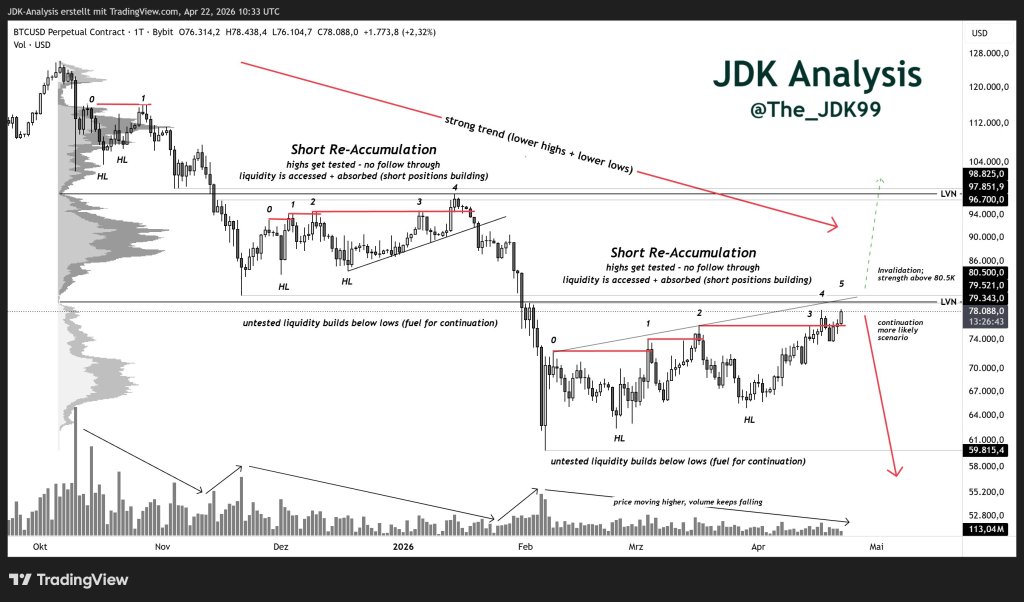
Bitcoin (BTC) saw a 7% correction between Thursday and Friday following a failed attempt to reclaim the $74,000 level. The pullback tracked weak US macroeconomic data and a spike in oil prices as the US and Israel-Iran war entered its seventh day. Traders now question whether Bitcoin can maintain support above $65,000.
Typically, deteriorating economic conditions pave the way for monetary stimulus, often boosting the stock market in anticipation of increased liquidity. However, this cycle saw the S&P 500 retreat as a generalized risk-off sentiment erased all of Bitcoin's gains from Wednesday.

US retail sales fell 0.2% in January compared to the previous month, while the US economy shed 92,000 jobs in February. Despite the cooling labor market, investors lack confidence that the Federal Reserve will cut interest rates further, as rising energy costs typically generate inflationary pressure.

US Treasury markets currently price a 78% probability that interest rates will remain steady between 3.5% and 3.75% through late April. A flight to safety pattern emerged as gold surged while the Russell 2000 Small Capitalization index hit a two-month low. Bitcoin’s drop below $85,000 in late January hindered its reputation as an uncorrelated asset, especially as silver rose to become the second most valuable asset.

Traders also fear a wave of corporate layoffs driven by artificial intelligence automation. Kansas City Fed President Jeff Schmid noted that AI is increasingly filling roles that once required manual labor. Schmid added that “older Americans are retiring,” causing a real-time structural change in the labor market, according to Yahoo Finance.
War and credit strain weigh on Bitcoin’s outlook
A prolonged war suggests increased US government spending, reducing the fiscal capacity for monetary stimulus aimed at economic expansion. Investors increasingly fear rising logistics costs beyond the commodities sector. Shipping giant Maersk announced on Friday the temporary suspension of two routes connecting the Middle East to Asia and Europe.
Bitcoin’s retest of the $68,000 level on Friday indicates that technical resistance levels identified by analysts may be secondary to geopolitical events impacting the oil and energy industries and, by extension, global growth prospects. The current weakness in risk assets appears to be a reflection of poor macroeconomic visibility rather than a structural collapse.
Related: Lyn Alden tips Bitcoin outperforming gold over next ‘two to three years’

A potential deterioration in trader expectations could originate within the US private credit market. BlackRock reportedly limited withdrawals from one of its largest credit funds following a spike in redemption requests, according to a Bloomberg report on Friday. Earlier this week, Blackstone’s flagship private credit fund fulfilled requests to tender a record 7.9% of shares, signaling rising retail anxiety.
Currently, the 3% option-adjusted spread for riskier firms is hovering within the normal range seen over the last six months. Periods of significant economic turmoil typically push this indicator above 5.0%, a level last seen in March 2023. As a result, there is no clear sign that Bitcoin will break below $65,000, even with the ongoing uncertainty surrounding global economic growth.
This article does not contain investment advice or recommendations. Every investment and trading move involves risk, and readers should conduct their own research when making a decision. While we strive to provide accurate and timely information, Cointelegraph does not guarantee the accuracy, completeness, or reliability of any information in this article. This article may contain forward-looking statements that are subject to risks and uncertainties. Cointelegraph will not be liable for any loss or damage arising from your reliance on this information.