Nvidia’s DLSS 5 Launch Sparks Meme Frenzy as Gamers Balk at AI ‘Neural Rendering’
NVIDIA pitched DLSS 5 as a breakthrough in real-time rendering. Players saw something closer to AI overreach.
 By Jose Antonio LanzEdited by Sebastian SinclairMar 17, 2026Mar 17, 20263 min read
In brief
- DLSS 5 introduces full neural rendering, shifting from performance enhancement to AI-driven image generation layered over game assets.
- Early demos impressed developers but triggered backlash online, with players criticizing altered character faces and “uncanny” visuals.
- Viral “DLSS OFF vs ON” memes captured concerns that the tech changes artistic intent rather than simply improving performance.
Jensen Huang called it the “GPT moment for graphics.” The internet called it a "yassification filter" with a $1,500 GPU requirement.
At GTC 2026 this week, NVIDIA unveiled DLSS 5—its most technically ambitious graphics feature to date, and almost certainly its most memed.
Unlike previous DLSS versions, which focused on upscaling or frame generation, DLSS 5 goes full neural rendering. It takes a game’s color buffer and motion vectors and then reinterprets them.
Skin gets subsurface scattering. Fabric gets that cinematic sheen. Hair, lighting, shadows, all dialed up toward what NVIDIA describes as Hollywood-level photorealism, generated in real time.
Think less “upscaling” and more “a second AI artist repainting your game every frame.”
Early demos ran on dual RTX 5090s. One GPU for the game, one for the neural model. But NVIDIA says single-GPU support is coming ahead of a Fall 2026 rollout.
Big titles like Assassin’s Creed Shadows, Starfield, Resident Evil Requiem, and Oblivion Remastered are already lined up. Developers can tweak intensity, masking, and colour grading to preserve their intended look.
That last part turned out to be doing a lot of heavy lifting. The tech press loved it. Everyone else, not so much.
Hands-on previews praised the lighting and detail as “astonishing,” especially on faces and environments. Developers echoed the hype, with Starfield director Todd Howard saying it “brought [the game] to life.”
But the internet saw something else entirely.
YouTube comments, Reddit threads, and gaming forums lit up with terms like “AI slop,” “uncanny valley,” and “Instagram filter gone wrong.”
Resident Evil Requiem’s Grace Ashcroft became the flashpoint, with side-by-side comparisons showing a version players described as plastic, airbrushed, and weirdly over-enhanced.
Then came the memes.
The format hit instantly: “DLSS 5 OFF vs ON.” OFF was the original art. ON was… something else.
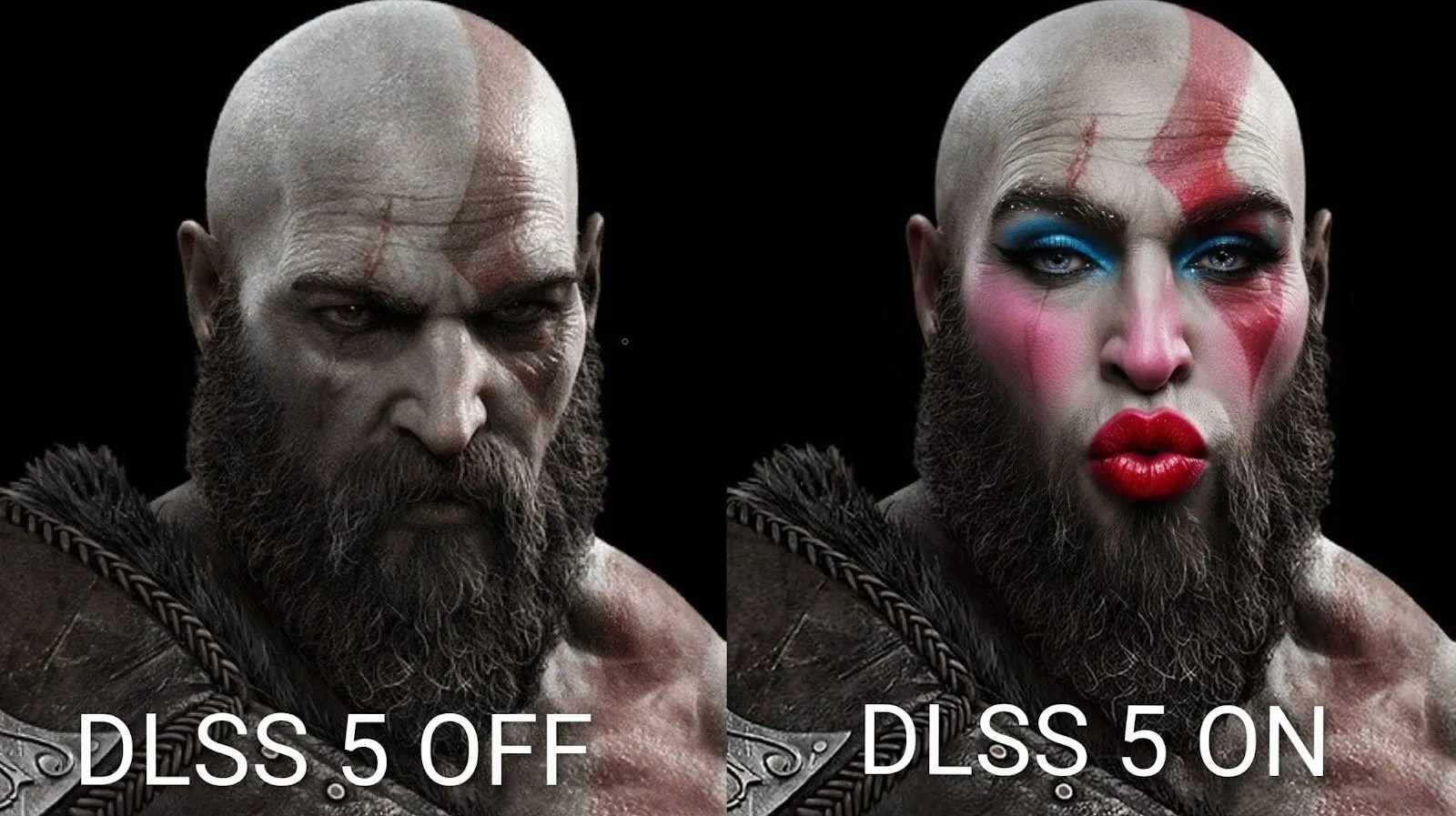
Kratos with full makeup. Patrick Star turned into a hyper-real nightmare. Even Jensen Huang got the treatment.
It spread fast enough that even major creators and devs joined in.
And that’s the thing—gamers have been fine with DLSS for years. Upscaling, frame gen, all of it. Because it was invisible. It helped performance without changing the art. DLSS 5 breaks that contract.
This isn’t just enhancing an image. It’s making decisions about how that image should look. When the AI hits a character’s face, it’s not asking what the artist intended. It’s applying its own idea of realism.
That shift, from tool to taste, is what people are reacting to. Because at that point, it’s not just about better graphics. It’s about whose graphics they are.