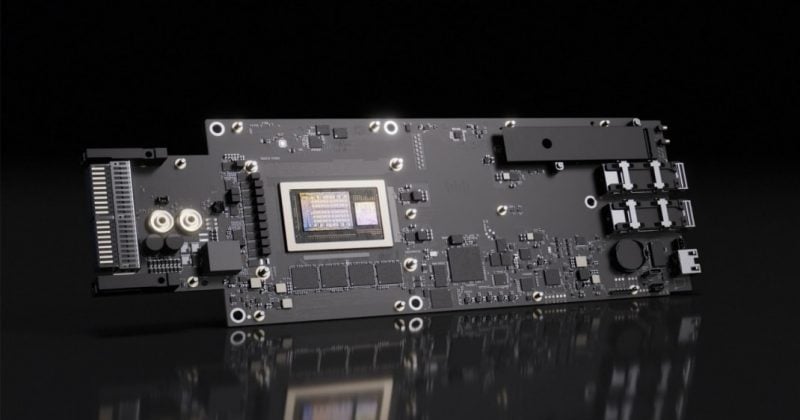
Nvidia Vera BlueField-4 STX delivers autonomous AI storage processing with in-silicon security
Nvidia's latest DPU architecture promises 5x token throughput and 4x energy efficiency gains for AI inference workloads, with Supermicro among the first partners to ship compatible hardware.
Share
Add us on Google by Editorial Team May. 31, 2026Nvidia just unveiled a new storage architecture designed to solve one of AI’s most persistent headaches: getting data to the model fast enough. The BlueField-4 STX, announced at GTC on March 16, 2026, combines a storage-optimized data processing unit with Nvidia’s Vera CPU, ConnectX-9 SuperNIC, and Spectrum-X Ethernet into a single modular reference design.
The pitch is straightforward. Instead of forcing traditional CPUs to handle the increasingly brutal demands of AI storage workloads, offload that work to purpose-built silicon. Nvidia claims the result is up to 5x token throughput, 4x better energy efficiency, and 2x faster data ingestion compared to conventional CPU-driven systems.
What the BlueField-4 STX actually does
BlueField-4 STX handles storage processing autonomously, offloading key-value cache and vector database tasks that would otherwise compete for GPU resources. This matters particularly for what Nvidia calls “long-context, agentic AI inference” — workloads where AI models need to maintain massive context windows and execute multi-step reasoning chains.
AdvertisementThe architecture also features what Nvidia describes as in-silicon security, baking data protection directly into the hardware layer rather than relying on software-based solutions that can introduce latency and attack surfaces.
The first full rack-scale implementation of this design is the Nvidia CMX context memory platform. It functions as a dedicated low-latency storage tier that extends GPU memory, providing a place to offload inference context without the performance penalties of reaching out to conventional storage.
Partners are already building
Supermicro unveiled BlueField-4 STX-compatible storage servers on March 17, just one day after Nvidia’s announcement. Nvidia has also named Cloudian and DDN as key partners in the BlueField-4 STX ecosystem. Eight cloud and AI providers have committed to deploying the new architecture early, though specific names beyond the initial partners haven’t been disclosed.
This release builds on the BlueField-3 Petascale JBOF arrays that Nvidia introduced in 2025, and follows a CES 2026 preview of BlueField-4 storage solutions. The trajectory from BlueField-3 to BlueField-4 STX represents a shift from petascale storage acceleration to fully autonomous storage processing.
What this means for the AI infrastructure market
The 5x token throughput claim is particularly notable because it suggests that storage, not compute, has been the binding constraint for certain inference workloads. A 4x improvement in energy efficiency directly affects the economics of running AI at scale, changing the math on which deployments are financially viable given existing data center power constraints.
Disclosure: This article was edited by Editorial Team. For more information on how we create and review content, see our Editorial Policy.