Nvidia Owns 90% of the Market… But AMD Is Still Exploding. Stop Buying Only #1 Stocks Like an Idiot.
--
We were all taught the same outdated lesson: Just buy the #1 company. The winner takes everything, and everyone else dies.
But that old rule is breaking in real time.
Nvidia controls 80–94% of the AI GPU market, yet AMD continues to hit all-time highs. SpaceX dominates space launches, but smaller players like Intuitive Machines are also delivering massive returns during sector booms.
So when is chasing the “undisputed leader” smart — and when is it financial suicide?
To answer this objectively, I created the EFI (Entry Feasibility Index) — a new quantitative tool that combines passive fund flows with B2B power dynamics to determine whether a sector is a “shared feast” or a “brutal winner-takes-all battlefield.”
The EFI Formula
This index uses only verifiable data from 10-K reports, ETF flows, and market metrics.
Current Market Scorecard
- Space Sector — EFI ≈ 0.78 → Safe Entry
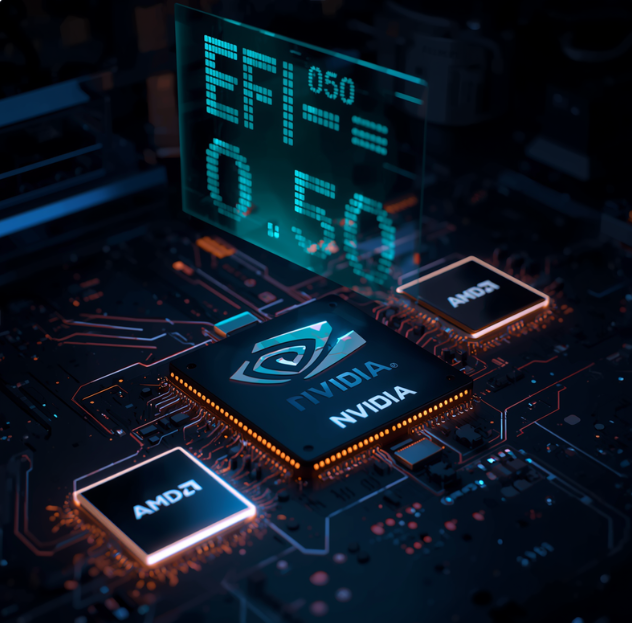
- AI GPU Sector — EFI ≈ 0.50 → Cautious (Scale In)
- 2010s PC Graphics Card Market — EFI ≈ 0.001 → Extremely Dangerous
- Hydrogen Energy Sector — EFI ≈ 0.035 → Stay Far Away
Practical EFI Rules
- EFI ≥ 0.50 → Safe to enter the sector. If the leader is too expensive, comfortably buy #2 stocks or supply chain plays.
- 0.20 ≤ EFI < 0.50 → Good structure but valuations are high. Use dollar-cost averaging.
- EFI < 0.20 → Avoid entirely. This market will likely turn into a brutal winner-takes-all slaughter.
Advice and Areas for Improvement
If you’re planning to use the EFI framework, here’s my honest advice and some important limitations you should know:
This EFI framework is sharp and captures something important about modern markets: passive capital (ETF flows) and powerful B2B buyers are changing the game and often preventing classic winner-takes-all outcomes.
However, keep these points in mind:
- VSF (Vertical Spillover Factor) and BPI (Buyer Power Index) are somewhat subjective. There are no universal standard definitions yet, so different analysts may calculate them differently.
- More backtesting is needed. While the four examples are compelling, testing against more historical cases (EV sector 2018–2020, cloud computing, etc.) would make the model much stronger.
- Early-stage or still-growing sectors tend to score lower on EFI. Because they often lack strong passive flows (PAS) and established powerful B2B buyers (BPI), even promising new sectors like hydrogen or certain emerging technologies may show low scores. This doesn’t always mean they are bad — it means the structural safety net is still weak.
- Never use EFI in isolation. It’s an excellent first-level screening tool, but you still need deep fundamental analysis on individual companies (moat, cash flow, management, technology, etc.).
- Valuation Multiple (VM) is highly sensitive. The final score changes dramatically depending on how you define “historical average.” Always run sensitivity tests.
My personal recommendation: Use EFI as a fast filter to build a shortlist of “structurally attractive” sectors. Then do thorough research on the best companies within those high-EFI sectors.
Disclosure: This article is for educational and discussion purposes only. It is not financial advice. Always do your own research and manage risk properly.
What do you think? If you have any suggestions for improvement, better variable definitions, or additional backtesting ideas, please leave a comment below. I’d love to hear your thoughts and refine this framework together.