
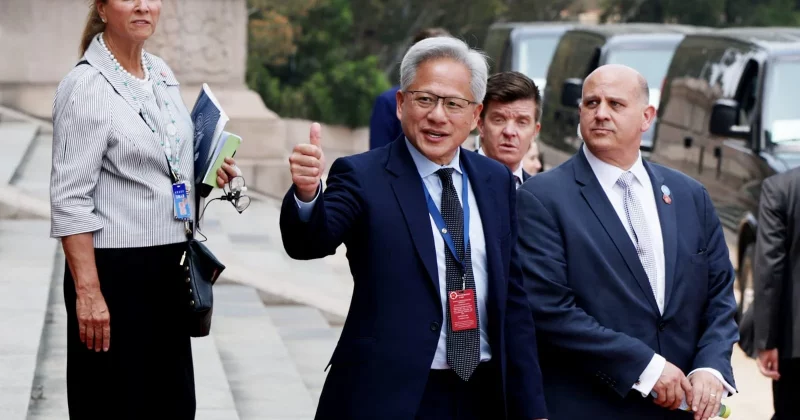
Nvidia CEO Jensen Huang declares support for President Trump at Beijing summit
The chipmaker's chief attended the Trump-Xi summit in Beijing, calling it 'one of the most important summits in human history' as Nvidia deepens its ties to the White House.
Share
Add us on Google by Editorial Team Jun. 7, 2026Jensen Huang, the leather-jacket-wearing CEO who turned Nvidia into the most valuable company on the planet, flew to Beijing this week to stand alongside President Trump at a summit with Chinese President Xi Jinping. His message was unambiguous: he’s backing this administration.
Huang described the May 12-14 gathering as “one of the most important summits in human history” and called his attendance an “incredible opportunity” to represent US interests and support Trump.
From chip deals to political capital
Huang’s presence in Beijing wasn’t spontaneous networking. Nvidia confirmed the trip came from a last-minute invitation directly from President Trump, designed to promote US interests during the delicate diplomatic proceedings with China.
The invitation makes more sense when you look at the timeline. In March 2026, Huang was appointed to the President’s Council of Advisors on Science and Technology, known as PCAST. He joined a roster that includes Mark Zuckerberg and Marc Andreessen, essentially forming a tech advisory supergroup for the White House.
AdvertisementAnd back in December 2025, Huang successfully advocated for approval to sell Nvidia’s H200 chips to China. That’s not a small thing. The H200 is a serious piece of AI hardware, and getting the green light to ship it to Chinese buyers required navigating one of the most politically charged trade issues in tech.
The semiconductor chess match with China
Nvidia has been caught in the middle of this tug-of-war repeatedly. The company has had to design watered-down versions of its best GPUs specifically to comply with export rules, only to watch the goalposts move as Washington tightened restrictions further.
Huang’s strategy appears to be: if you can’t beat the regulators, join the president’s advisory council. His PCAST appointment and summit appearance suggest Nvidia is trying to influence policy from the inside rather than simply react to it. The successful H200 export approval from December 2025 is evidence that this approach is working.
What this means for investors
Nvidia’s strategic alignment with the Trump administration could lead to further relaxation of semiconductor export controls. If more high-end chips get approved for sale to Chinese buyers, that opens a revenue stream that has been partially dammed up for years.
The PCAST appointment also positions Huang to shape AI policy more broadly. Regulations around AI training, data usage, and compute infrastructure could all be influenced by the advisory council.
The broader semiconductor industry is watching this dynamic carefully. Competitors like AMD and Intel don’t have their CEOs on PCAST or attending diplomatic summits. That asymmetry in political access could translate to asymmetry in market access, particularly in China.
No crypto tokens were tied to Huang’s summit participation. The story here is pure semiconductors, pure geopolitics, and the increasingly blurred line between Silicon Valley boardrooms and Washington power.
Disclosure: This article was edited by Editorial Team. For more information on how we create and review content, see our Editorial Policy.