Blockchain Explained Simply: The Magic Shared Notebook
 Adeniran Abdullahi Damilare3 min read·Just now
--
Imagine a classroom where kids trade toys all day, stickers for marbles, action figures for crayons. Arguments happen:
"You never gave me that!"
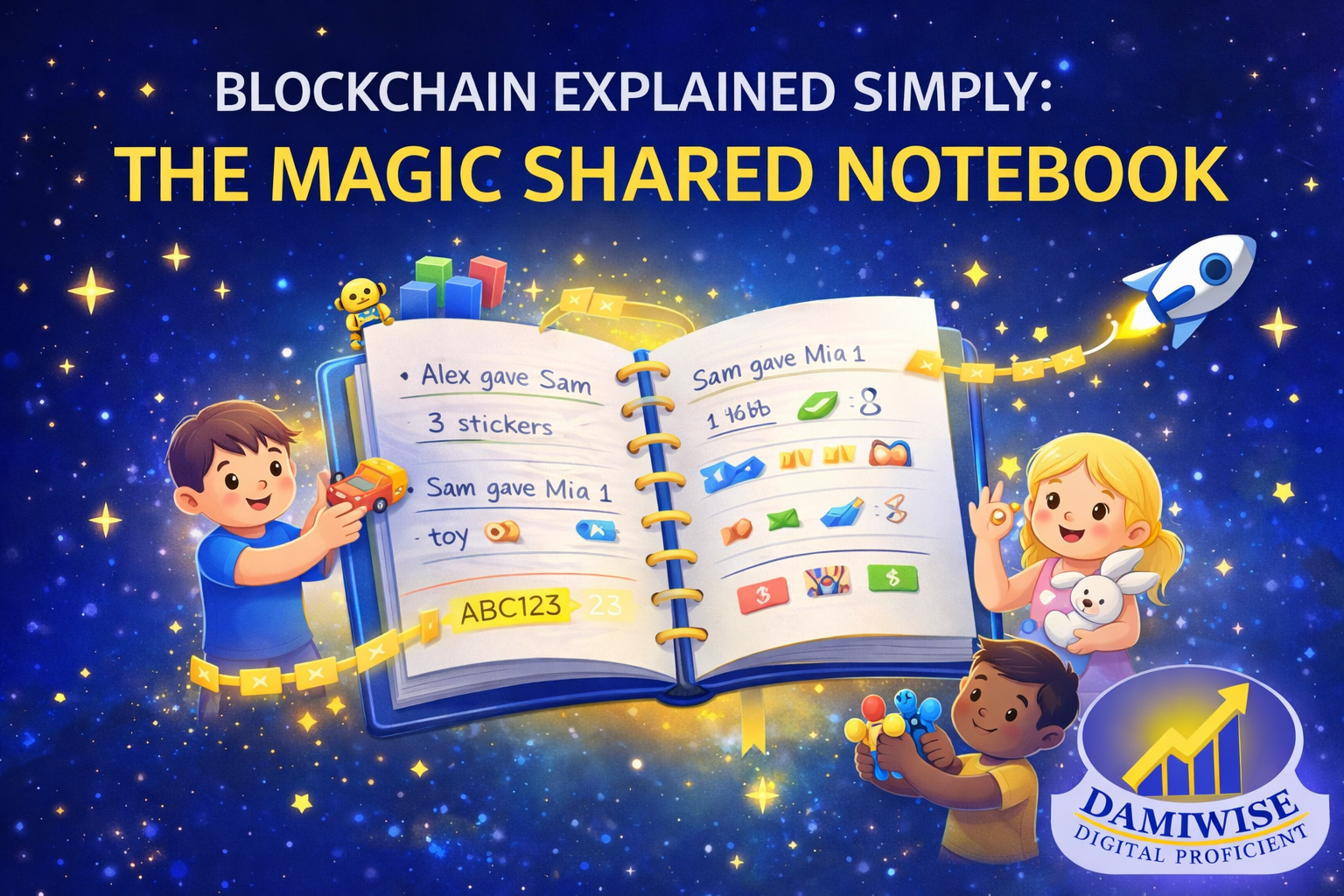
To fix this, they create a notebook. Every trade is written down. No one can erase anything. Everyone keeps a copy.
That simple idea is how blockchain works.
This guide explains blockchain using that “shared notebook” idea—clear, simple, and easy to understand.
What Is Blockchain?
At its core, blockchain is a record system that tracks who owns what.
But unlike traditional systems, no single person controls it.
Instead, everyone shares and verifies the same record.
The Shared Notebook
Think of each page in the notebook as a block.
Each block records transactions like:
- Alex gives Sam 3 stickers
- Sam gives Mia 1 toy
Now imagine:
- Everyone has the same notebook
- Everyone updates it together
- No one can secretly change anything
If someone tries to cheat, others compare copies and quickly spot the difference.
That’s blockchain: a shared source of truth.
How Blocks Stay Connected
Each block is linked to the next using a special code called a hash.
A hash works like a fingerprint:
- Every block has a unique code
- Each new block includes the previous code
If anything changes, the fingerprint changes too, and the chain breaks.
This makes the system secure and tamper-resistant.
No Central Control
There is no single owner of the blockchain.
No company.
No bank.
No authority.
Instead:
- Many participants maintain the system
- Everyone checks new entries
- The network agrees before updates are added
This is called decentralization, power is shared, not concentrated.
Why Blockchain Matters
Blockchain solves one key problem:
Trust.
Trust Without Middlemen
Traditionally, we rely on banks or institutions to keep records.
But they can:
- Charge fees
- Restrict access
- Make errors
Blockchain removes the middle layer.
The system itself ensures accuracy and transparency.
Strong Security
Blockchain uses cryptography to protect data.
- Records are locked with unique hashes
- Changes are easy to detect
- Data cannot be easily reversed
To fake a transaction, someone would need to change every copy at once, which is nearly impossible.
Built for Transparency
Everyone on the network can verify what’s happening.
This creates:
- Openness
- Accountability
- Fairness
No hidden changes. No silent edits.
Real-World Applications
Digital Money
Blockchain powers cryptocurrencies like Bitcoin.
You can send money directly to anyone—without a bank.
Transactions are recorded and verified globally.
Supply Chain Tracking
Businesses use blockchain to track goods.
From farm → transport → store, every step is recorded.
This improves safety, trust, and transparency.
Digital Ownership
Blockchain allows true ownership of digital assets.
Game items
Art (NFTs)
Music rights
Ownership is recorded permanently and cannot be altered.
Common Misconceptions
“Blockchain is just crypto”
Crypto is only one use.
Blockchain can manage records, identity, ownership, and more.
“It’s completely anonymous”
Blockchain is transparent.
Users may not show real names, but activity is visible and traceable.
“It uses too much energy”
Older systems consumed high energy.
Newer systems are far more efficient and sustainable.
Conclusion
Blockchain works because it replaces trust in people with trust in the system.
It is:
- Shared
- Transparent
- Secure
- Decentralized
Simple truth
When everyone shares the same record
and no one can secretly change it.
trust becomes built into the system.
How I Help Web3 Projects
Many Web3 ideas are powerful—but often difficult to explain clearly.
I help Web3 teams turn complex blockchain concepts into simple, human-centered content that users understand and trust.
If your project needs clear messaging, educational content, or simplified explanations, let’s connect. 🚀
#DAMIWISE