She has kept her savings in fixed deposits for twenty years. She does not speculate. She does not follow markets. She thinks stocks are for people who enjoy stress. But she called me one afternoon and said she was thinking about buying Bitcoin because she had read that BlackRock was involved now and if BlackRock trusted it, maybe she should too.
That conversation stopped me cold. Not because she was wrong to reconsider her assumptions. But because of what it revealed about where we are in the broader adoption cycle and what that actually means for anyone trying to understand these markets seriously.
When my aunt knows the name of an institutional Bitcoin product, something structural has shifted.
Why Institutional Names Change the Psychology of an Asset
There is a well documented pattern in how assets move through legitimacy cycles. Early in an asset’s life, it is held primarily by people who understand it deeply and are willing to tolerate the social and financial risk of owning something that most of the world considers fringe. As the asset develops a track record and begins attracting credible institutional participation, a second wave of buyers enters. Not because the asset changed fundamentally, but because the permission structure around it changed.
My aunt does not evaluate assets on technical merit. She evaluates them on institutional credibility. BlackRock managing trillions of dollars in assets globally is a name she recognizes as a proxy for legitimacy. If BlackRock is comfortable touching it, her mental framework says, maybe it is not the criminal speculation she always assumed it was.
This psychological mechanism is not irrational. Most people do not have the time or inclination to deeply evaluate a novel asset class. They use credibility signals from institutions they already trust. The entry of a firm like BlackRock into Bitcoin through a regulated product does not just bring institutional capital. It brings the psychological permission that a large category of conservative investors needed before they would consider the asset at all.
Understanding this mechanism matters for traders because it affects the demand picture for an asset in ways that are structural rather than speculative.
What the Bitcoin ETF Actually Changed
The approval of spot Bitcoin ETFs in the United States created something that did not previously exist for the category of investor my aunt represents: a familiar wrapper around an unfamiliar asset.
Before the ETF, buying Bitcoin meant dealing with exchanges, private keys, custody decisions, and a general infrastructure that felt foreign to anyone accustomed to traditional financial products. The friction was not just technical. It was psychological. Buying something through a brokerage account you already use, in a format you already understand, inside a regulatory framework you already trust, is a completely different experience from setting up a crypto exchange account and managing a wallet.
The ETF did not change what Bitcoin is. It changed the accessibility profile of Bitcoin for an enormous category of potential buyers. Pension funds with mandates that require regulated products. Wealth management platforms that could not previously offer clients direct Bitcoin exposure. Financial advisors who were professionally cautious about recommending something outside the regulated system. And conservative individual investors like my aunt, who needed the credibility of a familiar institutional structure before they would engage at all.
That is a genuine structural demand shift, not hype. The size of the capital pools that were previously excluded from Bitcoin exposure by friction or mandate is substantial.
The Market Timing Problem That Comes With Legitimacy
Here is where the honest conversation gets harder.
The moment an asset becomes something my conservative aunt is comfortable buying is, by definition, not early. The people who benefited most from Bitcoin’s legitimacy transition were the ones who were positioned before the ETF approval, before the institutional interest became mainstream news, before the name BlackRock started appearing in conversations at family dinners.
This is not a reason to dismiss the asset or to assume the move is over. But it is a reason to think carefully about what stage of the cycle you are entering and what that implies for your expectations and your risk management.
Markets tend to price anticipated developments before they happen. The Bitcoin ETF approval, while significant in its actual impact, was also widely expected by the time it occurred. Much of the price movement associated with institutional legitimization had already been incorporated into price before my aunt heard the story and picked up the phone.
Buying an asset because it has become legitimate feels safer than buying it when it was considered fringe. Psychologically it is more comfortable. But price and comfort tend to move in opposite directions. The least comfortable entries are often the most favorable ones. The most comfortable entries often come at prices that reflect the good news everyone can already see.
What Conservative Investors Often Misunderstand About Volatility
My aunt’s instinct to use BlackRock as a legitimacy signal is understandable. What she had not fully processed was that institutional involvement does not change Bitcoin’s volatility profile in the short to medium term.
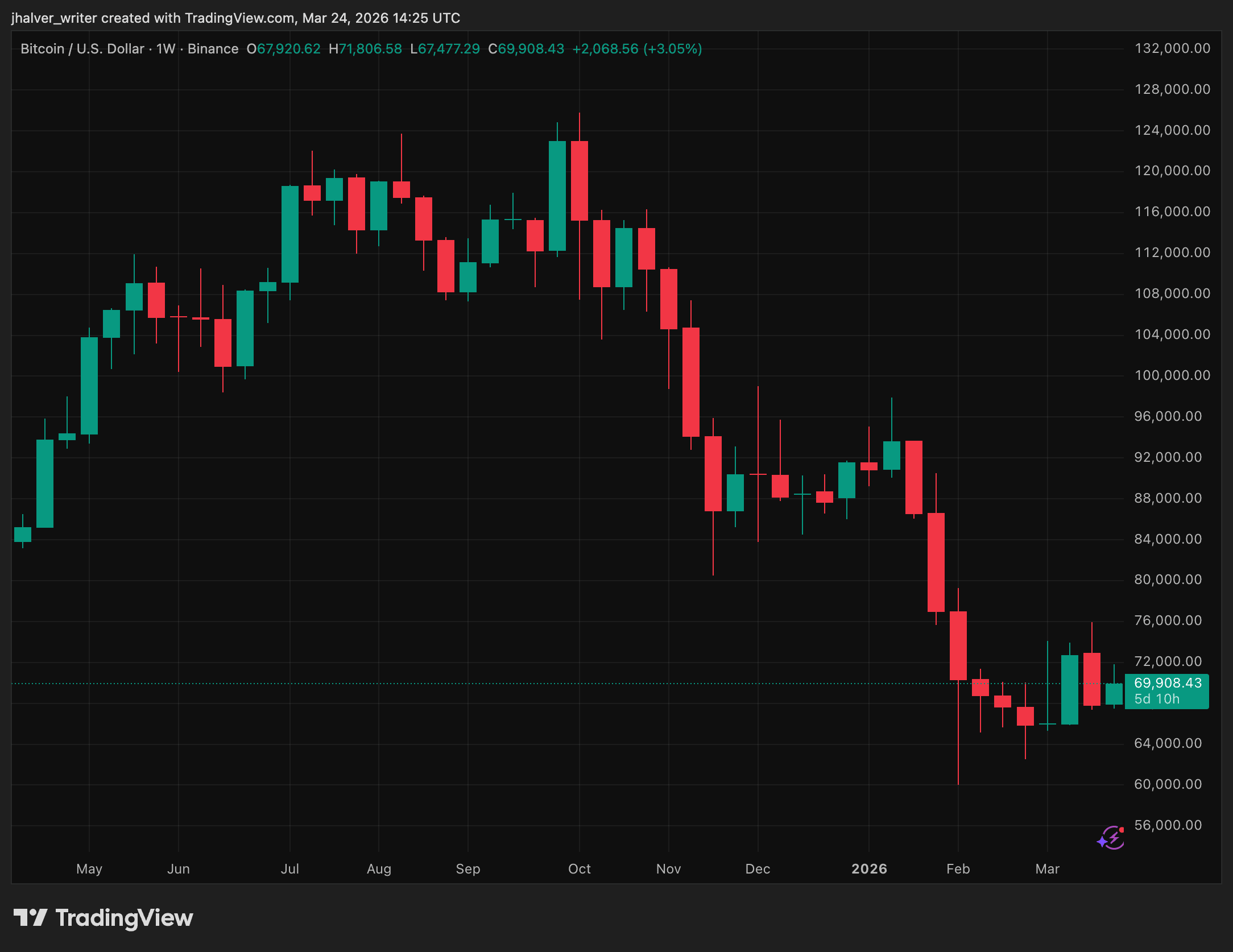
Bitcoin can fall 30% in a matter of weeks. It has done so multiple times across its history, including during periods of strong institutional interest. The asset is volatile structurally, not because it lacks legitimacy, but because of how it is sized relative to global capital markets, how concentrated its holder base remains, and how sensitive it is to shifts in macro liquidity conditions.
A conservative investor buying Bitcoin through a BlackRock ETF is still buying a volatile asset. The wrapper is regulated. The volatility is not.
This matters enormously for risk management. How much of your portfolio should be in an asset that can drop 30 to 50 percent in a drawdown? That question has a different answer for a 35-year-old with a long time horizon and stable income than for someone closer to retirement who cannot absorb that kind of temporary impairment without behavioral consequences.
The behavioral consequence is the real risk for most conservative investors entering volatile assets for the first time. They buy because the story feels compelling, hold through the first 10% decline telling themselves it is fine, start to worry at 20%, and sell at 30% down just before a recovery. They crystallize a real loss from an asset they did not actually understand how to hold.
How Institutional Flows Actually Affect Price Behavior
One of the more practically useful things to understand about the ETF era is how institutional buying changes market dynamics over time.
Large institutional products do not trade on the same emotional cycle as retail investors. They rebalance on schedules. They respond to client flows rather than to daily price movements. They accumulate gradually rather than in bursts. This creates a different kind of buying pressure than a retail driven rally where everyone rushes in together.
What this tends to produce over time is a market that has larger and more stable support structures at certain levels. When price declines to points where institutional products are still buyers on a valuation basis, that creates a different kind of floor than pure retail sentiment alone would.
That does not mean prices cannot fall significantly. It means the composition of buyers changes the dynamics of how drawdowns behave and potentially how long they last. Whether that changes the long term return profile in a meaningful way remains genuinely uncertain.
The Conversation I Had With My Aunt
I told her that the fact BlackRock was involved was real and meaningful information. The legitimacy shift in Bitcoin is genuine. The demand picture has structurally changed in ways that matter.
I also told her to think seriously about how much of her savings she could afford to see decline by 40% temporarily without panicking and selling. Not because that outcome is certain, but because it is possible, and if she would not be able to hold through that kind of drawdown, then the size of her position needed to reflect that honestly.
She decided to put in a small amount. Defined in advance as money she was comfortable leaving alone for several years regardless of what happened in the short term. Not a trading position. Not a speculation on near term price. A small allocation to an asset class she was now willing to consider, sized at a level she could manage emotionally through volatility.
That framing is, honestly, more sophisticated than how a lot of traders approach their own positions. Know your time horizon. Know your tolerance for drawdown. Size accordingly. Do not let narrative excitement push you into a position you cannot actually hold.
What My Aunt’s Call Tells Traders About Market Cycles
The moment when conservative, skeptical, previously uninterested investors start engaging with an asset is meaningful market information. It signals that the legitimacy narrative has reached a genuinely broad audience. That is a positive structural development and also a signal that requires honest assessment of where we are in the cycle.
Markets are always uncertain. Institutional involvement does not eliminate risk. Conservative packaging does not change underlying volatility. And the best time to have positioned for a legitimacy transition is usually before the story becomes something your most cautious relatives are bringing up at family dinners.
None of that means the opportunity is exhausted. It means the easy narrative trade has already occurred and what comes next requires more careful thinking about time horizon, position sizing, and honest risk management.
Trading involves real risk. That does not change because the asset has a new and reputable wrapper around it.
My Conservative Aunt Heard the Name BlackRock and Bought Bitcoin for the First Time was originally published in Coinmonks on Medium, where people are continuing the conversation by highlighting and responding to this story.