Multi-Swap Crypto Exchange: How CCE Cash Helps Users Run Multiple Swaps in One Session
--
A user may not always need one simple swap. Sometimes the exchange need is more layered: BTC to ETH, USDT TRC20 to another asset, or one source asset split across different receiving choices. Starting a new order every time can become repetitive, especially when the user is already working through several crypto movements in the same session. This is where a multi-swap crypto exchange flow becomes useful.
The problem is not only time. It is also friction. Each new exchange can mean repeating the same steps again: selecting assets, entering amounts, choosing a rate type, checking addresses, and tracking the order. For users who need multiple pairs, that process can feel heavier than the exchange itself.
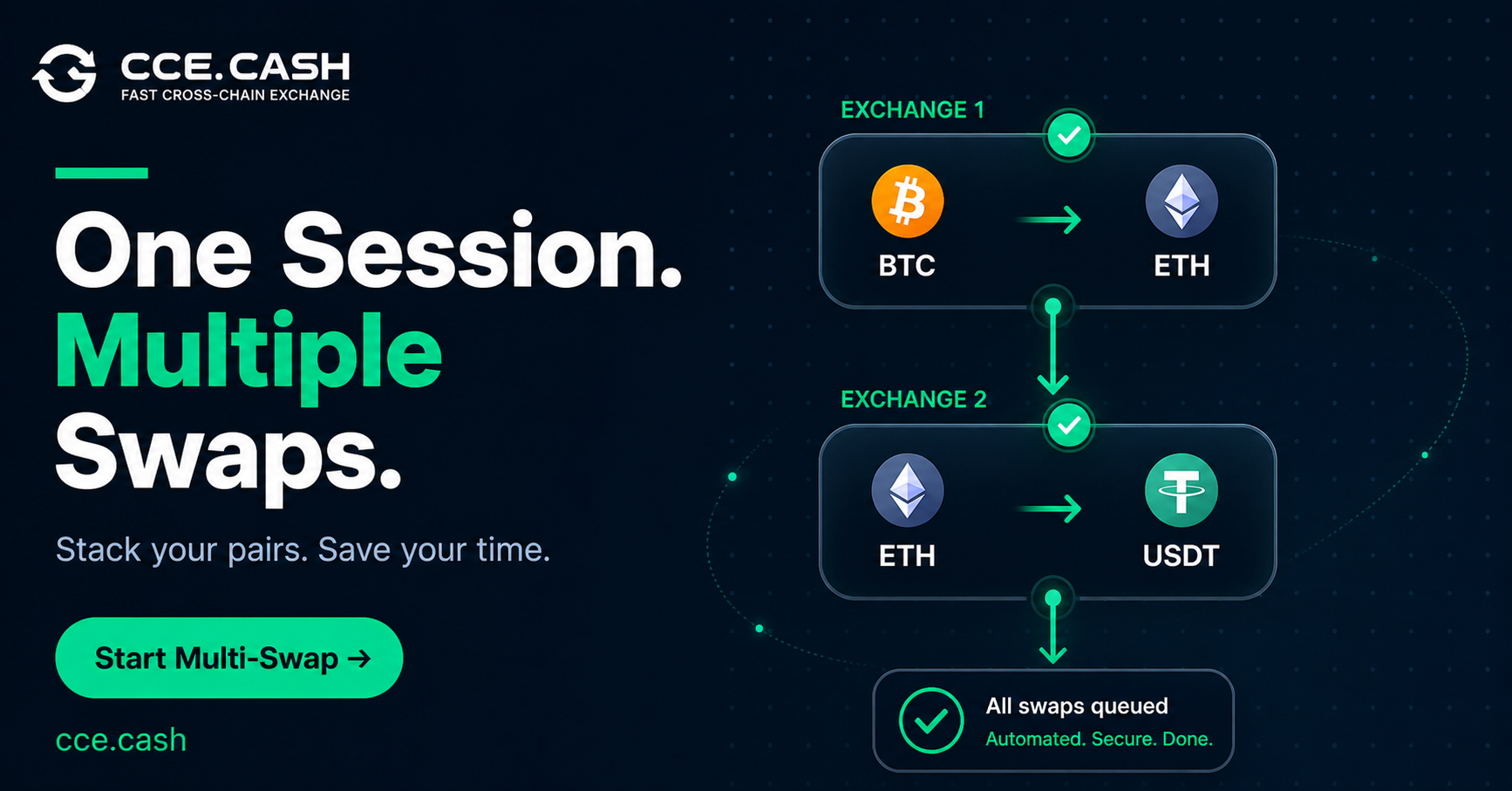
CCE Cash addresses this through an exchange session model where users can add more exchange pairs instead of treating every swap as a completely separate starting point. This helps make chained exchange activity cleaner, especially for users moving between supported assets and blockchains.
Multi-Swap Crypto Exchange: Why Single-Pair Flow Can Feel Limiting
Single-pair exchanges are simple when the user has one clear task. For example, BTC to ETH or USDT ERC20 to USDT TRC20. But crypto activity is often not that linear.
A user may want to move between different assets for separate receiving needs. Another user may need to exchange across chains without setting up a new session for every pair. Someone may want to compare fixed and floating rate choices while arranging more than one swap. In these situations, a single-pair flow can become repetitive.
A multi-swap crypto exchange approach reduces that repeated setup. Instead of starting from zero each time, users can add another exchange pair in the same session and keep the process more organized.
This is not about making crypto complicated. It is about reducing unnecessary clicks and repeated steps when the user already knows the exchange routes needed.
What “Add Exchange” Means in Practice
The Add Exchange functionality allows users to include additional exchange pairs in the same session. This is useful when the user needs more than one swap route and wants to avoid setting up each one separately.
A practical scenario may look like this:
A user wants to exchange XMR into BTC and ETH. Instead of running one exchange, waiting, then starting another from the beginning, the user can build a chained exchange flow in the same session. The user selects the sending currency, adds the receiving currencies, enters the receiving addresses, chooses the rate mode, and then follows the deposit instructions.
This kind of exchange session is useful because it keeps multiple pairs closer together in one flow. It also supports the broader value of cross-chain access: users can move between supported assets without needing a manual bridge-like process or repeated platform setup.
CCE Cash supports assets such as BTC, ETH, USDT TRC20 and ERC20, SOL, XMR, TRX, AVAX, BNB, LTC, DOGE, TON, TRUMP, ARB, SHIB, ETC, OP, BAT, BCH, and more. For users working across several of these assets, a cleaner exchange session can save time and reduce operational friction.
Rate Choice Still Matters in a Chained Exchange
When users add more than one exchange pair, the rate mode remains important. CCE Cash supports floating rate and fixed rate exchange modes.
A floating rate adjusts according to real-time market conditions. It is useful when users want fast execution and accept that the final amount can move with market changes. In a multi-swap session, this may suit users who prioritize execution flow over rate certainty.
A fixed rate locks the exchange rate for 10 minutes. This can help users avoid short-term volatility, but there are conditions. The transaction must arrive within 10 minutes and must match the exact order amount. If the order expires before the transaction arrives, the user can contact support to continue at a floating rate or request a refund minus network fees.
This makes rate selection a practical decision. Users should understand whether they need flexibility or rate certainty before sending funds. A batch swap or chained exchange flow still depends on correct transaction details, timely deposit, and required network confirmations.
Automation and Tracking Reduce Guesswork
Multi-step crypto activity can become stressful when the user cannot see what is happening. This is why automated processing and order tracking matter.
CCE Cash detects incoming deposits automatically. Once the required network confirmations are reached, the system completes the exchange and sends coins to the target address. There is no manual intervention required in the normal process.
Order tracking also helps users follow the status of the exchange. CCE Cash provides real-time status updates with block explorer links, and an order inquiry code is available. This is especially useful when users are running multiple exchange pairs and want visibility into the process.
The platform also works across devices and does not require an app. No registration is needed. Users only enter the receiving wallet address and follow the exchange steps.
Where CCE Cash Fits
CCE Cash is a fully automated service for exchanging cryptocurrencies and tokens at favorable terms. It is not a bank, wallet, mixer, or investment platform. Its focus is simple: automated cryptocurrency exchange, cross-chain support, dual rate options, no-registration access, and practical order visibility.
The process follows three main steps: select currency and amount, choose fixed or floating rate and enter the receiving address, then send funds. After the deposit receives the required network confirmations, the exchange completes automatically.
For users who need several exchange routes, the Add Exchange functionality helps reduce the friction of sequential single-pair swaps. It keeps the experience cleaner while preserving the same core process: select, choose, send, and track.
CCE Cash also uses an automated KYC/AML risk prevention system supported by SumSub. Suspicious transactions may be frozen, and users have 3 days to verify. Users who decline can email [email protected] for a refund within 24 hours minus network fees. CCE Cash does not support money laundering or illegal activities.
Discussion Question
When users need more than one swap, is it better to run each exchange separately, or does a chained exchange session make the process easier to manage?
CTA: Try stacking your swaps in one session: https://cce.cash