Most Fintechs Don’t Have a CRM Problem. They Have a Reality Problem.
Why customer systems break the moment scale actually begins
 Pranjal4 min read·Just now
--
A few months ago, I was talking to someone working at a fast-growing fintech startup.
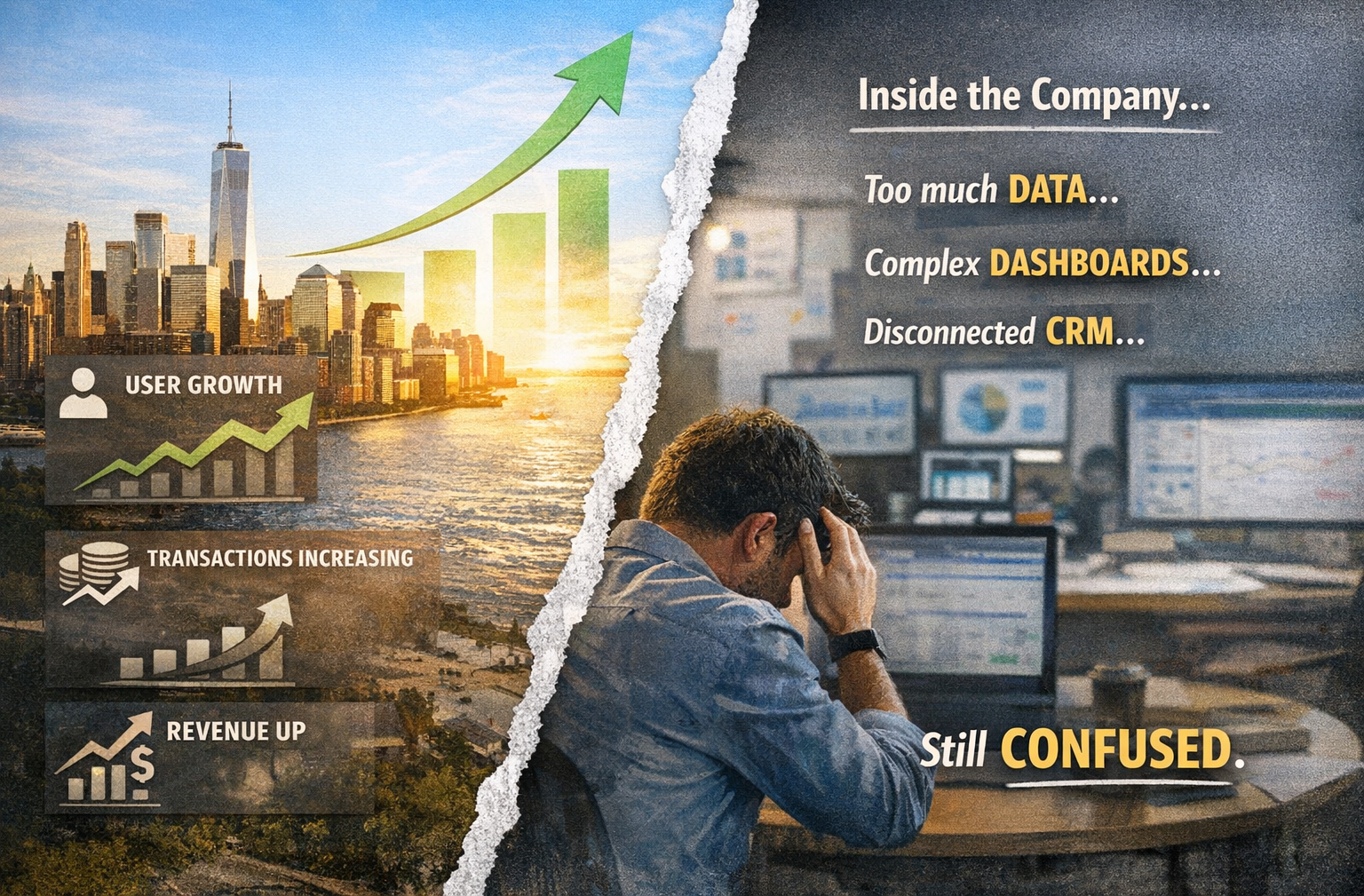
Things looked great from the outside.
Users were growing.
Transactions were increasing.
Revenue was moving in the right direction.
But internally, something felt off.
He said something simple that stuck with me:
“We don’t really know our users anymore.”
Not because they didn’t have data.
They had dashboards, analytics, and even a CRM.
But none of it was helping them understand what was actually happening.
That’s when it clicked.
Most fintech companies don’t have a CRM problem.
They have a reality problem.
What fintechs think a CRM is
If you ask most teams, CRM usually means:
- Customer data storage
- Support ticket tracking
- Sales pipeline management
- Basic user segmentation
It’s treated like a tool.
Something you plug in once the product starts growing.
And in early stages, that works.
Because the system is still simple.
- Fewer users
- Fewer transactions
- Fewer edge cases
You can still “feel” what’s happening.
But that doesn’t last.
What actually happens when fintech starts scaling
Scale changes everything.
Not just in size, but in complexity.
Suddenly:
- One user can have multiple transaction types
- Support issues aren’t isolated; they’re systemic
- Risk, compliance, and support start overlapping
And this is where most CRMs quietly fail.
Not because they’re bad tools.
But they weren’t designed for this kind of environment.
The hidden complexity nobody plans for
In fintech, a “customer” isn’t just a customer.
They are:
- A user
- A financial identity
- A compliance entity
- A risk profile
- A transaction history
All at the same time.
Now imagine trying to manage that inside a traditional CRM.
You end up with:
- Fragmented data
- Delayed insights
- Teams working in silos
And slowly, something dangerous happens.
You lose visibility
Not completely.
Just enough to start making slower decisions.
Support teams don’t see risk signals.
Risk teams don’t see behavior patterns.
Product teams don’t see real user friction.
Everything still “works.”
But it takes more effort to keep it working.
And that’s where most fintechs get stuck.
Why does this become a serious problem
At a small scale, inefficiency is annoying.
At a large scale, it becomes expensive.
Because:
- Delayed responses increase churn
- Missed signals increase fraud exposure
- Poor visibility increases compliance risk
And none of these show up instantly.
They build over time.
What fintech CRMs actually need to do
The problem isn’t CRM as a concept.
It’s how it’s being used.
A fintech CRM isn’t just about managing relationships.
It’s about managing systems of interaction.
That means:
• Real-time visibility
Not yesterday’s data.
What’s happening right now?
• Context across teams
Support, risk, compliance, and product should not operate separately.
They’re looking at the same user from different angles.
• Behavior-driven insights
Not just who the user is.
But how they are interacting with the system.
• Event-based architecture
Transactions, flags, triggers.
Everything connected.
What I’ve seen across multiple teams
There’s a pattern that keeps repeating.
Stage 1: Everything feels manageable
Small team, simple workflows
Stage 2: CRM gets introduced
Basic structure, some organization
Stage 3: Scale introduces chaos
Data grows faster than understanding
Stage 4: Workarounds begin
Spreadsheets, internal tools, manual fixes
Stage 5: System fatigue
Teams spend more time managing tools than users
And by this point, the CRM isn’t helping anymore.
It’s slowing things down.
The uncomfortable truth
Most fintech teams don’t outgrow their CRM.
They outgrow their assumptions.
The assumption that:
Customer data is simple
User journeys are linear
Teams can operate independently
None of that holds at scale.
What better systems look like
The strongest fintech teams don’t treat CRM as a separate layer.
They treat it as part of their infrastructure.
It’s not just:
“Where do we store customer info?”
It’s:
“How we understand system behavior through users.”
That shift changes everything.
A different way to think about CRM
Instead of asking:
“How do we manage customers?”
Ask:
“How does the system interact with users, and where does it break?”
Because that’s where real insight lives.
Final thought
CRM in fintech isn’t about relationships.
It’s about visibility.
And visibility is what determines:
- speed of decisions
- quality of responses
- ability to scale without chaos
Most systems don’t fail because of bad tools.
They fail because they can’t keep up with reality.
And in fintech, reality gets complex faster than most people expect.