
Most DeFi Strategies Don’t Fail — They Expire
 Adinda Purbaya7 min read·Just now
--
Understanding what separates short-term yield from sustainable DeFi strategies
DeFi has a familiar pattern. A new strategy launches with high APY.
Capital flows in. Yields spike. Then slowly, things change.
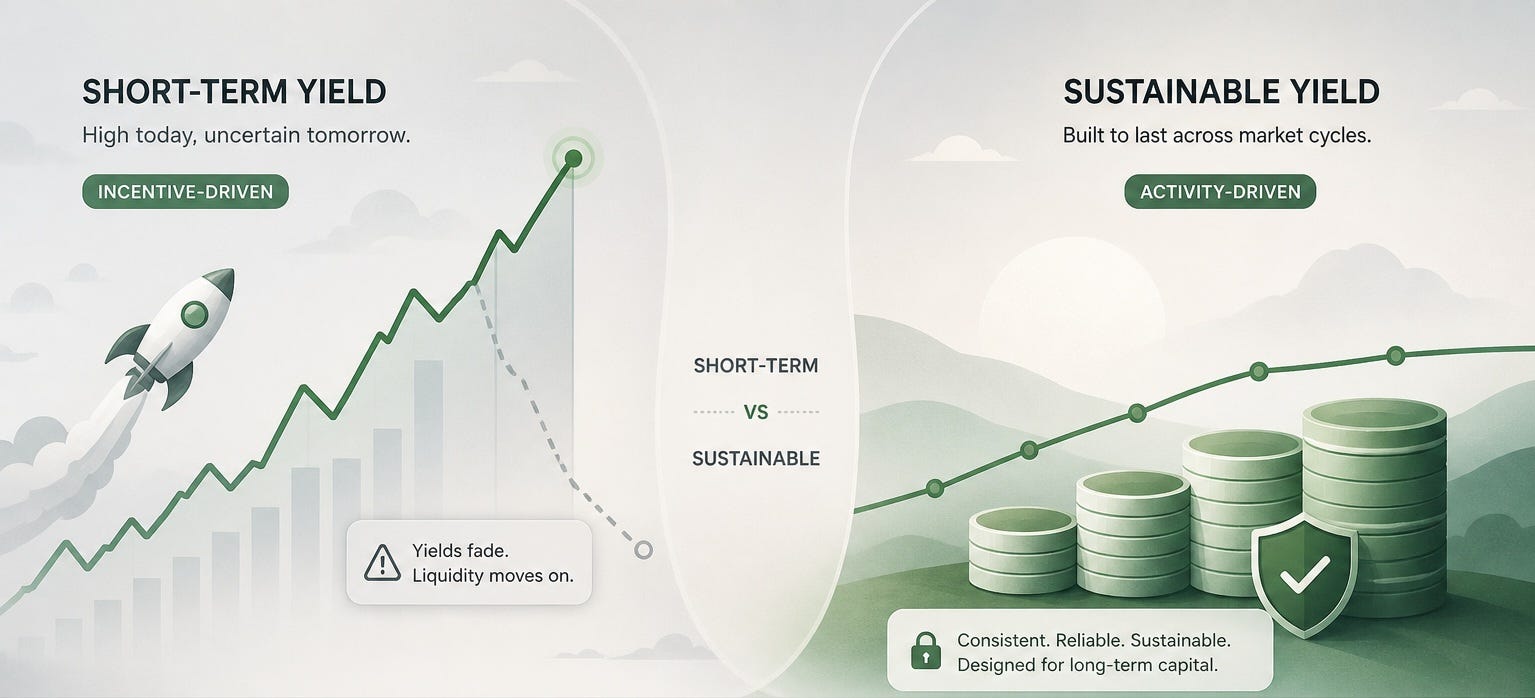
Yields begin to compress. Liquidity rotates out. And what once looked like an opportunity starts to fade. This cycle repeats across protocols, chains, and market conditions. Not because the strategies fail — but because most of them were never built to last. So the real question isn’t :
“What has the highest yield?”
It’s :
“What actually lasts?”
The Cycle of DeFi Yield
Across DeFi, the same pattern appears again and again. A new strategy launches with attractive yields.
Early capital flows in quickly, drawn by the opportunity to capture high returns. As more liquidity enters, those returns begin to compress.
What once offered double-digit APY gradually declines as the strategy becomes crowded and less efficient. At the same time, incentives that helped bootstrap the opportunity start to fade.
Emissions decrease.
Rewards dilute.
And the original appeal begins to weaken.
Eventually, liquidity rotates elsewhere — searching for the next high-yield opportunity. The strategy itself doesn’t necessarily break. It simply stops working as effectively as it once did. This cycle is not an exception in DeFi — it is the default. Which leads to a more important question :
Why do most strategies fade so quickly?
What “Sustainable” Actually Means
In DeFi, sustainability is often misunderstood. High yield is frequently mistaken for a strong strategy, when in reality, it often reflects short-term conditions rather than long-term viability. A sustainable strategy is not defined by how much it earns in a given moment — but by how consistently it can perform over time. A sustainable DeFi strategy typically :
- Generates consistent returns
Not just during favorable conditions, but across different market cycles. - Does not rely entirely on incentives
Yield is supported by underlying activity, not solely by emissions or temporary rewards. - Remains viable under changing conditions
The strategy continues to function even as liquidity, volatility, and demand evolve.
This shifts the focus from performance to durability. Because in the long run, what matters is not how high a strategy can go — but how long it can last.
Real Yield vs Temporary Yield
Not all yield in DeFi is created equal. Some returns are driven by real economic activity. Others are supported by incentives that may not last. Two types of yield dominate DeFi :
- Real yield
Generated from actual activity within the system — such as trading fees, lending demand, arbitrage, or liquidations.
These returns are tied to usage and tend to be more stable over time. - Temporary yield
Driven by emissions, rewards, or incentives designed to attract liquidity.
While often attractive at launch, these yields typically decline as incentives decrease or become diluted.
This distinction is critical. Strategies built on emissions can appear highly profitable in the short term, but often lose momentum as incentives fade. In contrast, strategies supported by real activity tend to be less explosive —
but far more durable.
Not because they offer the highest returns,
but because they are grounded in actual demand.
Liquidity & Market Conditions
The sustainability of a strategy does not exist in isolation. It depends heavily on the environment in which it operates. Several factors determine whether a strategy can last :
- Liquidity depth
Strategies require sufficient liquidity to function efficiently.
As capital grows, returns often compress — especially in crowded environments. - User activity
Yield driven by trading or lending depends on continued participation.
Without activity, even well-designed strategies can weaken. - Market volatility
Some strategies perform well under stable conditions, but struggle during periods of high volatility. - Underlying demand
The strength of a strategy is often tied to whether there is real demand for it — not just capital temporarily flowing in.
This is why many strategies appear strong under specific conditions, but fail to persist as the market changes. They are not inherently flawed —
they are simply not designed to adapt. In contrast, sustainable strategies are those that can operate across different environments, not just within one.
Risk & Cost Awareness
A strategy can look strong on paper, yet gradually weaken in practice. Not because the core idea is flawed — but because of the costs and risks that accumulate over time. In reality, several factors quietly erode returns :
- Execution costs
Every transaction incurs fees, especially across multiple protocols or chains. - Rebalancing impact
Adjusting positions over time introduces additional costs and timing inefficiencies. - Slippage
Entering and exiting positions can result in price differences, reducing effective returns. - Changing correlations
Market relationships shift, affecting how strategies perform under different conditions.
When these factors are ignored, a strategy may appear sustainable —
but in reality, it degrades over time. This is why sustainability is not just about generating yield, but about preserving it after all costs are accounted for.
Designing for Sustainability
If most strategies fade due to incentives, conditions, and hidden costs,
then sustainability is not something that happens by chance — it has to be designed.
A sustainable approach to DeFi is less about finding opportunities, and more about structuring how capital is deployed across them. Instead of relying on a single source of yield, strategies begin to incorporate multiple components that can adapt as conditions change.
This often means diversifying across different yield sources, continuously monitoring performance, and adjusting positions as markets evolve. It also requires shifting focus from headline returns to what actually remains after costs and risks are accounted for.
In this context, yield is no longer evaluated solely by its size,
but by its risk-adjusted profile — how consistently it can perform relative to the risks it carries.
This shift increasingly aligns DeFi with how institutional capital approaches strategy.
DeFi begins to resemble a system rather than a collection of isolated opportunities.
Capital is not just deployed — it is managed.
Yield is not simply captured — it is constructed.
And as this shift takes place, the difference between short-term strategies and sustainable ones becomes increasingly clear.
Concrete Vaults
As the focus shifts toward sustainability, the way capital is managed becomes just as important as where it is deployed. Generating durable yield is not only about identifying opportunities — but about selecting, combining, and adapting them over time.
This is where systems like Concrete vaults are designed to operate. Rather than chasing short-term incentives, vault-based strategies aim to prioritize yield sources that are more stable and supported by real activity. In practice, this means :
- Prioritizing sustainable yield sources
Focusing on returns driven by trading, lending, and other forms of real economic activity. - Managing capital across multiple strategies
Reducing dependence on any single opportunity or market condition. - Adapting to changing environments
Allowing strategies to evolve as liquidity, volatility, and demand shift. - Reducing reliance on short-term incentives
Avoiding overexposure to emissions-driven yields that tend to fade.
Instead of optimizing for the highest possible return at any given moment,
this approach focuses on building strategies that can continue to function over time. It reflects a broader transition in DeFi — from opportunistic yield to managed, sustainable systems.
Concrete DeFi USDT
To understand what sustainable yield looks like in practice, it helps to look at a simpler example. Not a strategy chasing double-digit returns, but one designed to deliver consistency.
Concrete DeFi USDT offers a more stable yield profile — around ~8.5%.
At first glance, this may seem less attractive compared to higher-yield opportunities across DeFi.
But over time, consistency often outperforms volatility.
The Future of DeFi Strategies
DeFi is gradually moving beyond short-term yield chasing. The focus is shifting toward strategies that can persist across market cycles — not just perform for a brief moment.
As the ecosystem matures, capital becomes more selective. It begins to favor strategies that are consistent, adaptable, and grounded in real activity, rather than those driven purely by incentives.
This marks a broader transition.
From chasing peak returns
to managing risk-adjusted yield.
From isolated opportunities
to structured systems.
From temporary performance
to long-term durability.
In this environment, the defining question is no longer:
“What offers the highest APY?”
But :
“What can continue to work over time?”
Because in the end, the future of DeFi will not be defined by the strategies that perform the best for a week — but by the ones that last.
Explore Concrete at : https://app.concrete.xyz/earn