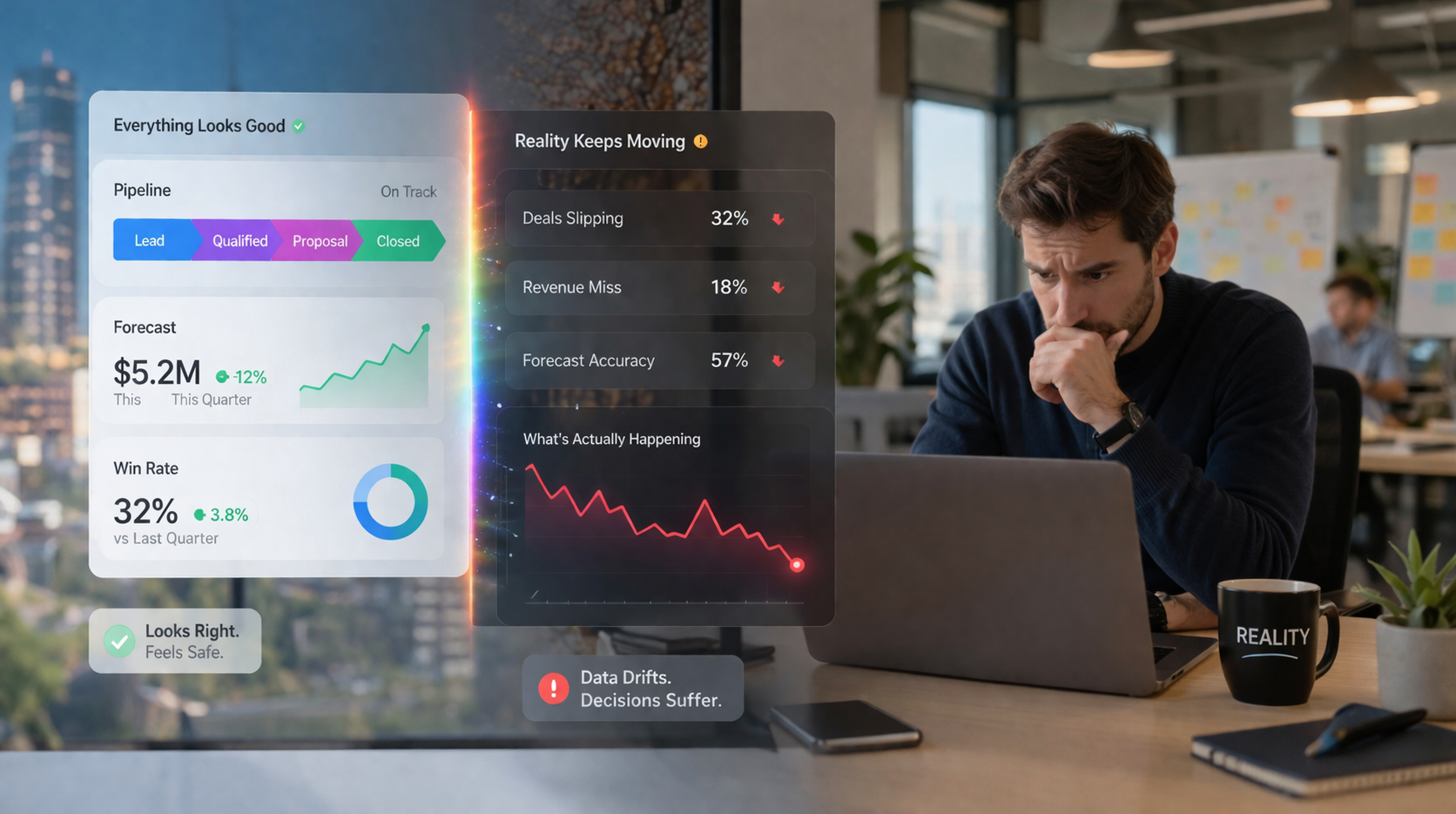
Most CRM Systems Don’t Fail, They Slowly Stop Telling the Truth
Why revenue systems quietly lose reliability as teams scale, and how that impacts decision-making across modern businesses
 FinTech with Aniket3 min read·Just now
--
There’s a moment in most growing companies where the CRM looks perfect.
Clean pipeline.
Clear stages.
Predictable forecasts.
Everything feels under control.
Until reality disagrees.
Deals slip.
Revenue misses.
Forecasts become guesses.
And suddenly, the system everyone trusted
starts feeling unreliable.
Not broken.
Just… off.
Why This Topic Is Trending
As companies scale, there’s an increasing focus on:
revenue operations
pipeline visibility
sales forecasting accuracy
data-driven decision-making
CRM systems sit at the center of this.
They are expected to:
capture reality
organize it
and turn it into insight
But as teams grow, something subtle happens.
The system becomes harder to trust.
The Popular Narrative
The common belief is simple:
If your CRM is properly used,
it gives you complete visibility.
If data is entered consistently,
decisions become accurate.
If dashboards are clean,
the business is predictable.
It sounds logical.
But it assumes something unrealistic.
That human behavior remains consistent at scale.
Where It Breaks
CRM systems depend heavily on input.
And input depends on people.
Sales teams optimize for outcomes.
Not for data accuracy.
That means:
Deals get updated late
Stages are adjusted strategically
, probabilities reflect optimism, not reality
This is not intentional deception.
It’s natural behavior.
People adapt systems to match incentives.
And over time, this creates drift.
Infrastructure Reality
At its core, a CRM is a data aggregation system.
It collects:
activities
deal stages
communication logs
forecast inputs
But it does not independently verify reality.
It reflects what is entered.
Not necessarily what is happening.
That creates a gap.
Between system visibility
and actual business conditions.
Scaling Consequences
As organizations grow, this gap widens.
More people.
More deals.
More pressure.
You start seeing:
overloaded pipelines
inconsistent deal progression
forecast volatility
misalignment between teams
Leadership relies on dashboards.
But dashboards rely on inputs.
And inputs are increasingly unreliable.
How Mature Teams Think Differently
More experienced teams recognize this limitation.
They don’t treat CRM as a source of truth.
They treat it as one signal among many.
They supplement it with:
financial data validation
customer behavior tracking
independent forecasting models
cross-functional verification
They reduce reliance on self-reported data.
And increase emphasis on observable outcomes.
Early Warning Signs
There are clear indicators when a CRM starts losing reliability.
Frequent forecast misses
Large last-minute deal changes
High discrepancy between pipeline and revenue
Heavy reliance on manual adjustments
These signals often appear before major issues.
But they’re easy to ignore.
Because the system still “looks” correct.
Final Reflection
CRM systems rarely fail dramatically.
They don’t crash.
They don’t stop working.
They just slowly stop reflecting reality.
And that’s more dangerous.
Because decisions continue to be made.
Based on data that feels accurate
but isn’t.
The goal of a CRM is not just organization.
It’s clarity.
And clarity requires more than data.
It requires alignment between what is recorded
and what is actually happening.
That alignment becomes harder as systems scale.
Which means the real challenge isn’t implementing a CRM.
It’s maintaining its integrity over time.
Because once that integrity is lost,
the system doesn’t just become less useful.
It becomes misleading.
And misleading systems don’t just slow growth.
They distort it.