Morgan Stanley questions AI’s impact on US economic elasticity
The bank's global head of fixed income research says AI capital spending is 'uniquely price insensitive,' with $800 billion flowing in 2026 regardless of soaring input costs.
Share
Add us on Google by Editorial Team May. 25, 2026Here’s something economists don’t see every day: companies spending more money precisely when things get more expensive. Morgan Stanley’s Andrew Sheets, the firm’s Global Head of Fixed Income Research, laid out the case in a May 11 podcast that AI infrastructure spending is fundamentally rewriting how the US economy responds to price signals.
The core observation is striking. Copper prices are up 40% year-over-year. Gas turbines have climbed 50%. Memory chips have surged between 150% and 300% in just twelve months. And demand for all of it keeps rising.
The $800 billion question
Morgan Stanley now anticipates $800 billion in AI-related capital expenditure from major US technology firms in 2026. That figure is nearly double the previous year’s estimates and roughly triple what was spent in 2024. The 2027 projection climbs even higher, to $1.1 trillion.
AdvertisementSheets described this spending pattern as “uniquely price insensitive.” In plain English: companies building AI infrastructure don’t flinch at higher costs. They just keep buying chips, data centers, and power equipment regardless of what the invoice says.
Good news, bad news
Sheets framed the situation as a “classic good news, bad news story.” The good news is obvious enough. When hundreds of billions of dollars flow into capital spending, it props up GDP growth, supports employment in construction and manufacturing, and generates corporate earnings. Morgan Stanley’s midyear outlook projects a 7% rise in US business spending in Q4 2026, with 8% growth forecast for 2027, driven in significant part by AI-related capex.
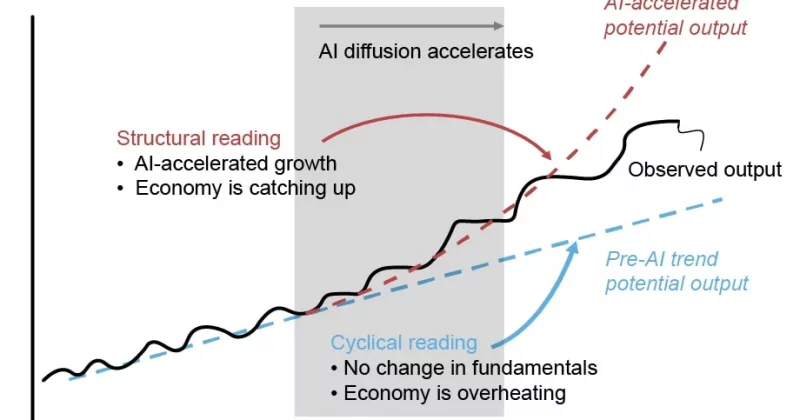
Now for the bad news. When a massive sector of the economy stops responding to price signals, inflation gets harder to tame. If companies keep buying copper and memory chips no matter the cost, producers have little incentive to moderate pricing.
There’s also the credit market angle. Sheets flagged the potential for widening credit spreads in corporate bond markets. Companies financing massive buildouts through debt issuance put pressure on the broader fixed income landscape. If enough firms are borrowing heavily to fund AI infrastructure, the risk premium on corporate bonds could expand, making borrowing more expensive across the board.
What this means for investors
For fixed income investors, the inflationary impulse from AI spending could keep interest rates elevated longer than consensus expects. If the Fed is trying to cool the economy while a trillion-dollar spending engine operates with apparent immunity to monetary tightening, the traditional transmission mechanism of rate hikes starts to break down.
Worth noting: Sheets was explicit that this analysis pertains to traditional financial markets. He made no reference to digital currencies or crypto assets in his assessment.
Disclosure: This article was edited by Editorial Team. For more information on how we create and review content, see our Editorial Policy.