Monthly Market Update (May)
 Jinming10 min read·Just now
--
Macro
May delivered a broad equity rally anchored by the positive negotiations between US and Iran on a ceasefire plan expected to be finalized soon. Xi–Trump Beijing Summit was more of an optics than a material improvement in bilateral relations has nonetheless highlighted the mutual intention to deepen their relationship going forward easing concerns over worsening geopolitical tension between the two global powers. China agreed to buy 200 Boeing aircraft and ≥$17B/yr in US agricultural products with potential tariff cuts, the most significant US–China de-escalation since early 2025.
Headwinds proved persistent: Moody’s stripped the US sovereign credit of its AAA rating mid-month, spiking 10-year Treasury yields to 4.60%; FOMC minutes flagged preparedness to hike on persistent inflation due to the ongoing Iran war. The Michigan Consumer Sentiment Index hit a record low of 44.8 with year-ahead inflation expectations at 4.8%, and the May flash PMI showed manufacturing at a 4-year high with input costs at their highest since late 2022 — confirming goods inflation is reaccelerating.
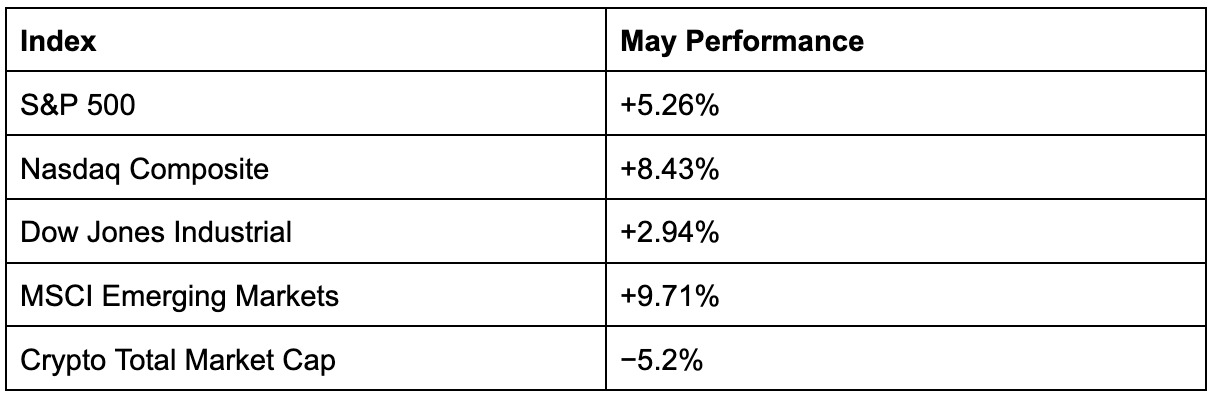
In crypto, the total market cap contracted ~5.2% MoM to $2.56T, with sentiment deteriorating from Neutral to Fear (Fear & Greed: 50 → 35). Crucially, crypto decoupled from equities in May: as the S&P and Dow hit all-time highs, BTC and ETH both declined. Hyperliquid ETFs launched, pushing HYPE price to an all time high.
Bitcoin
Key Theme: ETF Outflows, Institutional Fatigue
BTC surged to ~$82,500 on a 4-day ETF inflow streak in the first week of May that brought in ~$1.6B in net inflows, although institutional sentiment quickly reverses nearing the month with a 8-day outflow streak of ~$2.6B pushing the price back down below $80K. By the end of May, BTC ETFs recorded a net outflow of $2.4B. Overall, the price of Bitcoin remains fragile without any clear catalysts to drive upward momentum.
Strategy acquired 25,404 BTC (~$2.4B) in May, bringing total holdings to 843,738 BTC (~$65B) at average cost $75,700; Strategy mNAV sits at 1.28x (vs 3.15x 2024 peak). Strategy also retired $1.5B in convertible debt at an 8% discount. SpaceX revealed a holding of 18,712 BTC ($1.29B) on its balance sheet — the most significant non-financial corporate BTC disclosure of the year.
Ethereum
Ethereum activity deteriorated in May amid the wave of DeFi exploits, leadership exits, and the broader crypto decoupling that led to capital outflows from its ecosystem. ETH price tumbled ~11% MoM. ETH ETF flows returned gains in May logging an outflow of more than half a billion as institutional capital rotated into other sectors. ETH/BTC grounded to a 10-month low, down 35% from its August 2025 highs. A governance overhang deepened in May: five senior Ethereum Foundation leaders departed in May alone (eight total in 2026). Ex-EF researcher Dankrad Feist proposed a new $1B+ institution to protect Ethereum’s competitive position. With a slew of DeFi exploits occurring in May, most of which can be attributed to cross chain bridging and key signing compromises, Ethereum Foundation launched the Clear Signing standard to improve readability of onchain transactions and mitigate transaction risk. Meanwhile, ETH staking surpassed 32% of total supply, reaching all-time high as BitMine continues to stake a majority of its purchases, raising ongoing issuance policy debate.
Ethereum Performance in May
L2s
Base — Azul Upgrade
As part of the Azul Upgrade, Base launched Multiproofs which combines TEE and ZK provers into a single system, moving the network to stage 2 decentralization. The resulting benefit is that withdrawals of assets are now shortened from 7 days to 1 day, enhancing security and improving capital efficiency. Base also streamlined its tech stack to only support base-reth-node for execution and base-consensus for consensus, placing it on path to achieve 1 gigagas/s.
MegaETH — Revenue Funded Buybacks Launched
Launched MEGA token buyback programme funded entirely by USDm stablecoin yield — the first L2 to self-fund token buybacks through protocol revenue. Terminal points programme, an incentive campaign to attract users to explore the MegaETH ecosystem, has concluded early (May 21). The team also announced their plans to launch MOSS, a self-custody wallet that unifies liquidity across applications.
DeFi
Key Theme: A Rise in DeFi exploits and Hyperliquid’s significance as an onchain perpetuals DEX
May 2026 was the worst month for DeFi security in 2026 YTD in terms of exploit count, with 31 attacks according to DeFi Llama. The pattern of exploits observed during the month suggests that DeFi’s next major security challenge may increasingly lie in operational security and cross-chain infrastructure, rather than smart contract vulnerabilities alone. This is especially relevant as smart contract security standards continue to improve, supported by stronger audit practices and AI-assisted security tooling. Against this backdrop, risk appetite in DeFi also appeared to soften, with the spot DEX-to-CEX trading volume ratio receding from 14.9% to 14.04%.
Notable Security Incidents in May 2026
DeFi Metrics — May 2026
Key Development: MoonPay Gateway and Talos announced integration with Hyperliquid, significantly lowering the entry point for retail and institutional traders into the largest onchain perps platform.
Why it matters: MoonPay Gateway’s fiat-to-Hyperliquid integration represents a structural shift in DeFi’s trading landscape. Talos integration of Hyperliquid further extends DeFi exposure for institutional traders. By partnering with firms like MoonPay and Talos which each has a larger user base of retail and institutional traders, it significantly lowers the entry barriers and serves to reinforce the leadership of Hyperliquid which has grown its perps market share relative to centralized exchanges from 6% to 6.63% MoM.
Relative to other on-chain competitors, Hyperliquid also recorded an increase in trading volume in May, whilst volumes across competing platforms declined. As a result, Hyperliquid now accounts for the lion’s share of approximately 50% of the on-chain perpetuals trading volume. Hyperliquid’s growing usage has also been reflected in HYPE’s market performance, with the token rallying more than 66% MoM. This momentum was supported by the launch of regulated HYPE ETFs by Bitwise and 21Shares in May, which have collectively attracted over $136M in AUM.
Other Notable DeFi Developments
- Morpho Midnight launched — new lending protocol with enhanced risk isolation, direct response to April’s KelpDAO-driven credit market stress.
- Lighter RFQ now supports BTC, ETH, SOL, XRP, TON, and ZEC allowing users to execute large trade sizes directly with market makers. Tealstreet traders can now access and trade Lighter markets directly through the terminal.
- Aave V4 crossed $100 million deposits.
- Armitage, Wintermute’s new vault curation team, joined Morpho as a curator.
- Aster launched Hong Kong equities perps including $TENCENT, $XIAOMI, $MINIMAX, $POPMART with up to 3x leverage.
- Aave announced an overhaul of its collateral and listing standards following the $292M KelpDAO exploit, expanding criteria beyond financial risk to include cybersecurity and architecture assessments.
- Ethena joined Jupiter Lend with a dedicated isolated market on Solana with Bitwise acting as the vault manager, expanding lending venue options.
What to watch: CLARITY Act enters a critical Senate vote window in June (9 weeks before potential August recess). Section 308 would make blockchain analytics tools (TRM/Chainalysis/Elliptic) a statutory requirement for DeFi intermediaries — the first time specific compliance tech is named in US law. Section 305 creates a 30-day transaction hold authority. Passage could be a catalyst for on-chain infrastructure token re-rating; an August delay risks pushing reform to 2030.
Stablecoins & Payments
Key Theme: On Trump’s Crypto Banking Executive Order and Unifying the Agentic Payments Infrastructure Build-out
The stablecoin market hit a new all-time high of ~$323.4B mid-May before closing the month at $320B staying relatively unchanged. USDS (Sky) gained 4.75% MoM; USD1 gained 4.62% MoM. Ethena’s stablecoins USDe and USDtb saw robust MoM growth of 15.38% and 73.86% respectively. USDe grew significantly on Solana after Bitwise launched a curated vault on Jupiter Lend for USDe, with the vault now having $526M in AUM. Increased treasury yield rates in May across duration also added further tailwind for the capital inflows into USDtb.
Regulatory Catalyst: Trump’s Crypto Banking Executive Order
President Trump signed an Executive Order directing the OCC, FDIC, SEC, CFTC, CFPB, NCUA, and Fed to identify and remove rules blocking digital asset firms from bank partnerships, federal charters, and deposit insurance within 90 days (180 days to act). The Fed has 120 days to decide on non-bank access to Reserve Bank master accounts.
Why it matters: If implemented, US-chartered crypto firms gain direct Fedwire/RTGS access, eliminating the Operation Chokepoint 2.0 correspondent-banking bottleneck. The EO frames stablecoin dominance ($33T volume, $300B+ market cap, ~99% USD-pegged) as an American strategic interest.
Agentic Payments — Moving Toward Unified Standard
Early discussions focused on whether agents could hold wallets, pay for APIs, or execute transactions independently, but the more important infrastructure challenge is now coordination: how agents authenticate, discover services, receive permissions, enforce spending limits, exchange compliance context, and settle transactions across different rails.
Below are some notable developments toward this trend in May:
- Circle Agent Stack: Agent Wallets + Nanopayments (min $0.000001, gas-free) + Agent Marketplace + CLI — comprehensive autonomous payment infrastructure to further cement the adoption of USDC.
- x402 Protocol: 3.8M transactions in May, avg $0.52 per transaction. Fireblocks joins x402 Foundation while also launching its Agentic Payment Suite, positioning itself in direct competition with Coinbase as agent facilitators while being stablecoin, network and payment protocol agnostic.
- Amazon — launched Bedrock AgentCore Payments in preview, the first managed payment infrastructure for enterprise AI agents to autonomously transact using USDC; built with Coinbase (x402) and Stripe (Privy wallet).
Why it matters: As agentic payments scale and are expected to surpass human traffic on the web, having infrastructural support for agents is now table stakes for companies looking to capture value from agentic transactions. However, developers looking to integrate agentic payments often need to go through multiple loops, navigating through increasingly complex agent payment protocols, wallets APIs and agent-native security challenges. Firms like Amazon and Fireblocks are helping to abstract away these complexities in different workflows/scenarios through a single access point that delivers compliant, secure and comprehensive agentic payment support.
Rapid Growth of Non-USD Stablecoins
- Anchorpoint’s HKDAP cleared its first Ethereum mainnet test on May 14, targeting H2 2026 launch for cross-border and local payments.
- $KRWQ launched natively on Solana in May following its earlier listing on EDX markets. It is also accessible to institutional investors on Fireblocks via Base. Since launching in October 2025, the won-backed stablecoin has processed more than $24B in volume.
- Japan formally announced plans to include foreign stablecoins in legal electronic payment frameworks from 1 June 2026 — a major regulatory opening for JPYC adoption and USD stablecoin integration in Japanese commerce.
- EURC + EURCV combined: ~$572M (0.18% of market). A 37-bank European consortium announced plans to develop a euro stablecoin to challenge dollar dominance in cross-border settlement.
L1s
Solana Alpenglow — Testnet Live (Mainnet Q3 2026)
Community testnet launched May 11. Cuts block finality from 12.8 seconds → 150 milliseconds (85× faster) — a fundamental reconstruction of Solana’s consensus mechanism.
Ecosystem Milestones:
- Europe’s largest asset manager, Amundi, launches UCITS tokenized fund on Solana.
- Jupiter, Securitize and Jump Trading partnered to launch the first fully on-chain regulated tokenized equity stack on Solana.
- Bitwise became a vault curator for institutional capital into the USDe market by partnering with Jupiter and Fluid.
Hyperliquid — ETFs and Onchain Perps Dominance
Hyperliquid ETFs officially mark their launch in May with 21Shares and Bitwise being the initial issuers. Early demand has been strong, with the ETFs attracting over $164 million in AUM and ranking as the fifth-largest ETF category by AUM. Bitwise has also announced that 10% of its management fees will go towards acquiring HYPE. Alongside the growing volumes on Hyperliquid as it increasingly becomes an exchange for RWA, these catalysts have acted as tailwinds driving more than 66% gains in Hyperliquid in May.
NEAR — Private AI Inference and Confidential Transactions
NEAR emerged as one of May’s strongest performers, rising more than 88% as investor interest was supported by several catalysts, including its upcoming Dynamic Resharding upgrade, post-quantum secure signatures, and expanding role in confidential transactions and private AI inference. The Government of Bermuda deploying AI-powered public services on NEAR AI’s confidential inference infrastructure, beginning with an AI assistant for public servants underscores the vital role of NEAR when it comes to the theme of private AI.