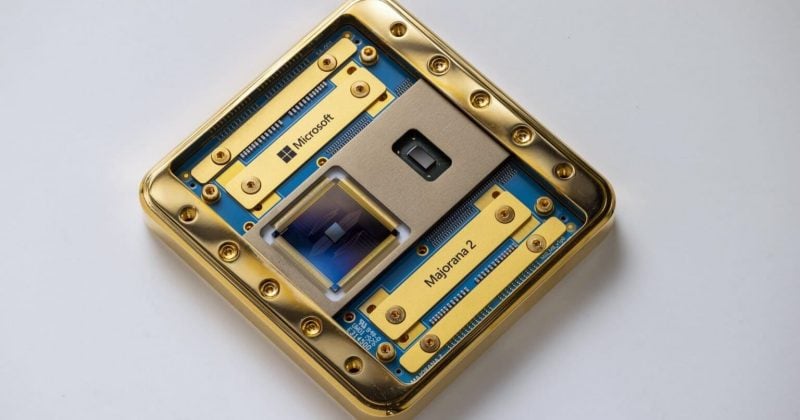
Microsoft reports major quantum computing gains with Atom Computing and EeroQ
Incremental breakthroughs in qubit stability and error correction are quietly shortening the timeline for quantum threats to crypto's core encryption.
Share
Add us on Google by Editorial Team Jun. 4, 2026Microsoft’s topological qubit hardware can now hold a stable parity state for over 20 seconds. That might not sound like much until you learn the previous benchmark was less than 10 milliseconds. We’re talking about an improvement of roughly three orders of magnitude, the kind of leap that turns a lab curiosity into something engineers can actually build on.
The update, published June 3, 2026, came alongside progress reports from two of Microsoft’s quantum collaborators: Atom Computing and EeroQ.
What actually changed
Microsoft’s stability gain came from something deceptively simple: better materials. The team swapped in lead for its superconductors and added tin to its semiconductors. That’s it. No new architecture, no revolutionary algorithm. Just the kind of painstaking materials science that doesn’t make for exciting demos but makes everything else possible.
AdvertisementAtom Computing, which builds quantum systems using neutral atoms trapped by lasers, tackled a different piece of the puzzle: error correction. Atom Computing’s solution was to keep spare, pre-cooled atoms on standby, swapping them in to maintain logical qubit stability across testing rounds.
The approach worked for up to 90 measurement rounds, a meaningful demonstration that error correction in neutral-atom systems can be sustained over operationally relevant timescales.
Then there’s EeroQ, which introduced a chip design that uses a resonator to couple individual electrons floating on the surface of liquid helium. The quantized motional states of those electrons serve as the building blocks for qubits.
Building on the 2024 milestone
These updates don’t exist in a vacuum. Microsoft and Atom Computing have been collaborating for years, and in November 2024 they demonstrated the entanglement of 24 logical qubits, a record at the time. The latest work on error correction and stability is the natural next step: once you can entangle that many qubits, the question becomes whether you can keep them coherent long enough to do useful work.
Why crypto should be paying attention
Every major blockchain, from Bitcoin to Ethereum, relies on elliptic curve cryptography (ECC) to secure wallets and validate transactions. A sufficiently powerful quantum computer running Shor’s algorithm could theoretically break ECC, meaning it could derive private keys from public keys.
Post-quantum cryptography, the family of encryption algorithms designed to resist quantum attacks, is already being standardized by NIST. Some blockchain projects have started exploring quantum-resistant signature schemes. But adoption across the crypto ecosystem remains minimal, largely because the threat still feels abstract.
For crypto investors, the practical takeaway isn’t to panic. It’s to start evaluating which protocols and projects are taking post-quantum security seriously and which are treating it as a problem for future developers to solve.
Disclosure: This article was edited by Editorial Team. For more information on how we create and review content, see our Editorial Policy.