And our partnerships with Ondo, Chainlink, Euler and several others soon.
I’ve been thinking a lot lately about the state of money. If you look at the traditional financial system through the lens of a software engineer, it looks surprisingly like a legacy codebase that hasn’t been refactored in fifty years. It’s full of race conditions (T+2 settlement), limited API access (banking hours), and worst of all, massive amounts of “dead code” — variables that are initialized but never used.
In finance, we call this “dead code” dormant capital.
The vast majority of the world’s wealth is locked in static equities. You buy a stock, it sits in a database (a custody account), and it does absolutely nothing until you sell it. It’s read-only memory. If you want to use that value—to buy a house, to hedge a position, or to hunt for yield—you have to delete the object (sell the stock), trigger a taxable event (garbage collection overhead), and then re-allocate. It’s inefficient.
Today, we are releasing the patch.
We are announcing Sentora Tokenized Equity Yield (STEY), a solution designed to turn static equity holdings into dynamic, programmable primitives. We are also announcing our first STEY pool in partnership with Ondo, Euler and Chainlink.
This isn’t just a new product; it’s a transition from “Finance 1.0” (static assets) to “Finance 2.0” (programmable, composable state).
The Problem: The Latency of Liquidity
In traditional finance (TradFi), liquidity and ownership are mutually exclusive. You either hold the asset (beta) or you hold the cash (liquidity). You can’t easily have both without engaging in complex, opaque, and slow prime brokerage agreements that are gated to institutional players.
DeFi changes the physics of this interaction. By moving equities onchain, we move from T+1 settlement delays to real-time, atomic transactions. This allows us to build Supervised Loans — smart contracts that can atomically check collateralization ratios and manage risk 24/7.
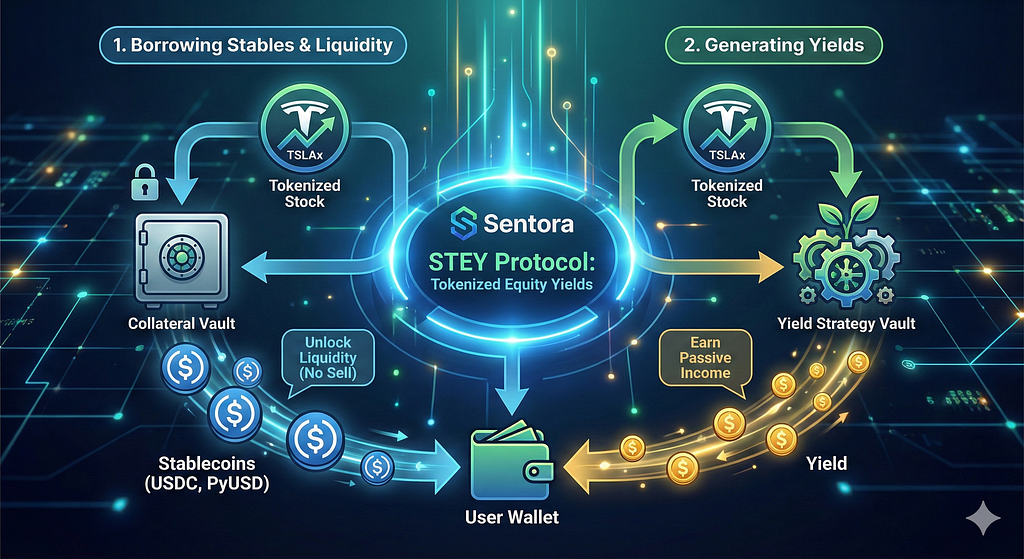
This is the core unlocking mechanism of STEY. It allows us to offer two fundamental capabilities that were previously impossible for the average investor:
- Borrowing: Accessing stablecoin liquidity against stock collateral without selling.
- Yield: Generating passive yield on stocks through DeFi vaults.
The STEY Primitives: The Full Stack
To build a robust system, you need robust primitives. You can’t build a skyscraper on a foundation of shaky float approximations. We treat the financial ecosystem as a stack of modular components.
The Asset Layer: Tokenization Engines First, we need the raw material. We rely on institutional-grade tokenization engines to wrap real-world securities (US Treasuries and equities) into compliant, onchain tokens. This ecosystem includes major players like Ondo Finance, Superstate, and Kraken’s Backed (via xStocks integration). These aren’t synthetic derivatives tracking a price; they are tokenized representations of the real assets, inheriting the deep liquidity of traditional equity venues.
The Data Layer: The Sensory Input Next, we need a reliable input stream. In a supervised loan system, the oracle is the single point of truth. If the oracle drifts from reality, the system either liquidates users unfairly or becomes under-collateralized. We utilize Chainlink Data Feeds to provide high-integrity, real-time pricing that reflects the full economic reality of the underlying security.
The Execution Layer: Lending Protocols For execution, we integrate with decentralized lending protocols. These serve as the permissionless runtime environment for liquidity. This includes protocols like Euler, Kamino, and Aave. These protocols allow for the creation of money markets where tokenized assets can be supplied as collateral to borrow stablecoins like USDC or PyUSD.
The Financial Layer: Smart Yields Finally, you need an operating system to manage these resources. Having assets, data, and execution venues is not enough; you need a layer to orchestrate the logic, manage the risk parameters, and route the capital efficiently. This is Sentora Smart Yields. It acts as the “Financial Layer” of the stack — the bridge between the raw infrastructure and the user’s capital, ensuring that the interaction between the asset and the lending protocol is both profitable and safe.
The Architecture: Supervised Loans
How do we actually generate yield on a static asset?
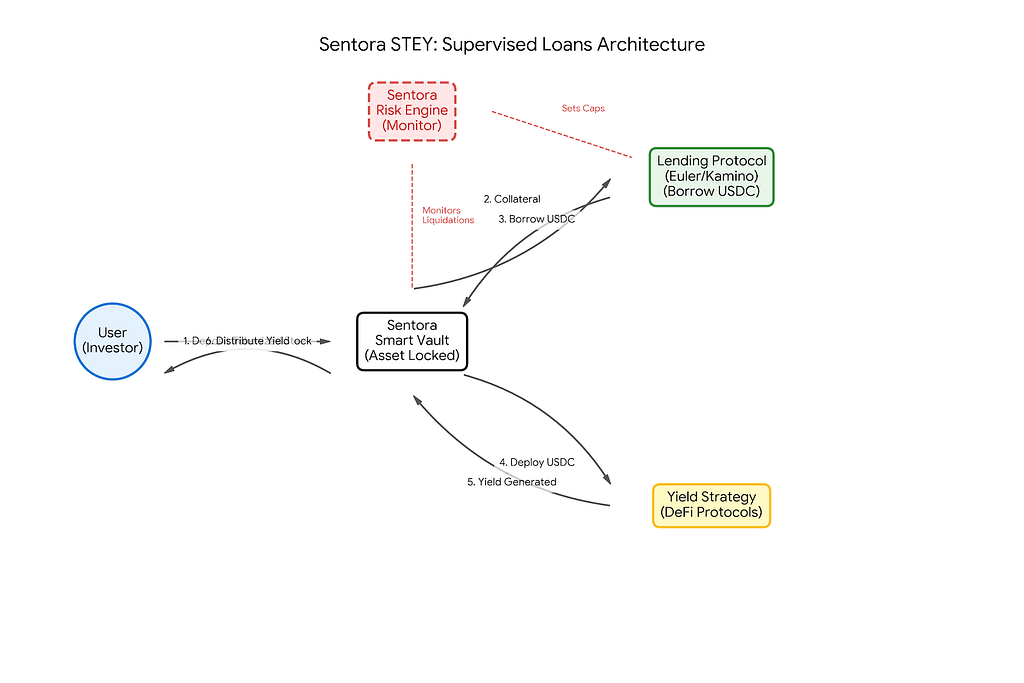
STEY is powered by Sentora’s Smart Yield supervised loan strategies. The architecture is designed to solve a fundamental mismatch in asset properties: equities are high-beta but non-yield friendly, while stablecoins are low-beta but yield-friendly in the DeFi ecosystem.
The core loop works by transforming the asset type within a risk-managed vault:
- Supply: The strategy supplies the non-yield friendly asset (the tokenized equity, e.g., TSLAx) into a lending market as collateral.
- Borrow: It borrows a yield-friendly asset (stablecoins like USDC or PyUSD) against that collateral.
- Earn: It deploys the borrowed stablecoins into yield-generating DeFi protocols.
This allows the user to hold the stock (and its upside) while the system synthetically extracts yield from the stablecoin markets on their behalf.
Connecting a volatile stock to a lending protocol sounds simple, but managing the risk is a high-dimensional optimization problem.
STEY is driven by Sentora’s risk engine, which acts as the hypervisor for these supervised loans. It doesn’t just check the price of the stock; it continuously models the health of the entire market structure.
Our Risk Engine manages critical vectors including:
- Liquidations: Monitoring health factors in real-time to prevent cascading sell-offs.
- Whale Exposure: Analyzing concentration risk to ensure no single entity can destabilize the pool.
- De-pegging Scenarios: Modeling the probability of the borrowed asset (stablecoin) breaking its peg, which would catastrophically alter the loan-to-value ratio.
- Liquidity Availability: Calculating liquidity depth on a block-by-block basis to ensure that if a liquidation does need to happen, there is enough market depth to absorb it without slippage.
This is effectively a “Model Predictive Control” (MPC) system for capital. It constantly observes the state of the market, predicts potential future states (insolvency risks), and actuates the control variables (collateral factors, interest rates) to keep the system stable.
Hello World: Launching on Euler with Ondo
Theory is great, but shipping code is better.
Today, we are executing the first instance of this architecture. We are launching the first tokenized equity markets on Euler, a modular lending protocol, using Ondo Finance assets.
This collaboration combines three critical components:
- Lending Venue: Euler provides the lending market infrastructure.
- Asset Liquidity: Ondo’s tokenized stocks and ETFs provide the underlying collateral, inheriting liquidity from traditional venues to support near-instant liquidations without significant slippage.
- Risk Curation: Sentora acts as the Risk Curator. We aren’t just dumping tokens into a pool; we are configuring the physics of the vault via Sentora STEY.
The specific implementation involves xStocks Vaults.
- Vault Logic: Each vault receives a single type of xStock as input.
- Strategy: The strategy behind the vault supplies the xStock to a lending protocol (like Euler), borrows stablecoins, and deploys those stables to generate yield.
- Risk Management: Using asset-level analysis, Sentora sets the collateral factors and borrow caps to ensure the market remains solvent.
This is the first time we are seeing a complete, institutional-grade stack for tokenized equities that allows global investors to access transferable tokenized U.S. stocks and use them as collateral.
Why This Matters: The Yield Arbitrage
Why go through all this trouble? Because the “spread” is where the alpha is.
STEY enables Yield Arbitrage: You can keep your exposure to a high-growth stock (like NVDA or TSLA) while simultaneously unlocking the capital to farm yield in DeFi. You are essentially stacking the “Beta” of the stock market with the “Alpha” of the DeFi yield market.
We are accelerating capital velocity. We are enabling global composability where equities can flow freely across applications. And we are doing it with programmable trust, replacing opaque back-office processes with transparent onchain logic.
We are moving toward a world where “Equity” is just another variable type in a global financial computer. It shouldn’t be static. It shouldn’t be locked in a silo. It should be an object you can call methods on: equity.borrow(), equity.stake(), equity.transfer().
STEY is our implementation of those methods.
Meet STEY: Sentora’s Yield Vaults for Tokenized Equities was originally published in Sentora on Medium, where people are continuing the conversation by highlighting and responding to this story.