
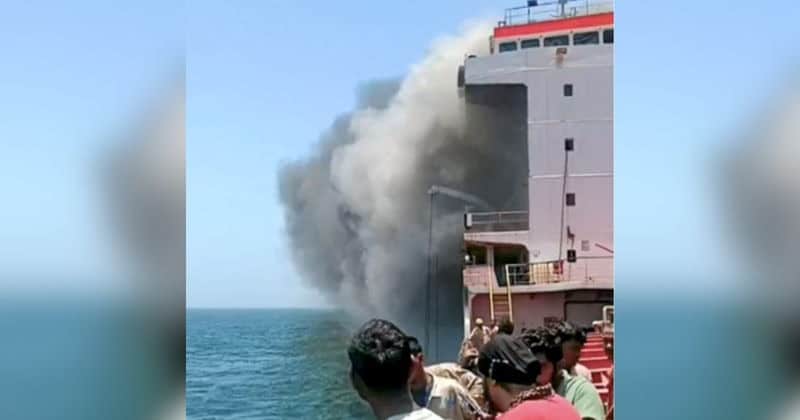
Marivex crew issues distress call after US missile strike off Oman
The Palau-flagged oil tanker becomes the seventh vessel disabled by US forces enforcing an Iran oil blockade, with all 24 Indian crew members safely evacuated.
Share
Add us on Google by Editorial Team Jun. 9, 2026A US Navy fighter jet fired a precision munition at the oil tanker MT Marivex in the Gulf of Oman on June 8, disabling the vessel and triggering a fire that forced all 24 crew members to issue a distress call and evacuate. The Indian-owned, Palau-flagged tanker had allegedly attempted to reach an Iranian port in violation of an ongoing US blockade, making it the seventh ship targeted by American forces in the Strait of Hormuz corridor.
Every crew member, all Indian nationals, was rescued without injury. Omani and Indian authorities coordinated the evacuation, bringing the sailors to safety at Masirah Island off Oman’s eastern coast.
What happened in the Gulf of Oman
US Central Command confirmed that an F/A-18 Super Hornet launched from the USS Abraham Lincoln carried out the strike. The tanker had reportedly disregarded US instructions to change course, continuing toward Iran despite warnings.
The MT Marivex, built in 2009 and carrying the IMO number 9464156, was unladen at the time of the engagement. The ship was empty, carrying no oil cargo, which meant the fire posed no immediate environmental threat from a spill.
AdvertisementThe munition was described as a precision strike intended to disable rather than sink the vessel. The Marivex caught fire but remained afloat long enough for the crew to evacuate safely.
The MT Marivex was previously known as the Arihant, a name it shares with Arihant Shipping Inc., a company that has been logistically linked to the transport of Iranian oil products and targeted by sanctions. The vessel’s history made it a known quantity for US naval intelligence operating in the region.
Seventh strike in an escalating campaign
This was not an isolated incident. The Marivex engagement marks the seventh time US forces have disabled a vessel around the Strait of Hormuz as part of broader efforts to halt Iranian oil shipments.
The Strait of Hormuz is one of the world’s most critical oil transit chokepoints. Roughly a fifth of global petroleum consumption passes through its narrow waters on any given day.
What this means for energy markets and beyond
For the shipping industry, the immediate consequence is insurance. War risk premiums for vessels transiting the Strait of Hormuz were already elevated before this incident. Each new strike pushes those premiums higher, which in turn raises the cost of moving oil through the region.
Companies with any logistical connection to sanctioned entities now face a binary choice: sever those ties entirely or accept the risk that a US warplane might put a hole in their hull. The Marivex’s link to Arihant Shipping Inc. suggests that the US is tracking vessel histories and ownership networks, not just monitoring real-time movements.
Iran has historically used cryptocurrency to circumvent financial restrictions, and Treasury and OFAC enforcement actions targeting crypto wallets linked to Iranian oil revenue have already increased in recent years.
Disclosure: This article was edited by Editorial Team. For more information on how we create and review content, see our Editorial Policy.