Layoff Trends 2025–2026: A Data-Driven Breakdown Across Industries
 Digital Unicon4 min read·Just now
--
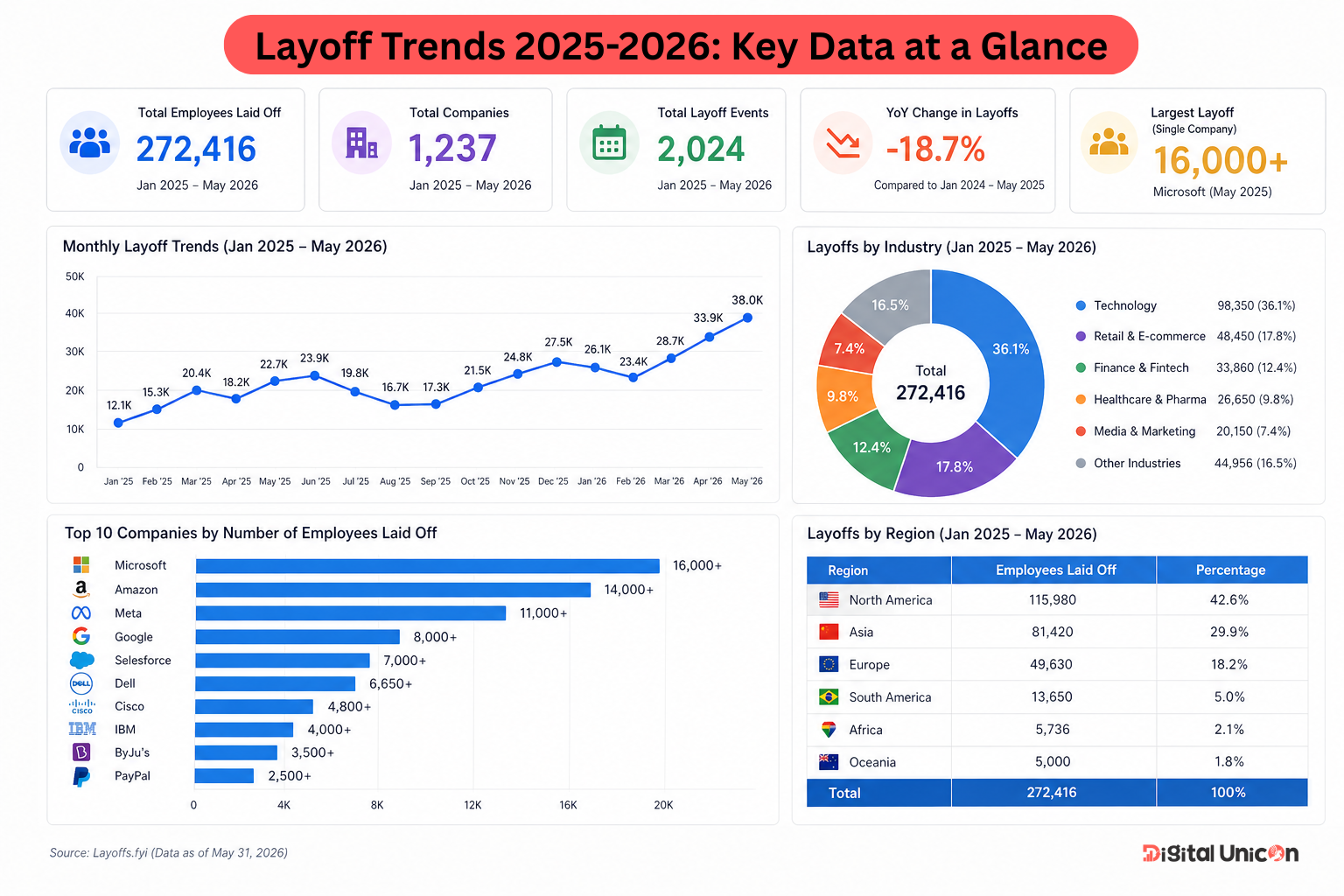
Layoffs in 2025 and 2026 are now a common occurrence in contemporary business cycles rather than singular occurrences connected to economic downturns. What started out as a post-pandemic correction has developed into an industry-wide structural reset. Businesses are redefining how work is done, not just reducing expenses.
A number of factors have come together to cause this change, including aggressive automation, rising capital costs, overhiring during growth surges, and shifting consumer demand. As a result, the labour market is becoming more skill-centric, less predictable, and more fluid.
The Macro View: What the Data Suggests
Across industries, several consistent patterns are emerging:
- Company layoffs are more frequent but more targeted
Companies are moving away from mass layoffs toward precision cuts – targeting redundant roles, underperforming units, or functions vulnerable to automation. - Unlike White-collar roles, they are no longer insulated
Unlike previous cycles, layoffs are heavily impacting knowledge workers — especially in tech, marketing, operations, and middle management. - The cost optimisation is replacing hypergrowth
The “growth at all costs” era has ended. Profitability and efficiency are now the dominant metrics. - organisational automation organisational AI adoption is accelerating workforce restructuring
Automation is not just replacing jobs — it’s reshaping entire organizational hierarchies.
Industry Breakdown
1. Technology: From Expansion to Efficiency
The tech sector continues to lead layoff volumes, but the narrative has shifted.
Key drivers:
- Overhiring during 2020–2022 digital boom
- Increased investment in AI and automation
- Pressure to improve margins
What’s changing:
- Reduction in non-core roles (HR, recruiting, support functions)
- Consolidation of product teams
- Higher demand for AI, data, and infrastructure talent
Insight: Tech layoffs are less about decline and more about reallocation. Companies are cutting legacy roles while aggressively hiring for future-facing capabilities.
2. Startups: The End of Easy Capital
Startups, particularly in SaaS and consumer tech, are undergoing a major reset.
Key drivers:
- Reduced venture capital funding
- Higher interest rates
- Investor focus on sustainable growth
What’s changing:
- Smaller, leaner teams
- Delayed expansion plans
- Shutdown of non-performing verticals
Insight: Startups are shifting from experimentation to execution. Layoffs are often a survival strategy rather than a scaling adjustment.
3. Finance & Fintech: Automation Meets Regulation
Financial institutions are balancing digital transformation with regulatory complexity.
Key drivers:
- Automation in operations and compliance
- Market volatility
- Consolidation in fintech
What’s changing:
- Decline in back-office roles
- Increased hiring in cybersecurity and risk analytics
- Mergers leading to workforce overlap
Insight: Efficiency gains through automation are reducing headcount, but regulatory demands are simultaneously creating specialised roles.
4. Retail & E-commerce: Demand Normalization
After pandemic-driven highs, retail is stabilising – and correcting.
Key drivers:
- Reduced online spending growth
- Inventory mismanagement
- Rising logistics costs
What’s changing:
- Cuts in warehouse and fulfillment roles
- Streamlining of supply chain operations
- Greater reliance on predictive analytics
Insight: Retail layoffs reflect demand normalisation rather than collapse, with a shift toward data-driven operations.
5. Media & Marketing: AI Disruption in Real Time
Few sectors are feeling AI’s impact as immediately as media and marketing.
Key drivers:
- AI-generated content tools
- Declining ad revenues in some segments
- Platform dependency
What’s changing:
- Reduced need for repetitive content roles
- Growth in strategic, creative, and brand-focused positions
- Increased demand for AI-literate marketers
Insight: The nature of creative work is evolving — execution is automated, strategy is amplified.
Cross-Industry Patterns
When comparing industries, several overarching themes emerge:
1. Middle Management Is Shrinking
Organisations are flattening hierarchies. Decision-making is becoming more centralised, reducing layers of management.
2. Skills Are Replacing Roles
Static job descriptions are losing relevance. Companies are prioritising adaptable skill sets — especially in AI, analytics, and cross-functional problem-solving.
3. Geographic Arbitrage Is Increasing
Remote work has enabled companies to optimise labour costs globally, leading to layoffs in high-cost regions and hiring in emerging markets.
4. Contract Work Is Rising
To maintain flexibility, companies are relying more on freelancers and contract-based talent instead of full-time employees.
The AI Factor: Replacement vs Augmentation
A central question behind 2025–2026 layoffs is whether AI is replacing jobs or transforming them.
Reality: It’s doing both.
- Replacement: Repetitive, rules-based roles are being automated
- Augmentation: High-skill roles are becoming more productive with AI tools
This creates a polarisation effect:
- Low-skill roles decline
- High-skill roles evolve and expand
What This Means for Professionals
The implications are clear:
- Job security is no longer role-based — it’s skill-based
- Continuous learning is mandatory, not optional
- Adaptability is the most valuable career asset
Professionals who align with emerging trends — AI, data, and systems thinking — are far more resilient to layoffs.
What This Means for Businesses
Organisations must balance efficiency with sustainability:
- Over-reliance on layoffs can damage culture and productivity
- Reskilling initiatives are becoming a competitive advantage
- Transparent communication is critical to maintaining trust
Companies that treat layoffs purely as cost-cutting tools risk long-term instability.
Conclusion: A New Workforce Paradigm
Layoffs in 2025–2026 are not an anomaly — they are a signal of a deeper transformation in how businesses operate. The workforce is becoming leaner, more dynamic, and increasingly shaped by technology.
The key takeaway is not that jobs are disappearing — it’s that the definition of work itself is changing.
Those who understand this shift early — both individuals and organisations — will be better positioned to navigate the uncertainty and capitalise on the opportunities ahead.