Keltner Channel Explained: A Practical Tool for Volatility and Breakouts
 Otet Markets6 min read·Just now
--
The Keltner Channel is one of those indicators that looks simple on the chart but becomes much more useful once you understand what it is actually measuring.
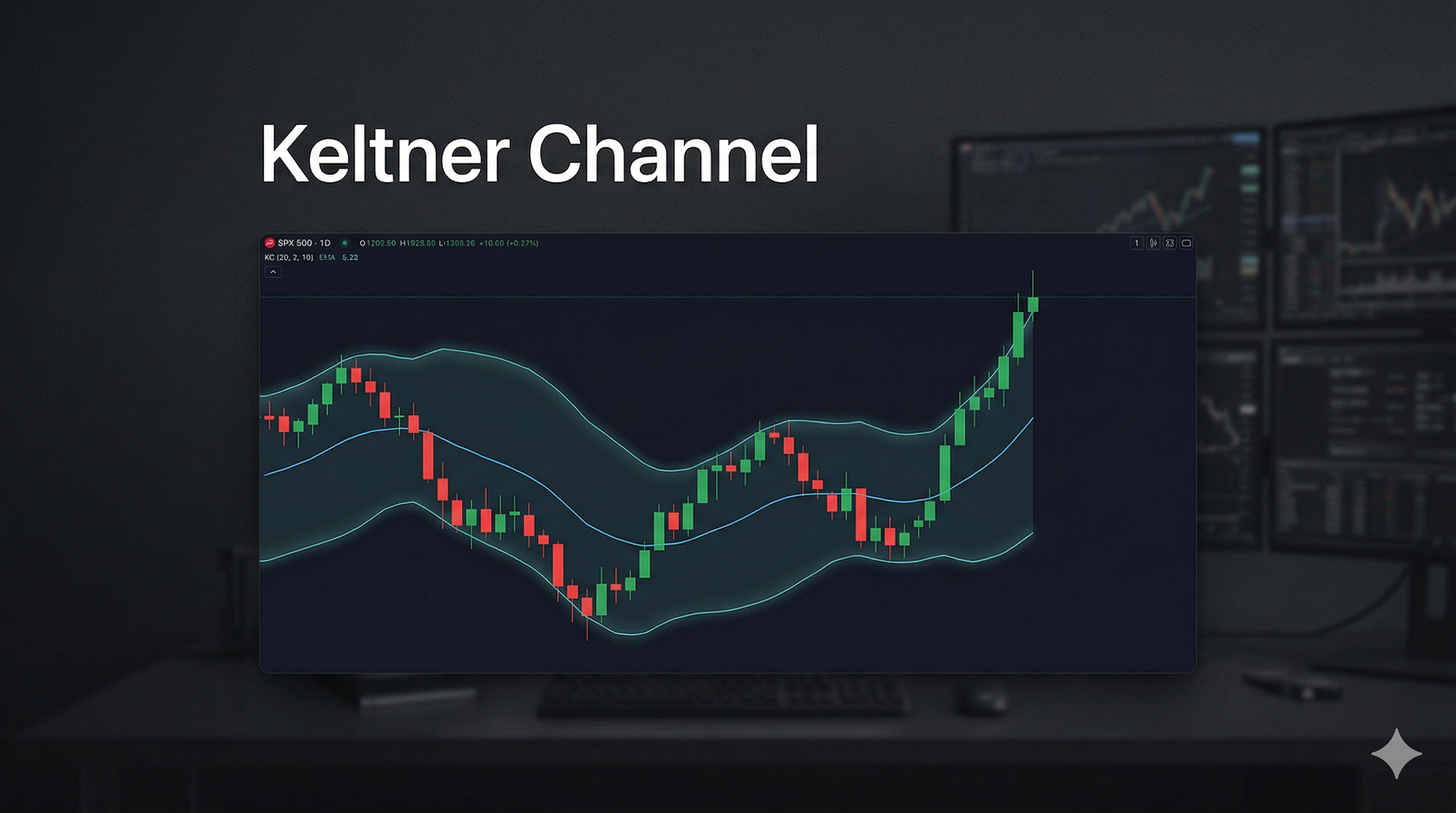
At its core, the Keltner Channel is a volatility envelope built around a moving average. The modern version most traders use today places an upper and lower band around a central moving average using Average True Range, or ATR, as the band-width input. TradingView describes it as a lagging indicator built around a moving average, with envelopes set a user-defined multiple of a range away from the middle line.
For traders, that makes it useful in three practical ways: reading trend strength, spotting pullbacks, and judging whether a breakout is happening with real volatility behind it. The key is to treat it as a context tool, not a prediction tool. Because it is based on a moving average, it reacts to price rather than forecasting it.
What the Keltner Channel actually is
The original idea goes back to Chester Keltner’s 1960 book How to Make Money in Commodities. Fidelity’s technical guide still describes the classic version as bands plotted above and below a simple moving average of average price, designed to show what a “normal” trading range looks like. TradingView notes that the concept was later expanded and simplified, most notably by Linda Bradford Raschke, who popularized the modern version using an exponential moving average and ATR-based envelopes.
That distinction matters because many traders use the same name for two slightly different versions. In practical charting today, the modern ATR-based version is usually what people mean when they say “Keltner Channel.” TradingView’s documentation describes the modern structure as a middle line built from a moving average, often an EMA, with upper and lower bands set by a multiple of ATR.
The modern formula traders usually mean
A common starting setup is straightforward:
- Middle line = 20-period EMA
- Upper band = EMA + ATR × multiplier
- Lower band = EMA — ATR × multiplier
TradingView’s support documentation says the middle line is typically a simple or exponential moving average and that Raschke popularized using an exponential moving average with ATR for the envelopes. Across charting references and common platform defaults, a 20-period EMA with a 2x ATR-style channel is widely used as the standard starting point.
That said, the settings are not sacred. Different assets and timeframes can behave differently, and TradingView notes that the envelope distance is user-defined. In other words, 20 EMA plus 2 ATR is a practical default, not a universal truth handed down from the mountain.
What the indicator is really showing
The Keltner Channel is best understood as a visual way to track price relative to recent volatility.
When the channel widens, volatility is expanding. When it tightens, volatility is contracting. When price rides the upper band, it often signals strong upward momentum. When price stays near the lower band, it can reflect sustained downward pressure. TradingView specifically notes that the main occurrences traders watch are breakthroughs above the upper envelope or below the lower envelope, and that the indicator is useful for identifying overbought, oversold, and trend-related behavior depending on context.
That last part is important. Price moving outside the channel does not always mean reversal. In a strong trend, it can mean continuation. In a range-bound market, it can behave more like extension that later snaps back toward the middle line. The same signal can mean very different things depending on the environment.
How traders actually use it
The first practical use is trend confirmation.
If price keeps pressing against or slightly outside the upper band while the middle line slopes upward, that usually tells you the trend has strength. The same logic works in reverse for a downtrend. TradingView’s guide notes that persistent interaction with the outer bands can reflect strong directional movement, not just immediate exhaustion.
The second use is pullback analysis.
In a healthy trend, traders often watch whether price pulls back toward the middle line and then resumes in the direction of the broader move. That gives the middle band a practical role as a trend-reference zone rather than just a decorative average on the chart. Because the channel adapts to volatility, those pullbacks can sometimes be cleaner to read than with a standalone moving average. This logic fits TradingView’s explanation of the indicator as a moving-average-based envelope used to interpret both trend and extension.
The third use is breakout context.
When the channel has been relatively tight and price begins to expand outside the bands with momentum, traders may read that as a volatility-backed breakout rather than a random spike. The key is not just that price left the band. It is that the move is happening after contraction, with expanding range and follow-through. Because the Keltner Channel is built around ATR, it is especially useful for seeing that shift in volatility regime.
Where traders get it wrong
The biggest mistake is treating every touch of the upper band as overbought and every touch of the lower band as oversold.
That sounds neat, but markets are rarely that obedient. TradingView’s documentation makes clear that a breakout above the upper envelope can signal overbought conditions, but it can also reflect strong bullish momentum. The same is true on the downside. Without context, traders end up fighting trends just because price looks extended on the indicator.
The second mistake is forgetting that the Keltner Channel is lagging. Since the whole structure is built around a moving average, it reacts after price has already moved. That means it can help organize what price is doing, but it will not warn you in advance like some mythical fortune-teller in a candlestick robe.
The third mistake is copying default settings blindly. Fidelity’s classic description and TradingView’s modern explanation show that even the indicator’s definition has evolved over time. So it makes no sense to assume one exact setup works equally well on every instrument and timeframe. Traders should start with common settings, then test and adjust based on the asset they trade.
Keltner Channel vs. simpler volatility reading
What makes the Keltner Channel useful is that it combines trend and volatility in one structure.
A plain moving average shows direction but not much about the volatility context around that direction. A raw ATR reading shows volatility but not where price sits relative to a trend-reference line. The Keltner Channel combines both ideas, which is why it can be more practical for reading breakouts and pullbacks than looking at those tools separately. TradingView explicitly frames it as a banded indicator similar to Bollinger Bands and moving-average envelopes, but with range-based envelopes built around a moving average.
That does not make it better than every other tool. It just makes it useful for a specific job: helping traders judge whether price is moving with controlled trend pressure, volatility expansion, or unstable extension.
The bigger takeaway
The Keltner Channel is not complicated once you strip away the jargon.
It is a volatility-aware trend envelope. In the modern version, it uses an EMA in the middle and ATR-based bands above and below. That makes it useful for reading momentum, judging pullbacks, and spotting when a breakout may have real pressure behind it. But like any moving-average-based tool, it works best when traders use it for context instead of prediction.
The real edge is not in memorizing the formula. It is in understanding what the indicator is trying to show you: whether price is moving with the trend, stretching away from it, or shifting into a new volatility phase.
Follow Otet Markets for practical market insights, trading education, and macro analysis.