
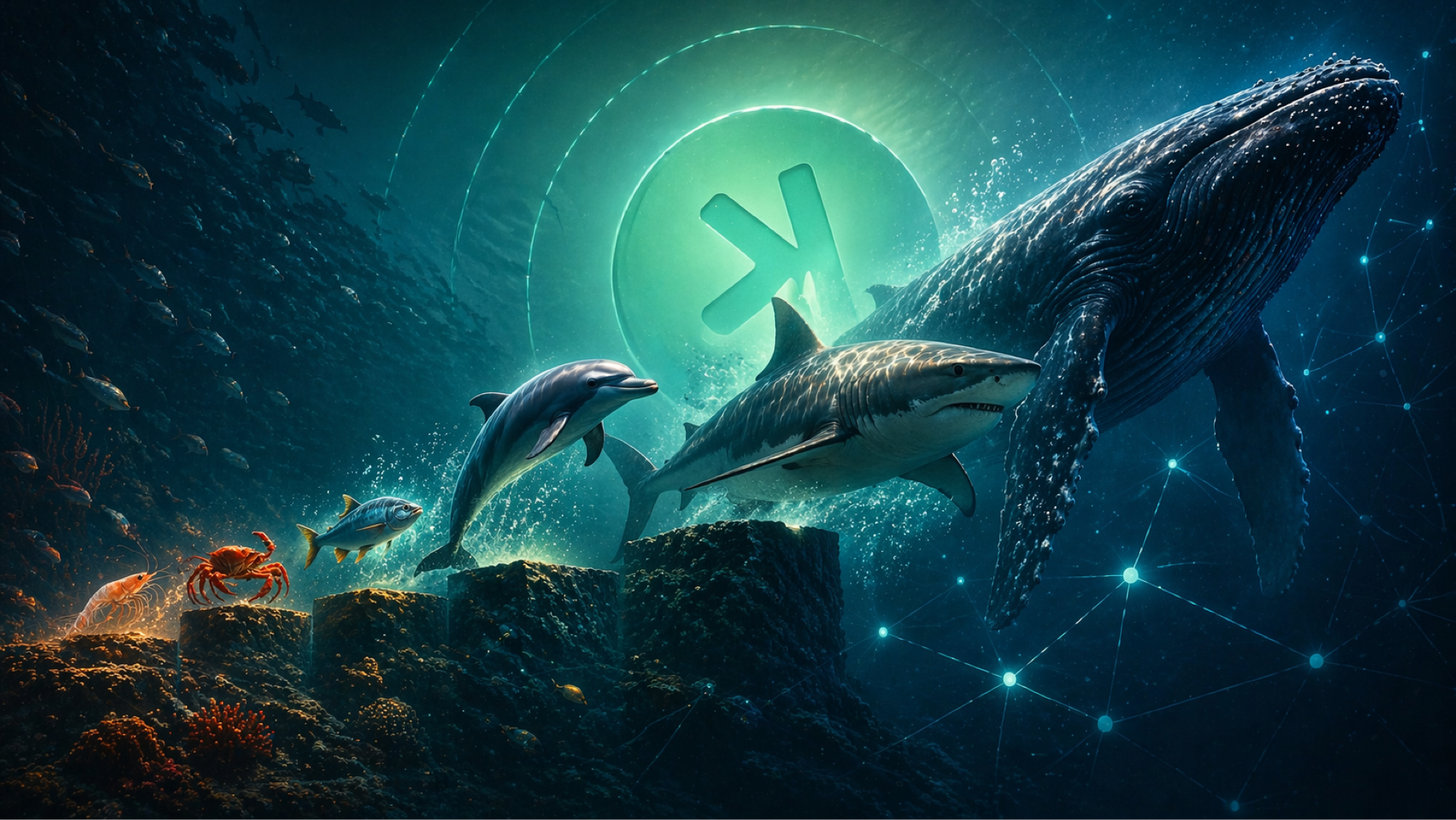
Kaspa’s Hidden Hierarchy: From Shrimp to Whale 🐋
 James Allan6 min read·Just now
--
Like any community, Kaspa has its own hidden social layers and hierarchies. I’ve already explored how KNS introduces elements like identity, branding, and culture — but beneath all of that lies a simpler, more primal force: wallet size.
Within the community, terms like “whale” get thrown around to describe those with significant holdings. But below the whales exists an entire, often overlooked ecosystem of smaller players — an intricate web of participants that rarely gets the same attention.
This article is an homage to that full spectrum, from plankton to whale. We’ll break down what defines each tier and the roles they play in shaping the broader Kaspa ecosystem.
🍤 Shrimp
< 1,000 KAS
Shrimps are members holding less than a thousand KAS. This layer includes faucet users, test wallets, and long-forgotten balances drifting through the network. On an individual level, plankton carry little economic weight — but collectively, they represent something far more important: the constant emergence of new possibilities. They are the earliest signals of growth, the first traces of future participants, and the raw potential from which the rest of the ecosystem evolves.
🦀 Crab
1K — 10K KAS
Crabs are members holding between one and ten thousand KAS. They represent the entry-level cohort — new users finding their footing within the community. These are the casual buyers in an active learning phase, steadily building conviction.
Crabs spend their time researching Kaspa: digging into the team, understanding the tokenomics, studying past price action, and forming their own views on the network’s future. They may not move markets, but they are engaged, curious, and gradually transitioning from passive observers to informed participants.
🐙 Octopus
10K — 100K KAS
Octopus are members holding between ten and one hundred thousand KAS. This is the first tier that crosses an important psychological threshold: “I care about this project.” They are still relatively small holders, but their position is intentional, and their mindset is long term.
Octopus play a critical role in the ecosystem. Their growing conviction drives them to actively evangelize Kaspa — not just to attract others, but to reinforce their own beliefs. Having only recently graduated from the crab stage, their knowledge is fresh, their enthusiasm is high, and their explanations are relatable. In many ways, they are the most effective ambassadors of the network, spreading the message with both credibility and urgency.
🐟 Fish
100K — 1M KAS
Fish are members holding between one hundred thousand and one million KAS. These are serious retail players building meaningful positions. Fish are also the first group truly exposed to the emotional and financial weight of price movement. Fluctuations are no longer abstract; they matter. This exposure begins to shape behavior, discipline, and conviction in a deeper way.
Within the ecosystem, fish serve as a stabilizing middle layer. They provide a sense of assurance to crabs, signaling that there is real capital committed beyond the entry tiers. At the same time, they act as a kind of structural glue — helping form a base of support that whales ultimately rely on. Without fish, the ecosystem would lack both depth and resilience.
🐬 Dolphin
1M — 10M KAS
Dolphins are members holding between one and ten million KAS. This tier is typically composed of miners and early investors — participants whose involvement goes beyond belief and into direct influence.
Dolphins are high-conviction actors and often among the earliest adopters within the ecosystem. Their behavior begins to register in a meaningful way on-chain. Miners in this group quite literally support the network’s foundation through hash power, while early adopters tend to shape the narrative around it.
In the latter case, many dolphins function as informal influencers. Their perspectives, actions, and public positioning can sway sentiment and guide the behavior of smaller holders. At this level, participation is no longer just personal — it becomes directional, helping steer both perception and activity across the broader Kaspa ecosystem.
🦈 Shark
10M — 100M KAS
Sharks are members holding between ten and one hundred million KAS. At this level, participants are recognized as large holders — individuals whose actions can influence liquidity and even trigger short-term price movements.
Sharks are the first tier that begins to act as a visible signal to the market. While their movements don’t carry the same weight as true whales, they are still noticed and often interpreted as indicators of shifting sentiment. In that sense, sharks can be thought of as entry-level whales — large enough to matter, but not yet dominant.
They also serve a quieter but important role: legitimacy. Reaching shark status requires a substantial financial commitment, placing these individuals among the wealthier members of the community. And, as in many social systems, the presence of capital at the top acts as a form of validation — signaling to others that the ecosystem is worth taking seriously.
🐋 Whale
100M+ KAS
Whales are members holding more than one hundred million KAS. They sit at the top of the ecosystem, carrying significant influence over both sentiment and price action. Many are insiders, early miners, or funds — the original participants who accumulated before broader awareness took hold. They are the OGs of the network.
When a whale moves, the market pays attention. Their transactions don’t go unnoticed — they spark speculation, narratives, and often ripple effects across every lower tier. Unlike sharks, whales are pure signal.
This becomes especially clear during periods of volatility. In shakeouts, all eyes turn to whale behavior. If they hold, confidence stabilizes. If they sell, uncertainty can quickly cascade into panic. That dynamic gives whales an outsized, almost fiduciary role within the ecosystem.
In many ways, whales are not just participants — they are pillars. Their decisions underpin the structure of price action, anchoring both the floor and the psychology of the entire Kaspa market.
It’s important to remember that these labels are social shorthand — not protocol-defined categories. They don’t exist on-chain, nor do they carry any formal authority. Instead, they help us orient ourselves within the community and develop an intuition for the range and scale of participants in the ecosystem.
At the same time, this framing serves a deeper purpose. By thinking in terms of distribution — who holds what — we gain a clearer lens into how power is concentrated across the network. It allows us to move beyond anecdotes and begin forming a more grounded understanding of influence, decentralization, and the structural balance of the Kaspa ecosystem.
Now let’s zoom out to the bigger picture. There is a total supply of 28.7 billion KAS distributed across roughly 528,000 wallet addresses. Of that, the top 100 wallets alone control about 35.5% of the supply. The largest wallet holds over 1 billion KAS, while the 100th wallet holds just 24 million. That last detail is critical.
If rank #100 only holds 24 million KAS, it tells us that true “whale” status is far more exclusive than the term is casually used to imply. The drop-off in holdings is steep, meaning only a very narrow slice at the top commands truly outsized positions.
From this distribution, it’s reasonable to infer that only the top 20 wallets qualify as whales in the strictest sense. That’s <0.01% of all addresses. Beyond that point, balances fall into the “shark” range — still significant, but no longer dominant enough to independently shape the broader market.
This reinforces a key insight: influence in the Kaspa ecosystem is highly concentrated, but not as widespread as the surface-level language might suggest. Thankfully, since Kaspa is not Proof of Stake, large holders don’t control consensus directly. Mining power matters more than coin balance.
The uneven wealth distribution in Kaspa is not an anomaly — it’s a textbook example of the Pareto principle in action. In most systems, a small percentage of participants naturally end up holding a large share of the resources, and Kaspa is no exception. But distribution of wealth is not the same as control.
Even though a significant portion of KAS sits within a relatively small number of wallets, that does not translate into centralized authority over the network. Many of these large wallets belong to exchanges, custodial services, or funds — structures where ownership is fragmented across thousands of users rather than concentrated in a single actor. In other words, the appearance of concentration at the wallet level can mask a much broader distribution at the human level.
The key takeaway is this: while capital may cluster, control remains decentralized. Kaspa’s security and governance are not dictated by who holds the most coins, but by the underlying mechanics of the network itself. So despite the presence of whales at the top, the system remains grounded in a broader base. In that sense, Kaspa is still very much in the hands of the people