ITL — The Asset That Moves an Economy
How Real-World Usage Generates Liquidity in the InterLink Architecture
 Done.T Insight5 min read·1 hour ago
--
🔙 Part 1 explained why ITL supply expands slowly — and why that constraint is structural rather than accidental.
ITL — The Asset That Cannot Be Unlocked
Why InterLink Designed ITL as a Treasury / Reserve Asset First
medium.com
But supply control alone does not create a functioning economy. A reserve asset that never circulates is not an economy. It is a vault.
Circulation is what transforms a constrained asset into something with ongoing economic presence. This is where InterLink introduces its second structural layer.
Unlike most crypto assets, ITL is not designed to live exclusively inside exchange order books.
It is designed to move through real economic activity — and that movement is what generates the circulation that trading volume alone cannot sustain.
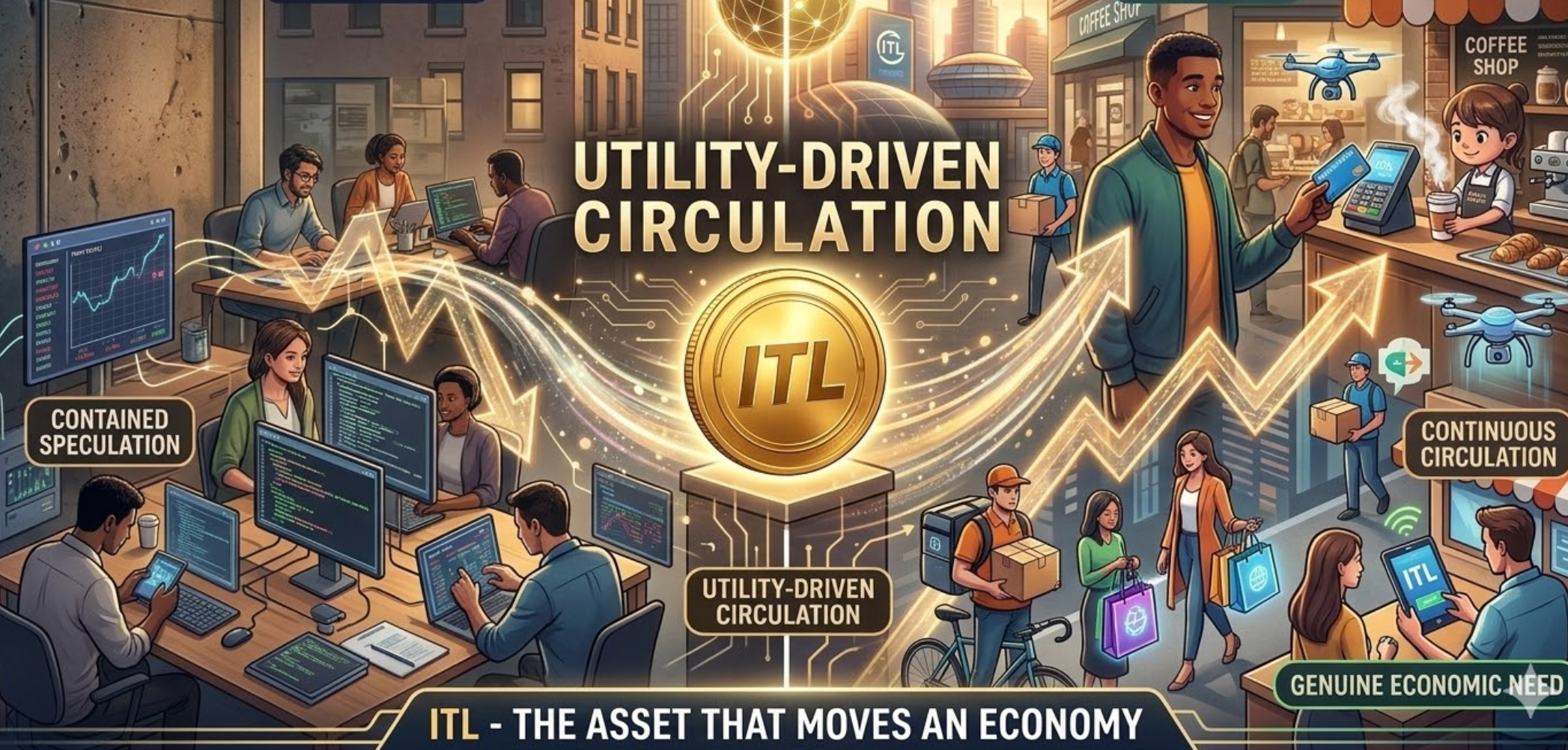
how real-world usage drives ITL circulation.
♻️ The Basic Circulation Path
Within the InterLink ecosystem, ITL moves through a repeating cycle.
Verified ITLG holders convert into ITL. Some hold. Some trade. Some spend. Merchants and service providers receive ITL through payments.
A portion of that returns to markets through operational needs. The rest is retained — as treasury assets, as ecosystem liquidity, as working capital.
What this means structurally is that exchanges are not the center of the system. They are intermediate hubs.
The actual circulation engine runs through economic activity happening outside of trading venues.
⚙️ Why ITL Is Designed Differently
Most crypto payment tokens follow a predictable and self-defeating pattern.
A user pays with the token. The merchant receives it. The merchant immediately sells it — because they have no reason to hold a volatile asset they cannot use for operations.
The cycle repeats with every transaction, generating continuous downward sell pressure.
This structural problem is one of the primary reasons payment-focused tokens have struggled to maintain price stability despite genuine user adoption.
InterLink attempts to break that cycle at the merchant level.
Businesses receiving ITL are not forced into immediate liquidation.
They can convert a portion for operational expenses, retain a portion as treasury assets, or continue using ITL within the ecosystem.
The result is that sell pressure from merchant activity becomes selective rather than automatic.
Not every payment generates a corresponding sell order.
And that asymmetry matters for price behavior over time.
💱 Consumption as a Liquidity Engine
Traditional financial systems generate liquidity through markets — through trading, lending, and capital flows between institutions.
The InterLink model introduces a parallel source. Everyday economic activity.
When someone pays for coffee, a service, or a digital product using ITL, that transaction does two things simultaneously.
It creates demand for ITL at the point of purchase. And it puts ITL into the hands of a merchant who must then make a decision — hold, spend within the ecosystem, or convert.
That decision point, repeated across thousands of daily transactions, is what transforms consumption into a liquidity mechanism.
Each transaction is not the end of a circulation cycle. It is the beginning of the next one.
Because consumption occurs continuously rather than episodically, the circulation pressure it generates is also continuous.
This is fundamentally different from the liquidity dynamics of a token that lives only inside exchanges, where volume is driven by trader sentiment rather than underlying economic need.
It is generated by economic activity.
💳 The Role of Payment Infrastructure
InterLink has referenced a target of 10,000 payment points as part of its ecosystem infrastructure vision — alongside Interlink Visa Cards, ITLX DeFi integration, and AML-compliant payment rails designed for enterprise adoption.
This signals something important about where circulation is expected to originate.
Liquidity is not planned to come primarily from exchange market-making or token emissions. It is expected to emerge from a payment network operating across real economic contexts — retail, services, cross-border transactions, and enterprise settlement.
If that infrastructure reaches its intended scale, the source of ITL’s liquidity shifts from speculative trading to utility-driven circulation.
And that shift is structurally significant, because utility demand is less sensitive to market sentiment than trading demand.
It does not disappear when prices fall.
It persists because the underlying economic need persists.
💡 Done.T Insight
In the InterLink architecture, liquidity is not injected. It is generated by usage.
🏁 Series Conclusion
The original question — won’t limited supply create a liquidity problem? — is a reasonable one.
But it is a question asked from inside a trading-first framework.
InterLink’s architecture operates from a different starting point.
From a treasury perspective, the supply model removes the insider distribution risk that makes most crypto assets unsuitable for reserve use.
From a circulation perspective, real economic activity generates ongoing demand that does not depend on exchange volume.
These two forces are not separate features.
They are designed to interact.
Supply discipline keeps the asset structurally scarce. Economic circulation keeps it moving.
And the interaction between those two dynamics is what determines how ITL actually behaves over time — not market management, not artificial pegs, not token emissions.
A token economy does not stabilize because markets manage it.
It stabilizes when its architecture removes the need for management.
If you’d like to support my research, you may use my Interlink invitation code below(optional). It also unlocks an instant mining boost ✚︎ Welcome Bonus for new users.
Interlink Invitation Code: 905079415
Wallet Invitation Code : HSVZZPEJ (75% Commission Rebate)
🔎 Search “Done.T InterLink” on Google for real data & analysis.
❓ New to Interlink?
Interlink Starter Guide: Set Up, Verify Your Identity, and Start Mining in Under 10 Minutes
From “No-ID” Sign Up to Security Circles: How to position yourself correctly in the 4M+ Human-Centric Economy.
medium.com
ITLX Wallet Setup Guide: Unlock HCS, US Stocks & Pro Trading (+0.2 Bonus) 🚀
Your gateway to a Non-Custodial DEX: Mine, Trade, and Own Real Assets without KYC.
medium.com
📚 Done.T’s Related Insights
Is It Too Late to Join InterLink? Here’s What the Numbers Actually Say
Before the majority arrives, the design is already in place.
medium.com
You Can’t Build a Reserve Asset on Borrowed Infrastructure
Is Layer 2 a Permanent Structure — or a Transitional Optimization?
medium.com
🔗 Access Full Thesis
[Chapter 2. The Deep Dive — Mechanics & Insights]
(Disclosure: This post contains referral link. It supports my research at no cost to you)