
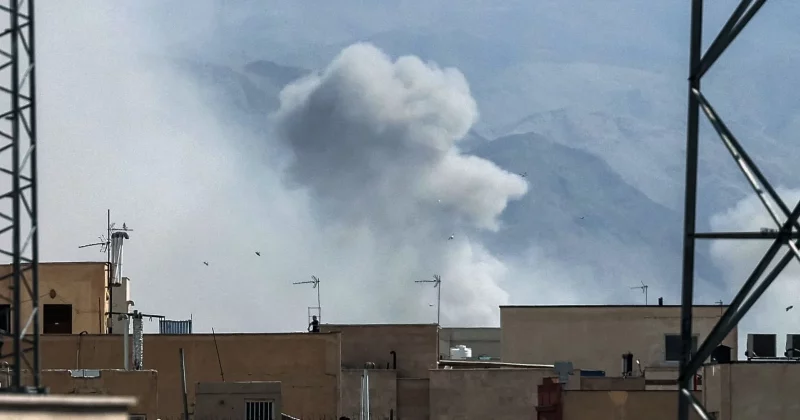
Israeli military strikes Iranian regime targets as crypto markets brace for volatility
The Israeli Air Force hit military sites across western and central Iran on June 8, sending Bitcoin sliding toward $104K as geopolitical risk reprices across digital assets.
Share
Add us on Google by Editorial Team Jun. 8, 2026Israel launched airstrikes against Iranian military targets in western and central Iran on June 8, 2026, marking the first direct military action against Iranian soil since the two nations observed an April 8 ceasefire. The strikes came less than 24 hours after Iran fired ballistic missiles at northern Israel, specifically targeting the Ramat David Airbase on June 7.
Bitcoin dropped to the $103,900 to $104K range as the news broke.
What happened and why it matters
The Israeli Air Force used air-launched ballistic missiles to strike targets across two geographic zones in Iran. The operation targeted military installations belonging to the Iranian regime, though specific facility names have not been disclosed.
AdvertisementOn February 28, Israel and the United States jointly conducted dual operations, codenamed Operation Roaring Lion and Operation Epic Fury, which hit key Iranian military and nuclear facilities. The April 8 ceasefire was supposed to cool things down. It lasted exactly two months.
Iran’s decision to launch ballistic missiles at the Ramat David Airbase on June 7 effectively shattered any remaining diplomatic framework. The suspected involvement of the Islamic Revolutionary Guard Corps (IRGC) in coordinating these provocations adds another layer of complexity to an already volatile situation.
Crypto markets feel the shockwave
Bitcoin’s slide to the $103,900–$104K zone mirrors the risk-off behavior observed during earlier Israel-Iran flare-ups in 2025 and 2026. Ethereum experienced similar declines, though specific price levels were not immediately available.
Outflows from Iranian cryptocurrency exchanges surged by over $2M within an hour of earlier conflict escalations in the 2026 cycle, according to Chainalysis data. Over one particularly tense weekend during the February operations, $10.3M reportedly left Iranian crypto exchanges entirely.
These outflow patterns suggest that for Iranian citizens, crypto is functioning as an escape hatch from a financial system that could face further sanctions, freezes, or disruptions at any moment.
What this means for investors
The correlation between Middle Eastern military escalation and crypto sell-offs has been one of the most consistent patterns in digital asset markets over the past 18 months. Every major Israel-Iran incident since 2025 has produced a measurable dip in Bitcoin and Ethereum prices, followed by recovery windows of varying length.
The February strikes involved US participation. The April ceasefire suggested diplomatic channels still existed. Both of those stabilizing factors are now in question. The pattern of capital flight from Iranian exchanges, with $10.3M leaving over a single weekend during the February escalation, points to something more structural: regional instability reshapes liquidity flows, exchange volumes, and the geographic distribution of crypto holdings.
Disclosure: This article was edited by Editorial Team. For more information on how we create and review content, see our Editorial Policy.