ISO 27001: The Business Survival Framework Most Companies Ignore Until It’s Too Late
How ISO 27001 Helps Businesses Prevent Data Breaches, Build Trust, and Grow with Confidence
 Sara Taylor4 min read·1 hour ago
--
A few years ago, a rapidly growing technology company seemed unstoppable. New customers were signing up every day, revenue was increasing month after month, and investors were showing interest. The future looked bright.
Then one morning, everything changed.
The company discovered that sensitive customer information had been compromised. Within hours, clients were demanding answers, social media was filled with criticism, and business partners began questioning whether they could continue working together. What had taken years to build started unraveling in a matter of days.
Unfortunately, this story is not unique. Businesses of all sizes are facing an increasing number of cyber threats. Data breaches, ransomware attacks, phishing scams, and insider threats have become common headlines. While many organizations assume these incidents only happen to large corporations, small and medium-sized businesses are often the most vulnerable because they lack structured security practices.
This is where ISO 27001 comes into the picture.
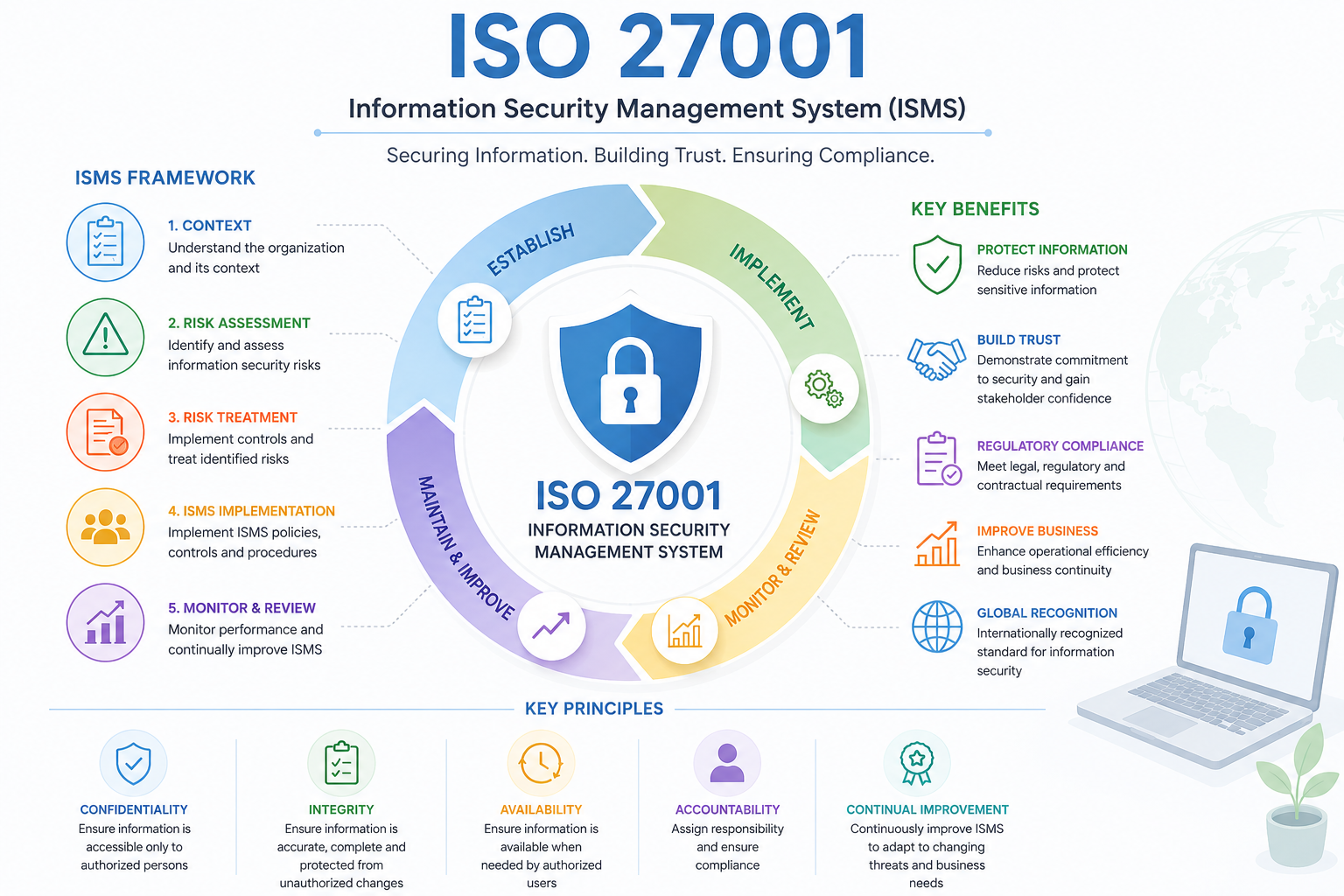
Many people think ISO 27001 is simply another certification or compliance requirement. In reality, it is much more than that. It is a globally recognized framework designed to help organizations identify risks, protect sensitive information, and create a culture of security that supports long-term growth. Rather than reacting to security incidents after they happen, ISO 27001 helps businesses prevent them before they occur.
One of the biggest challenges organizations face today is not knowing where their security risks actually exist. Companies often store sensitive information across multiple systems, departments, and third-party platforms without fully understanding who has access to it or how well it is protected. This lack of visibility creates significant risk. ISO 27001 addresses this problem by requiring businesses to conduct structured risk assessments, identify vulnerabilities, and implement controls that reduce potential threats. Instead of relying on assumptions, organizations gain a clear understanding of their security posture.
Trust is another area where ISO 27001 delivers tremendous value. In today’s digital economy, trust has become one of the most important factors influencing customer decisions. People are sharing personal information, payment details, business documents, and confidential data with organizations every day. They want reassurance that their information is being handled responsibly. Achieving ISO 27001 certification demonstrates that a company follows internationally recognized best practices for information security. It sends a strong message to customers, partners, and investors that security is a priority rather than an afterthought.
Beyond customer trust, businesses are also facing increasing pressure from regulators. Data protection laws such as GDPR and industry standards like PCI DSS have made compliance more complex than ever before. Many organizations struggle to keep up with evolving requirements, often treating compliance as a series of disconnected tasks. ISO 27001 helps create a structured approach to governance and risk management, making it easier to align security practices with regulatory expectations. While it may not automatically satisfy every compliance requirement, it provides a strong foundation that significantly simplifies the process.
Interestingly, technology is not always the biggest security challenge within an organization. Human error continues to be one of the leading causes of data breaches. Employees may click on phishing emails, use weak passwords, share sensitive information unintentionally, or fail to follow security procedures. ISO 27001 recognizes that effective security requires more than technology alone. It encourages organizations to educate employees, establish clear policies, and build awareness programs that make security a shared responsibility across the business. When employees understand their role in protecting information, the entire organization becomes stronger.
As businesses grow, maintaining security becomes even more difficult. New employees join the company, additional systems are introduced, partnerships expand, and customer data volumes increase. Without proper controls, growth can create vulnerabilities that are difficult to manage. ISO 27001 provides a scalable framework that grows alongside the organization. Whether a company has twenty employees or two thousand, the same principles can be applied to maintain consistency, accountability, and security.
What often surprises business leaders is that the benefits of ISO 27001 extend far beyond cybersecurity. Organizations frequently report improvements in operational efficiency because processes become more clearly documented and responsibilities are better defined. Enterprise sales teams often find it easier to close deals because prospective clients view certification as evidence of maturity and reliability. Investors gain confidence knowing that risks are being managed systematically, and leadership teams benefit from greater visibility into potential threats before they become costly problems.
In many ways, ISO 27001 has evolved from being a security initiative into a business strategy. It enables organizations to reduce risk, improve resilience, strengthen customer relationships, and support sustainable growth. In an environment where a single security incident can damage years of hard-earned reputation, having a structured approach to information security is no longer optional.
The reality is simple: every modern business depends on information. Whether it is customer data, financial records, intellectual property, or operational insights, information is one of the most valuable assets an organization possesses. Protecting that information is not just an IT responsibility; it is a business responsibility.
Companies that invest in security before a crisis occurs position themselves for long-term success. Those that wait until after an incident often discover that recovery is far more expensive than prevention.
ISO 27001 provides organizations with a roadmap for navigating an increasingly complex digital world. It helps businesses identify risks, build trust, improve compliance, and create a foundation for secure growth. Most importantly, it transforms information security from a reactive function into a strategic advantage.
As cyber threats continue to evolve, one question remains: Is your business prepared for tomorrow’s challenges, or are you still relying on luck?
Because when it comes to information security, prevention will always be cheaper than recovery.