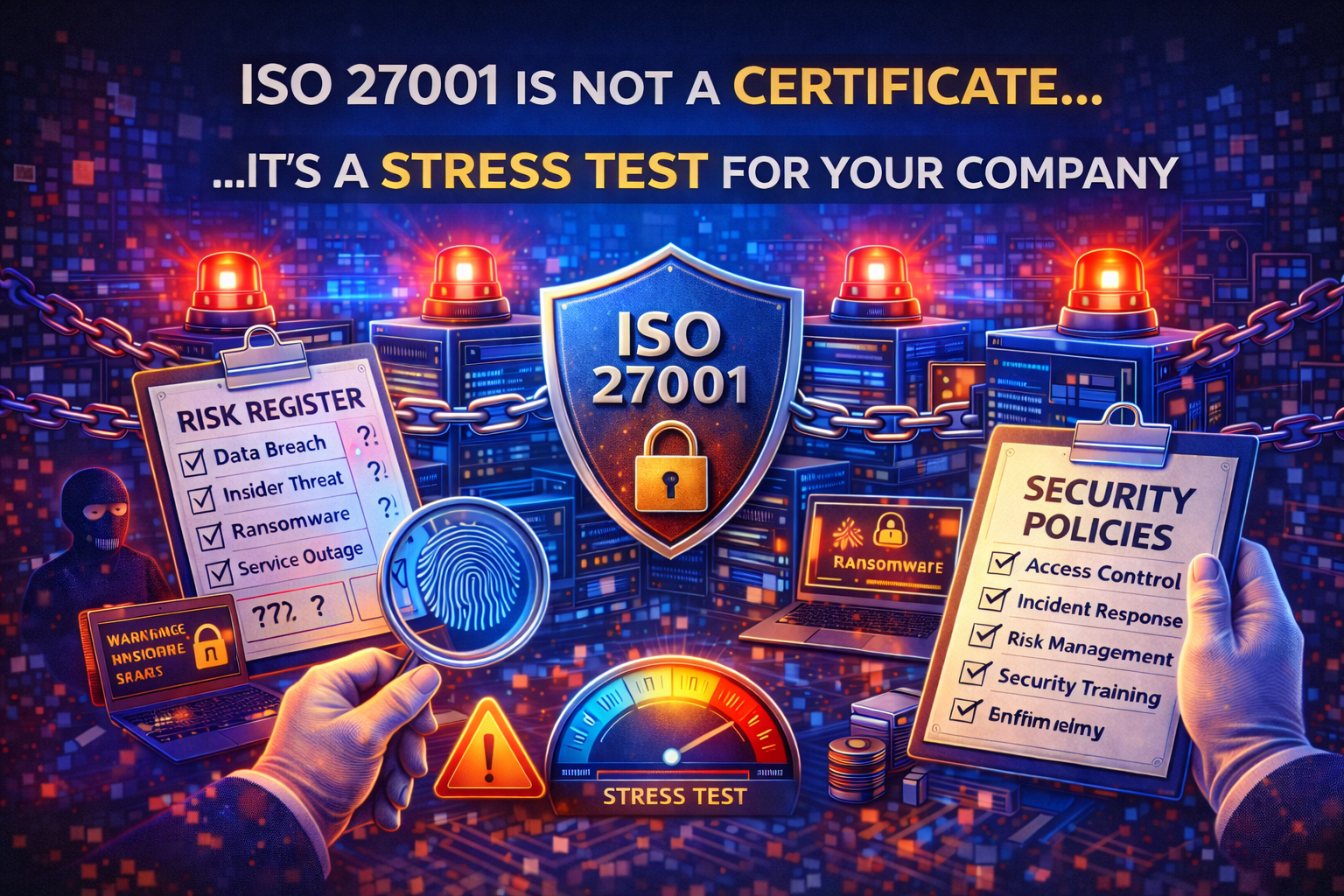
ISO 27001 Is Not a Certificate. It’s a Stress Test for Your Company.
Most founders first hear about ISO 27001 during a sales conversation.
 Fintech By Tanu4 min read·Just now
--
An enterprise prospect asks casually:
“Are you ISO 27001 certified?”
And suddenly, it feels urgent.
You start researching.
You see timelines.
You see auditors.
You see documentation requirements.
It looks like a badge you need to unlock bigger deals.
But ISO 27001 isn’t a badge.
It’s a stress test.
And what it tests isn’t your product.
It tests your discipline.
The Illusion of “We’re Secure Enough”
Early-stage fintech and SaaS companies often believe they’re secure.
They use reputable cloud providers.
They encrypt databases.
They enforce basic access controls.
Technically, they’re not careless.
But ISO 27001 doesn’t just ask:
“Do you have security tools?”
It asks:
- Is security documented?
- Is risk formally assessed?
- Are responsibilities assigned?
- Are reviews conducted regularly?
- Are incidents tracked and learned from?
Security maturity isn’t about having controls.
It’s about proving how you manage them.
The First Internal Gap
When teams begin ISO 27001 preparation, something uncomfortable happens.
They discover:
- Access permissions granted long ago and never reviewed.
- Informal change processes.
- Incident response plans that live only in Slack.
- No structured risk register.
- Policies written reactively, not proactively.
Nothing feels broken.
But nothing feels structured either.
ISO 27001 exposes that difference.
A Pause for Founders and CTOs
If you’re building fintech or SaaS today, ask yourself honestly:
If a major security incident happened tomorrow, would your team respond through defined process or improvisation?
Improvisation works when teams are small.
But improvisation doesn’t scale.
ISO 27001 forces companies to replace tribal knowledge with institutional systems.
That’s uncomfortable.
But necessary.
Risk Is the Core of ISO 27001
At the heart of ISO 27001 is risk management.
You must:
- Identify risks.
- Evaluate likelihood and impact.
- Decide how to treat them.
- Document the decision.
- Review them regularly.
This changes thinking.
Security stops being reactive.
It becomes anticipatory.
Instead of waiting for something to break, you ask:
Where are we exposed?
And what are we doing about it?
That shift is cultural.
Policies Are Not Paperwork
Many founders initially see ISO documentation as bureaucracy.
Policies feel abstract.
Access control policy.
Incident response policy.
Asset management policy.
Business continuity policy.
But policies serve a purpose:
They define how decisions are made consistently.
Without documentation, processes depend on individuals.
With documentation, processes survive turnover.
ISO 27001 isn’t about writing documents.
It’s about operational continuity.
The Human Layer
Security isn’t purely technical.
ISO 27001 addresses people as much as systems.
- Background checks
- Employee training
- Defined onboarding and offboarding
- Role-based access
- Separation of duties
Many breaches happen because of human oversight.
ISO treats humans as part of the system.
That’s realistic.
Enterprise Trust and Procurement
In fintech especially, enterprise clients care deeply about security posture.
They ask for:
- Security certifications
- Risk management evidence
- Audit reports
- Data protection measures
ISO 27001 simplifies those conversations.
It signals:
“This company has structured security governance.”
It reduces procurement friction.
It shortens trust-building cycles.
In competitive markets, that matters.
The Discipline of Change Management
One underestimated part of ISO 27001 is change management.
Every change to systems should be:
- Planned
- Reviewed
- Tested
- Approved
- Documented
For fast-moving startups, this feels restrictive.
But uncontrolled change is one of the biggest sources of outages and vulnerabilities.
ISO introduces thoughtful friction.
Not to slow growth but to stabilize it.
Certification Is Not the Finish Line
A dangerous misconception:
“Once certified, we’re secure.”
ISO 27001 requires ongoing surveillance audits.
Controls must remain active.
Risks must be reassessed.
Processes must evolve.
Certification is a milestone.
Security is a posture.
The Cultural Shift
The real transformation ISO 27001 creates is internal.
Security stops being “the IT team’s responsibility.”
It becomes shared accountability.
Product considers data sensitivity earlier.
Engineering restricts access intentionally.
Leadership discusses risk strategically.
ISO 27001 embeds security into daily thinking.
And embedded thinking scales better than reactive patching.
The Hidden Benefit
Founders often approach ISO 27001 reluctantly.
But many discover unexpected clarity.
You gain:
- Clear asset inventory
- Defined ownership
- Structured incident handling
- Better vendor risk awareness
- Cleaner documentation
Clarity reduces chaos.
And chaos is expensive at scale.
The Real Question
ISO 27001 doesn’t ask:
“Are you secure?”
It asks:
“Can you demonstrate how you manage security consistently?”
That distinction matters.
Security without structure is fragile.
Structure without security is useless.
ISO aligns both.
Closing Thought
ISO 27001 is not about impressing customers.
It’s about building a company that doesn’t rely on luck.
It replaces informal processes with resilient systems.
It introduces discipline where improvisation once ruled.
And in fintech and SaaS, discipline is competitive advantage.
If this reflection helped you think differently about ISO 27001, feel free to clap so other builders can discover it.
And I’d genuinely love to hear:
What surprised you most during your ISO 27001 journey?
Because real operational maturity often begins where comfort ends.