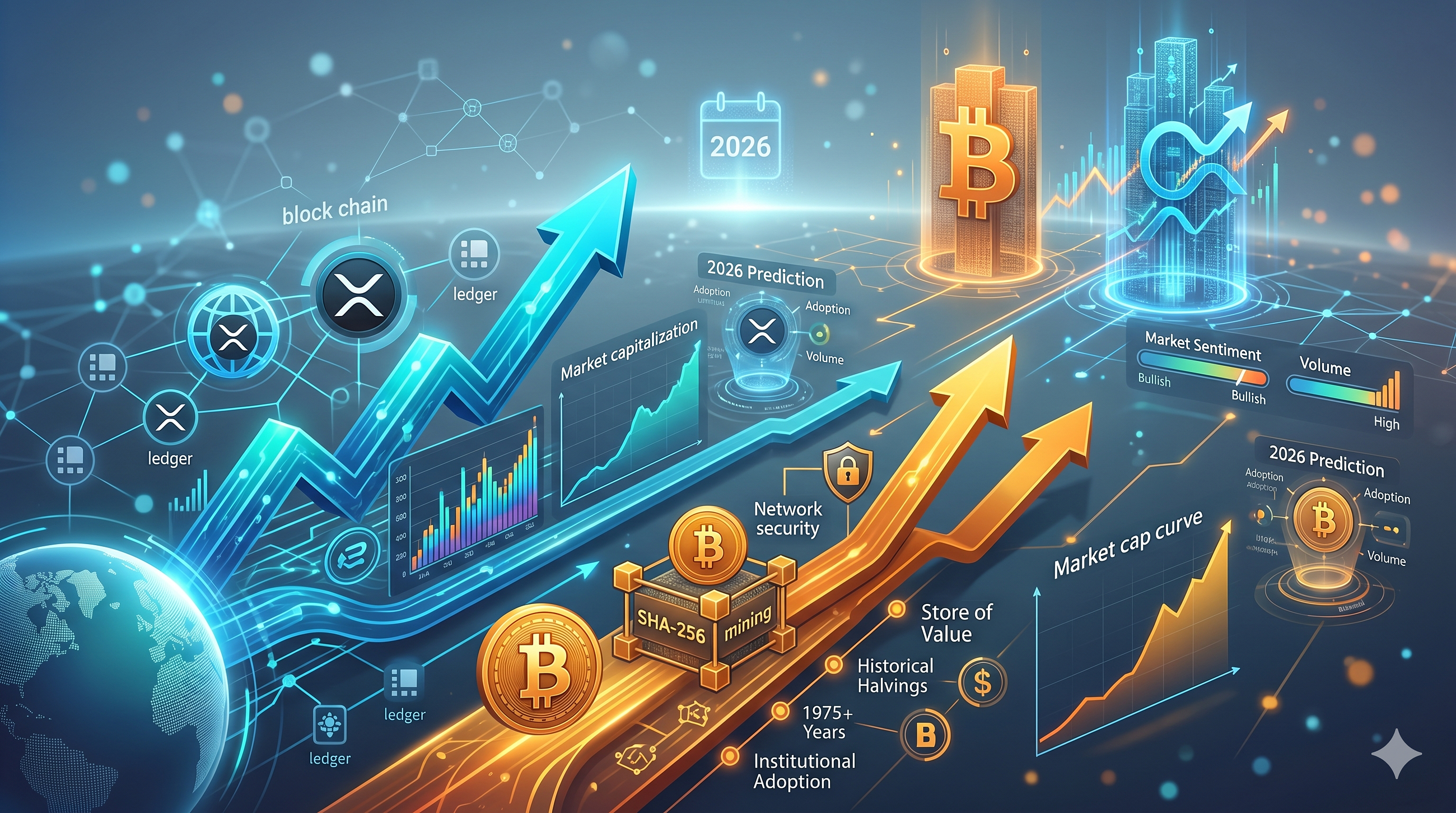
Is XRP the Next Bitcoin? A 2026 Cryptocurrency Market Analysis
--
The cryptocurrency landscape in 2026 presents a fascinating dichotomy: Bitcoin (BTC) maintains its throne as the undisputed market leader with a market cap consistently above $1.5 trillion, while XRP (Ripple) has emerged from years of regulatory purgatory to reclaim its position as the fourth-largest digital asset by market capitalization . As investors search for the next generational opportunity, the question on everyone’s mind is whether XRP could replicate — or even surpass — Bitcoin’s historic trajectory.
The Current State of Play: XRP vs. Bitcoin in April 2026
As of mid-April 2026, XRP trades at approximately $1.42, representing a market cap of roughly $87.7 billion with a circulating supply of 61.57 billion tokens . Bitcoin, by contrast, hovers near $75,000, maintaining its dominance at approximately 59% of total crypto market capitalization — a threshold that historically precedes significant altcoin rotations .
The asymmetry in market cap creates an intriguing value proposition. With XRP’s $88 billion valuation, a $500 million institutional allocation could theoretically move the price 5–10%, whereas the same capital injection into Bitcoin’s $2 trillion market would barely register at 0.5% . This mathematical reality underpins the “asymmetric upside” thesis that has attracted speculative capital to XRP throughout 2026.
The Legal Overhang Is Gone: Why 2026 Is Different
The most consequential development for XRP’s 2026 narrative is the complete resolution of its SEC entanglement. The lawsuit, which began in December 2020 and concluded in August 2025 with a $50 million settlement, officially ended years of paralyzing uncertainty . On March 17, 2026, the SEC and CFTC jointly issued formal guidance classifying XRP as a digital commodity — a watershed moment that reopened U.S. exchange access and legitimized ETF products .
This regulatory clarity arrived at a critical juncture. XRP had plummeted 61% from its July 2025 peak of $3.65 to the $1.40 range, driven not by legal fears but by macro headwinds, ETF underperformance, and geopolitical risk . The March commodity classification triggered a 20% single-day spike to $1.60, but without sustained catalysts, the price retreated. What makes April 2026 different is the convergence of multiple demand drivers.
Catalysts Driving XRP’s 2026 Trajectory
1. The CLARITY Act: Make-or-Break Legislation
The single most important near-term catalyst is the CLARITY Act, targeted for Senate Banking Committee markup in late April 2026 . This legislation would permanently codify XRP’s commodity status into federal law, eliminating the jurisdictional ambiguity between SEC and CFTC oversight that has deterred institutional participation .
Senator Tim Scott, chairing the Banking Committee, indicated on April 2026 that three hurdles remain — stablecoin yield provisions, DeFi regulations, and Republican alignment — but expects resolution within weeks . If markup dates are announced before month-end, analysts project XRP could breach the $1.45 resistance level that has trapped 60% of circulating supply in underwater positions .
2. Institutional Adoption Accelerates
Ripple’s corporate momentum has never been stronger. RLUSD, the company’s USD-backed stablecoin launched under a New York DFS Trust Charter, has crossed $1 billion in circulation and is now integrated into Mastercard settlement pilots . On April 15, 2026, Rakuten Wallet launched XRP as a payment method for 44 million users across Japan — the largest real-world payment integration in XRP’s history .
Simultaneously, Ripple announced a partnership with Kyobo Life Insurance to pilot Korea’s first tokenized government bond settlement on blockchain . These developments represent tangible utility beyond speculative trading, addressing the “bridge currency” use case that has always been XRP’s core value proposition.
3. ETF Dynamics and Supply Scarcity
XRP investment products recorded approximately $119.6 million in net weekly inflows for the week ending April 4, 2026 — their strongest weekly figure since mid-December 2025, representing 53% of all global crypto fund inflows that week . This institutional appetite coincides with exchange reserves dropping to multi-year lows, creating a supply-demand squeeze reminiscent of Bitcoin’s pre-ETF approval dynamics .
Price Predictions: Can XRP Challenge Bitcoin’s Dominance?
Analyst forecasts for XRP in 2026 vary dramatically, reflecting the binary outcomes tied to legislative progress:
Conservative Scenario ($1.15-$1.60): If the CLARITY Act stalls and geopolitical tensions persist (particularly around the Iran ceasefire expiration on April 22), XRP could test support at $1.28-$1.30 . Technical indicators show 27 of 29 signals flashing bearish as of mid-April, with the 14-day RSI at neutral 43.62 .
Base Case ($2.00-$2.80): Standard Chartered’s Geoffrey Kendrick, despite slashing his year-end target from $8 to $2.80 following February’s downturn, maintains this as a “minimum expectation” predicated on macro recovery alone . Breaking $2 requires clearing four resistance levels: $1.45 (current supply overhang), $1.55 (100-day EMA), $1.88 (200-day moving average), and the psychological $2.00 barrier .
Bull Case ($3.00-$5.25): Finder’s expert panel surveyed in 2025 projected $5.25 by 2030, while Coinpedia’s 2026 full-year model extends to $3-$6 contingent on expanded banking partnerships and On-Demand Liquidity adoption . The most aggressive institutional forecast suggests XRP could reach $18.40 if the XRP/BTC ratio hits 1:5,000, implying a $1.84 trillion market cap — rivaling Ethereum and approaching Bitcoin’s dominance .
The Bitcoin Comparison: Similarities and Critical Differences
XRP and Bitcoin share certain 2026 tailwinds: both benefit from post-halving cycles (Bitcoin’s April 2028 halving is already priced into medium-term models), institutional adoption curves, and regulatory clarity . However, fundamental distinctions prevent XRP from being a direct “next Bitcoin” analog:
Decentralization vs. Enterprise Focus: Bitcoin’s value derives from its censorship-resistant, decentralized monetary policy. XRP derives value from Ripple’s enterprise partnerships and the XRP Ledger’s utility for cross-border settlement. The latter creates dependency on corporate execution rather than pure network effects.
Supply Dynamics: Bitcoin’s fixed 21 million supply cap creates deflationary scarcity. XRP’s 100 billion total supply, with monthly escrow releases of 1 billion coins, introduces persistent inflationary pressure that caps price appreciation unless demand growth outpaces issuance .
Market Maturity: Bitcoin’s $2 trillion market cap and 15-year track record provide institutional-grade liquidity that XRP’s $88 billion valuation cannot yet match. As noted by market analysts, Bitcoin dominance near 59% has historically marked turning points before altcoin rotations, but a sustained shift below 55% would be required for genuine capital migration .
Risk Factors: Why XRP Might Not Be the Next Bitcoin
Despite compelling catalysts, XRP faces structural headwinds. Competition from Stellar (XLM), JPMorgan’s Onyx platform, and emerging CBDC infrastructure threatens its cross-border payment niche . Geopolitical instability could redirect capital back to Bitcoin and gold as safe-haven assets, while banks might prefer private ledgers over public blockchain settlement .
Moreover, the correlation between XRP and Bitcoin remains high — sector-wide sell-offs typically overwhelm token-specific news. If Bitcoin drops toward $65,000 on macro shocks, XRP’s $1.40 support would likely fail regardless of Rakuten integrations or CLARITY Act progress .
Where to Track XRP’s 2026 Journey
For investors monitoring these developments, staying informed requires access to real-time data and diverse trading pairs. Platforms offering comprehensive XRP markets, including spot and derivatives trading with deep liquidity, are essential for navigating this volatile environment. KuCoin provides extensive XRP trading options alongside market analytics tools that help track the CLARITY Act’s impact on price action and institutional flow dynamics — particularly useful given the token’s sensitivity to regulatory headlines and ETF flow data .
Conclusion: A Different Kind of Digital Asset
Is XRP the next Bitcoin? The honest answer is no — and that’s not a bearish verdict. Bitcoin occupies a unique position as digital gold: a decentralized store of value with no corporate dependencies. XRP, conversely, is carving a distinct lane as the leading enterprise settlement token, backed by real-world banking integrations and regulatory clarity that no other altcoin currently matches.
The more pertinent question is whether XRP can capture meaningful market share in the $1.6 trillion daily foreign exchange market, where its 3–5 second settlement times and near-zero transaction costs provide genuine utility . If the CLARITY Act passes, ETF inflows sustain, and Ripple’s partnerships translate into on-chain volume, the path to $2.80 — and potentially higher — is credible. But expecting XRP to replicate Bitcoin’s cultural and monetary dominance misunderstands what each asset represents.
For 2026 investors, XRP offers asymmetric upside with commensurate risk — a speculative complement to Bitcoin’s foundational position, not a replacement for it. The next sixty days, centered on Senate Banking Committee action and macro pivot points, will determine whether this compressed potential finally decompresses.
Disclaimer: Cryptocurrency investments carry substantial risk. This analysis synthesizes publicly available data as of April 20, 2026, and does not constitute financial advice. Past performance is not indicative of future results.