Is Olymp Trade Real or Fake? I Thought They Were Manipulating the Charts. Here’s What
I Actually Found.
 Unique3 min read·1 hour ago
--
A college student’s honest account of OTC market doubt, chart comparison experiments, and
what actually changed
I want to write this the way I wish someone had written it for me before I started trading
Not "here’s how to make money." Just: here’s what actually happened, and what I figured out
along the way.
Where I started
I was a college student with a general interest in the stock market. I had no formal background in finance, just curiosity and probably too much confidence. When I found Olymp Trade, the FTT mode seemed straightforward. It looked simple, but in fact it isn’t.
The suspicion begins
My early losses didn’t feel random. Price reversals happened at exactly the wrong moment.Candles closed in ways that seemed almost deliberate. I started to build a theory: the platform was working against me.
My focus was mostly on OTC markets, instruments that trade 24 hours a day, seven days a
week. Real markets close. Real markets have weekends. OTC doesn’t. That felt suspicious to
me. And when I tried to verify OTC price data against external sources, I couldn’t find anything
comparable. No standardized external feed, no TradingView equivalent. The opacity made the
suspicion worse.
I was convinced there was manipulation happening.
What research actually showed
The shift wasn’t a single moment. It came from spending time learning what OTC markets
actually are
OTC instruments are synthetic. They’re not connected to a centralized exchange order book.
The 24/7 availability isn’t suspicious; it’s a structural feature of how synthetic instruments work.And on regulated platforms, the kind of active price manipulation I was imagining is restricted by compliance requirements
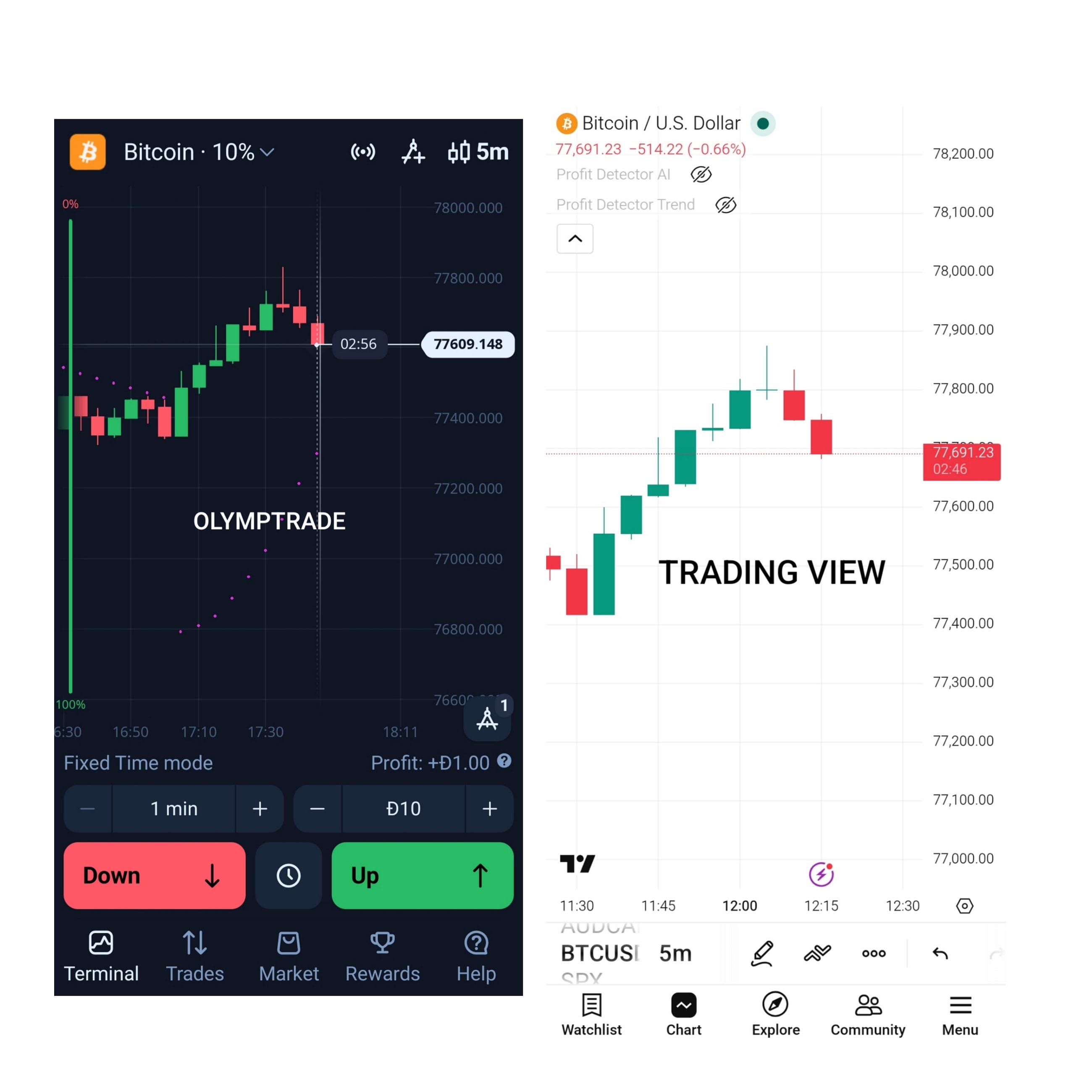
I ran my own informal comparison. Bitcoin on Olymptrade versus Bitcoin on TradingView. I checked the 5-minute timeframe consistently over time.
The overall directional movement matched. There were minor differences in candle body sizes,
the representation varied slightly. But the structure was the same. What I’d been interpreting as
"fake candles" was actually the natural result of different data feeds representing the same underlying movement differently.
The harder realization
The platform wasn’t manipulating me. My analysis was just wrong.
I was trading solely on indicators, without combining price action, chart patterns, market
structure, or proper confluence. I was entering positions based on one signal and expecting consistency. That’s not a strategy, that’s hope.
After I understood this, I rebuilt my approach from scratch. I studied candlestick patterns
properly. I started learning support and resistance, liquidity concepts, and overall market
structure. I stopped asking "why did the chart do that to me" and started asking "what was I
missing in my analysis."
The losses didn’t stop. But they stopped feeling like evidence of manipulation
What I still think Olymp Trade should do better
I want to be honest here, too.
The transparency around OTC instruments is limited. As a trader, I’d find it genuinely useful to know: when this instrument was launched, who provides the pricing, how volume is calculated, and whether there is an audit trail. Not because I believe something is being hidden, but because having that information would allow traders to build real confidence in what they’re trading, rather than having to figure it out themselves
Transparency isn’t just good ethics. It’s practical. It reduces the doubt that leads people like me
to spend months questioning whether the charts are real.
What I’d tell someone starting today
Trading is not easy money. It requires patience, discipline, and proper risk management, not just
indicators and a good feeling about a trade.
Before you blame the platform, ask whether you actually understand what you’re trading. OTC markets are different from exchange markets. That difference isn’t suspicious; it’s just different. Learn it.
And if you’re comparing charts across platforms, keep in mind that minor differences in candle
representation are normal. The directional movement is what matters.
I didn’t start out trusting this platform. I started as someone who was sure it was working against me. What changed wasn’t the platform; it was my understanding.
Trading involves risk. This is not financial advice.