Is It Cheaper to Mine Bitcoin or Buy It in 2026?
--
People ask the same question in different ways: How much does it cost to mine a Bitcoin? Is mining still profitable? Is it cheaper to mine or just buy BTC? The answer in 2026 is not a single number. It depends mostly on two variables: your miner’s efficiency and your electricity rate. Everything else matters, but those two factors drive the outcome. Using April 17, 2026 data, the cost to mine 1 BTC ranges from roughly $31,000 to $144,000 depending on the setup, with the most efficient hydro hardware at competitive hosted power sitting well below spot price.
Bitcoin mining in 2026 is not a simple yes-or-no business. It is a cost structure business.
That means the real question is not, “Can I mine Bitcoin?” It is, “Can I mine Bitcoin for less than I can buy it?”
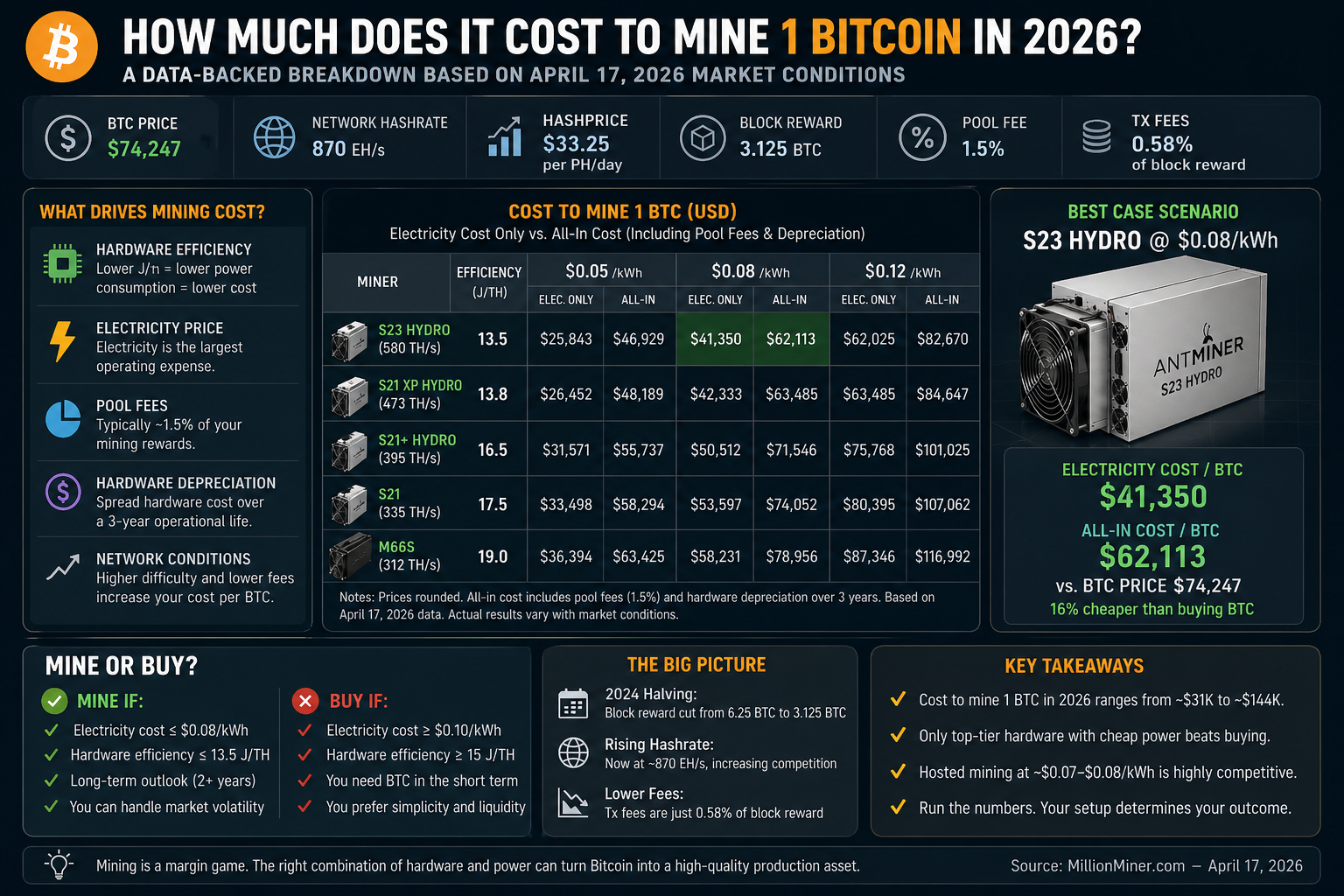
Using April 17, 2026 market conditions, MillionMiner’s breakdown shows that the answer depends mainly on hardware efficiency and electricity cost. The article uses a 15-cell matrix built from five miners and three electricity rates, then compares electricity-only cost with an all-in view that also includes pool fees and hardware depreciation. The headline result is stark: at $0.08/kWh, the Antminer S23 Hydro produces 1 BTC for about $41,350 in electricity alone and about $62,113 all-in, both below the then-current BTC price of $74,247. Most other combinations cost more than simply buying Bitcoin on an exchange.
Why the average number misleads
A lot of headlines quote a single average production cost for Bitcoin. The article notes that CoinDesk, citing Check on chain data, put the industry average around $87,000 per BTC, while Best Brokers calculated about $106,135 using U.S. commercial power pricing. But the article’s point is that averages can hide the reality that miners are operating with very different hardware and power prices. Older, less efficient miners can pull the average up dramatically, even if modern hosted hardware is much more competitive.
That is why the article argues the only number that matters is your number.
If your machine is efficient enough and your power rate is low enough, mining can still deliver Bitcoin at a discount. If not, the math flips fast.
The formula that actually matters
The article reduces the problem to a clear sequence:
Daily BTC production is based on a miner’s hash-rate and the current hash-price, minus a 1.5% pool fee. Daily electricity cost is simply wattage divided by 1,000, multiplied by 24 hours, multiplied by your electricity rate. Electricity cost per BTC is then the daily electricity cost divided by net daily BTC production. An optional all-in cost adds hardware depreciation over a 3-year operational life.
That is the right framework because it reflects how mining really works: you are not just buying a machine, you are buying a production system.
The most important cost comparisons
The article’s strongest comparison is the S23 Hydro at $0.08/kWh. Based on the supplied April 2026 data, it produces about 0.000256 BTC per day after pool fees, and the electricity cost works out to about $41,350 per BTC. That is roughly 44% below the market price of $74,247. With hardware depreciation and pool fees included, the all-in cost is about $62,113, still about 16% below spot.
At the other end of the matrix, some setups are clearly uncompetitive. The S21 base and M66S are already above spot at hosted rates around $0.08/kWh, and residential electricity pricing makes air-cooled hardware even less viable. The article is blunt about this: at typical residential rates, mining is usually more expensive than buying BTC directly.
What changed the economics
The article identifies three structural reasons mining is expensive in 2026. First, the April 2024 halving cut the block reward from 6.25 BTC to 3.125 BTC. Second, network hash-rate rose to about 870 EH/s, increasing competition. Third, transaction fees fell to roughly 0.58% of total block reward, which leaves miners heavily dependent on the block subsidy. Together, those forces push the cost per BTC higher for most operators.
Mine or buy?
The article’s answer is pragmatic, not ideological.
Mine if you have electricity at $0.08/kWh or below, you can run hardware at 13.5 J/TH or better, and you have a long enough time horizon to ride out volatility. Under those conditions, you can produce Bitcoin at a measurable discount to spot. Buy if your electricity is above $0.10/kWh, your hardware is less efficient than 15 J/TH, or you need BTC immediately. In that case, exchange purchase is simpler, faster, and cheaper.
The article also makes a useful point about payback and time. A single S23 Hydro at current network difficulty produces about 0.00778 BTC per month, which means it would take roughly 10.7 years to reach 1 BTC by itself. A single S21 XP takes far longer. That is a reminder that mining is not a shortcut to fast BTC accumulation; it is a production and infrastructure strategy.
Why hosting matters
The article and the website both support the same practical conclusion: hosted power changes the equation. MillionMiner says its hosted mining rate is about $0.07 to $0.08/kWh all-in across four U.S. facilities, with power, cooling, monitoring, and racking bundled. That is the type of pricing that makes efficient hardware competitive.
The broader brand promise reinforces that point: free DDP shipping, a live dashboard, daily BTC payouts, and a free test miner help reduce uncertainty before purchase. For a buyer trying to decide whether mining is worth it, those are meaningful proof points.
In 2026, Bitcoin mining is not automatically profitable, and it is not automatically a bad deal either. It is a margin game.
Conclusion
If you have modern hardware and genuinely cheap power, you may mine BTC below market price. If you do not, buying Bitcoin outright is often the better move. That is the honest answer, and the article’s value is that it shows the math instead of hiding behind slogans.
The real cost to mine 1 Bitcoin in 2026 depends on hardware efficiency, power price, and network conditions. For elite hardware at low hosted rates, mining can still beat buying. For most home setups, the exchange is the cheaper path.
If you are evaluating mining seriously, start with the numbers first: choose hardware by efficiency, lock in your electricity rate, and run the calculation against live market data. MillionMiner’s hosted setup, DDP shipping, and free test miner are designed to make that decision process easier and more transparent.