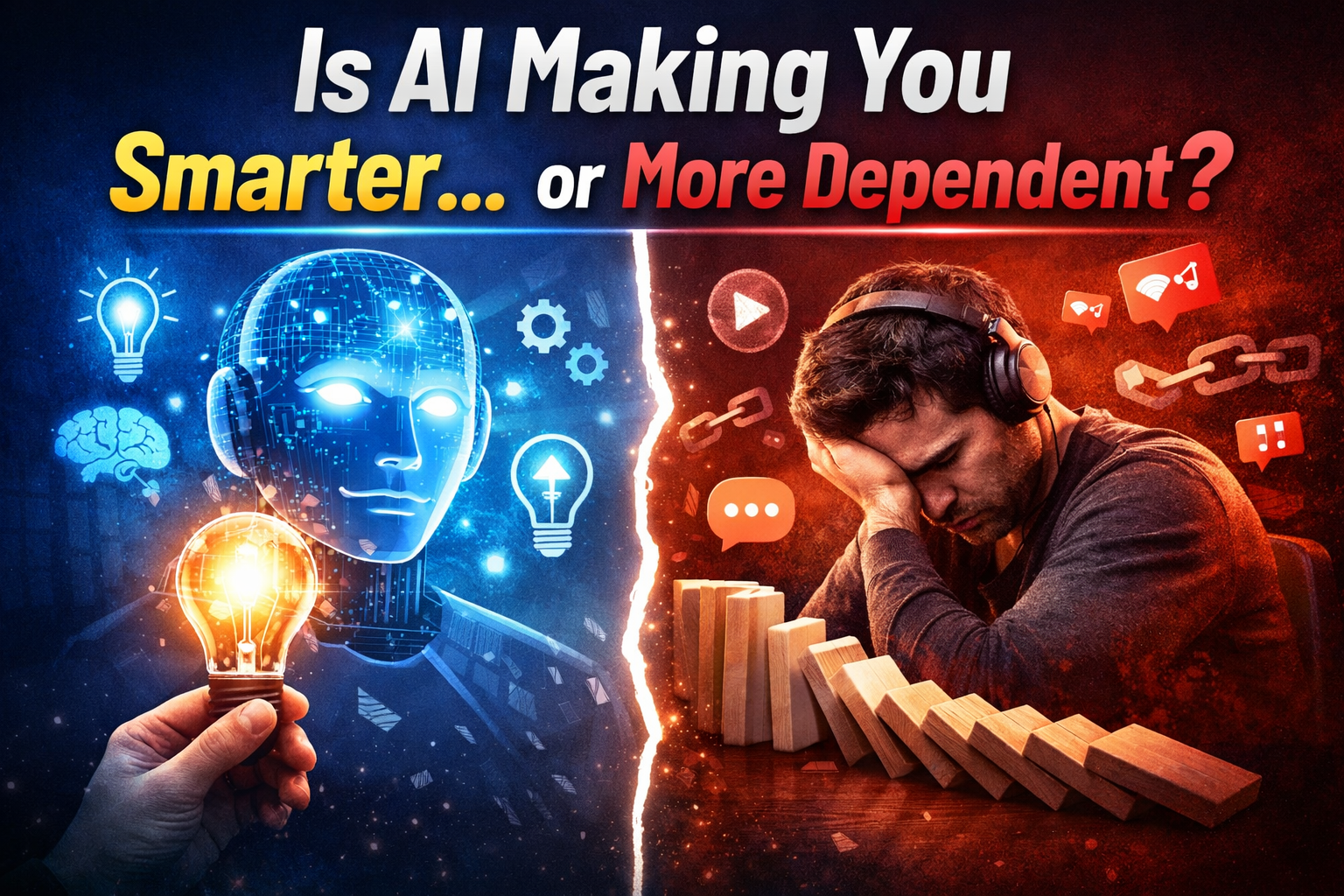
Is AI Making You Smarter — or Just More Dependent?
 mscode073 min read·Just now
--
In 2026, AI is everywhere.
It writes our emails, fixes our code, generates our designs, and answers questions instantly. What once took hours now takes minutes.
At first glance, this feels like progress.
But there’s an uncomfortable question we’re not asking enough:
Are we becoming more efficient — or just more dependent?
The AI Explosion Happened Fast
It all accelerated in late 2022 with the launch of ChatGPT.
Within months, millions of people started using AI tools daily. Students, developers, designers, writers — everyone found a use case.
For the first time:
- You didn’t need to search — you could just ask
- You didn’t need to think step-by-step — AI could do it for you
- You didn’t need expertise — just a prompt
This wasn’t just another tech upgrade.
It changed how humans interact with information.
Why Everyone Adopted It So Quickly
The reason is simple: AI removes friction.
- Tasks that took hours now take minutes
- Complex problems feel simpler
- Creativity feels easier to execute
A student can generate essays.
A developer can debug faster.
A creator can produce content at scale.
AI didn’t just improve productivity.
It made effort optional.
And that’s where things start getting interesting.
Nothing Is Actually Free
Most major AI tools offer free plans.
At first, this feels like generosity. But it’s not.
These companies operate massive data centers. Their costs are enormous. So why give access for free?
Because you are not the customer — you are part of the product.
Every prompt you write:
- reveals how you think
- shows what you want
- captures how you communicate
This data helps train better models.
Over time, AI doesn’t just answer questions —
it learns human behavior at scale.
The Subtle Shift We Ignore
AI isn’t just helping us.
It’s slowly changing how we think.
Instead of:
- solving → we ask
- researching → we prompt
- struggling → we generate
This creates a subtle dependency.
You may still get the answer —
but you might lose the process of arriving at it.
And that process is where real learning happens.
The Real Impact: Speed vs Skill
There’s no doubt — AI is powerful.
It has:
- increased productivity
- reduced time to execution
- lowered barriers to entry
But there’s a trade-off.
Some skills are getting stronger:
- ideation
- execution speed
- tool usage
While others are weakening:
- deep thinking
- patience
- problem-solving from scratch
At the same time, the job market is shifting.
Roles that involve repetitive or predictable work are being automated.
New roles are emerging — but they require adaptation, not avoidance.
So… What Should You Do?
Avoiding AI is not the answer.
Blindly depending on it isn’t either.
The real advantage comes from using AI intentionally.
- Use it to speed up execution
- Not to replace thinking
- Use it to assist learning
- Not to skip it
Because in the long run:
AI won’t replace you.
But someone using AI better than you might.
Final Thought
AI is one of the most powerful tools humans have ever built.
But like any tool, its impact depends on how you use it.
You can use it to:
- build faster
- learn smarter
- create more
Or you can use it to:
- avoid effort
- skip thinking
- depend completely
The difference is small — but the outcome is massive.
AI is not making you dumb.
But how you use it might.
✨ Thanks for reading! If you would like more Solana tech blogs, subscribe to me here for weekly insights.
About Me
I’m Abhishek (mscode07) — developer & indie hacker.
I write about Web3, building, and learning in public.
Feedback
I’m still improving my writing —
So feel free to share honest feedback (good or bad).