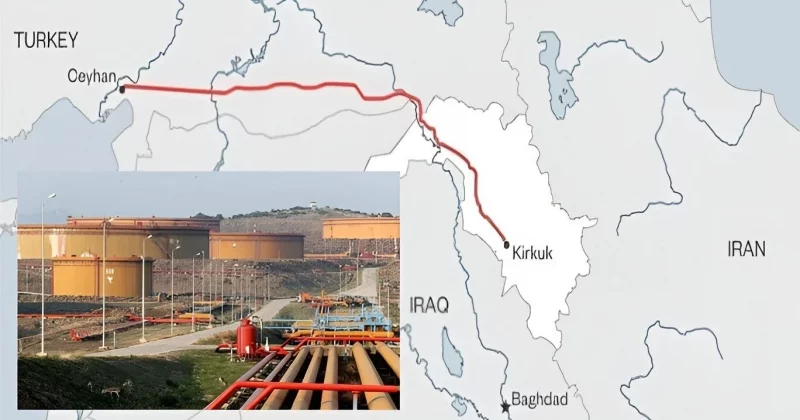
Iraq to triple crude oil exports via Ceyhan pipeline amid Strait of Hormuz closure
Baghdad and the Kurdistan Regional Government are fast-tracking a pipeline capacity expansion to offset the catastrophic loss of southern export routes during the Iran conflict.
Share
Add us on Google by Editorial Team Jun. 2, 2026Iraq is scrambling to reroute its oil exports through Turkey after the Strait of Hormuz, the chokepoint that once carried the vast majority of the country’s crude, effectively shut down amid the 2026 Iran conflict. The plan: triple the flow through the Kirkuk-Ceyhan pipeline from roughly 200,000 barrels per day to as much as 650,000 bpd.
The numbers tell a brutal story
Iraq’s southern exports, which flow through the Strait of Hormuz and into the Persian Gulf, collapsed to just 10 million barrels in April 2026. For context, normal monthly volumes through that route sit around 93 million barrels. That’s a roughly 89% drop, practically overnight in oil market terms.
The Kirkuk-Ceyhan pipeline, which connects northern Iraqi oil fields to the Mediterranean port of Ceyhan in Turkey, became the obvious lifeline. A deal struck on March 17, 2026, between Baghdad’s federal government and the Kurdistan Regional Government paved the way for oil to start flowing again the very next day, March 18, at an initial rate of 150,000 to 250,000 bpd.
AdvertisementCurrent throughput has settled at approximately 200,000 bpd. Iraqi officials are now in discussions to push that figure to somewhere between 500,000 and 650,000 bpd, which would represent a tripling of present output through the route.
The pipeline itself has a theoretical maximum capacity of 1.6 million bpd, so the infrastructure can technically handle the increase. The Kirkuk-Ceyhan route has a checkered history of operational disruptions, including sabotage, territorial disputes, and the advance of ISIS in 2014, as well as politically motivated shutdowns.
How the Baghdad-KRG deal changed the calculus
Key players in the renewed arrangement include Iraq’s Oil Ministry, the KRG’s natural resources department, Turkey’s government (which controls the Ceyhan terminal), and the state-run North Oil Company, which operates the major northern fields around Kirkuk.
The speed of the deal was notable. Negotiations concluded and oil began flowing within 24 hours.
Why tripling still isn’t enough
If Iraq manages to hit the high end of its target, 650,000 bpd through Ceyhan, that translates to roughly 19.5 million barrels per month. Compare that to the 93 million barrels per month that normally flowed through southern terminals. Even at maximum expansion, the Ceyhan route would replace only about 21% of lost volumes.
The Strait of Hormuz isn’t just Iraq’s problem. Roughly 20% of global oil supply transits through the narrow waterway between Iran and the Arabian Peninsula. Its closure affects exports from Kuwait, Saudi Arabia, the UAE, and Qatar as well.
Disclosure: This article was edited by Editorial Team. For more information on how we create and review content, see our Editorial Policy.