Iran, Oil, the Dollar, and Interest Rates: How to Read the Big Direction in Crypto Markets
--
Oil prices. Interest rates. The dollar index. M2 money supply. VIX. Most crypto investors ignore these — and pay for it when markets move against them. Here’s how six macro indicators connect directly to Bitcoin’s price, explained simply with the Iran conflict as a real-world case study.
The Strait of Hormuz — through which approximately 20% of the world’s seaborne oil passes — was effectively blocked. Nine days after the war began, on March 9, WTI crude surged to $112 per barrel. Brent briefly reached $138 — the highest level since 2008.
Crypto markets shook alongside oil markets.
Many investors were left asking the same question:
“Why does a war in Iran affect Bitcoin’s price?”
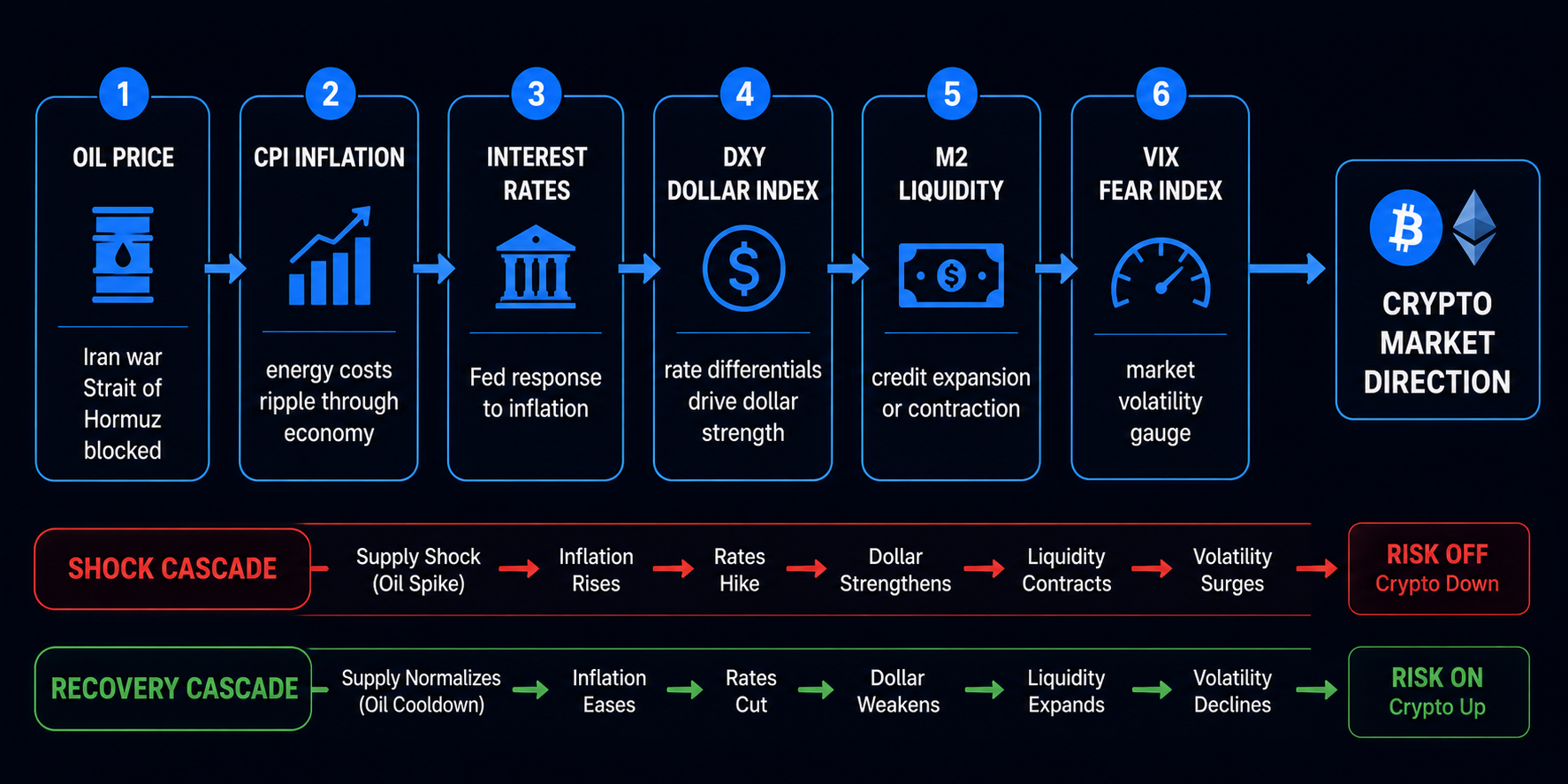
To understand the answer, you need to understand six indicators.
Oil. CPI. Interest rates. DXY. M2. VIX.
Taken separately, these feel like economics textbook material. But read together as a single flow, they become the most powerful tool available for understanding the direction of crypto markets.
Step 1 — Oil: The Trigger for Everything Else
Oil is not simply the price of fuel. Modern economies run on petroleum. Factories. Freight trucks. Agricultural machinery. All of it requires oil.
When oil prices rise, the cost of everything rises.
What the Iran war showed:
When the Strait of Hormuz was blocked, global crude output fell by approximately 12 million barrels per day. Brent reached $138 at its April 2026 peak — roughly $75 higher than a year prior. As of early June 2026, oil remains elevated. Iran suspended negotiations and threatened to fully close the strait, pushing WTI back above $92 per barrel.
When oil prices rise:
- Gasoline prices rise
- Shipping costs rise
- Food prices rise
- Fertilizer costs rise
- Plastic manufacturing costs rise
Oil is the trigger for the entire inflation chain. When oil moves, everything downstream moves with it.
Step 2 — CPI: The Trigger for Interest Rates
CPI (Consumer Price Index) measures the change in prices that ordinary people actually pay — food, housing, transportation, healthcare, education.
Think of it as the “grocery basket” price.
The relationship between CPI and interest rates:
The Federal Reserve’s most important mandate is price stability. Its target: approximately 2% annual inflation.
When inflation exceeds 2%, the Fed raises interest rates.
Why? Higher rates make borrowing more expensive. More expensive borrowing reduces spending. Reduced spending lowers demand. Lower demand brings prices down.
What the Iran war showed:
When oil hit $112–$138, energy inflation fears exploded. Analysts projected that the probability of Fed rate cuts in 2026 dropped by as much as 67%. If prices won’t come down, the Fed cannot cut rates.
Step 3 — Interest Rates: The Determinant of Dollar Direction
Interest rates are the price of money.
When rates are high, holding dollars or buying U.S. Treasuries is attractive — you receive stable returns at low risk.
The relationship between rates and risk assets:
Higher rates → Dollar deposits and Treasuries become attractive → Capital flows out of risk assets (stocks, crypto) → Crypto faces downward pressure
Lower rates → Dollar deposits and Treasuries lose appeal → Capital searches for higher returns → Crypto benefits
This is precisely why Bitcoin fell from $69,000 to $16,000 when the Fed aggressively raised rates in 2022.
What the Iran war showed:
Oil spike → inflation fears → rate cut expectations erased → prolonged high rates → risk assets under pressure.
Step 4 — DXY: The Dollar’s Thermometer
The DXY (Dollar Index) measures the strength or weakness of the U.S. dollar against a basket of six major currencies: the euro, yen, pound sterling, and others.
DXY rising = dollar strengthening. DXY falling = dollar weakening.
The relationship between DXY and crypto:
DXY rises (stronger dollar) → capital flows into dollars → risk assets face selling pressure → crypto weakens
DXY falls (weaker dollar) → dollar loses appeal → capital diversifies into other assets → crypto strengthens
Bitcoin and DXY historically exhibit an inverse relationship. Periods of a sharply rising DXY typically coincide with Bitcoin weakness.
What the Iran war showed:
As geopolitical uncertainty spiked, capital rushed into the safe-haven dollar. DXY strengthened, and broad risk assets — including crypto — came under pressure.
Step 5 — M2: The Water Level of Global Liquidity
M2 is the total amount of money in circulation — cash, bank deposits, and short-term financial instruments combined.
The relationship between M2 and crypto:
Fidelity’s analysis found that changes in global M2 explain approximately 87% of Bitcoin’s price movements.
The mechanism is straightforward:
More money in circulation (M2 rises) → More capital needs somewhere to be invested → Some portion flows into crypto → Crypto rises
Less money in circulation (M2 falls) → Less investment capacity → Capital exits crypto → Crypto falls
The connection between rates and M2:
Higher rates → borrowing becomes more expensive → less new money created → M2 growth slows → crypto faces headwinds
Lower rates → borrowing becomes cheaper → more new money created → M2 expands → crypto benefits
Step 6 — VIX: The Market’s Fear Gauge
VIX is the Volatility Index — commonly called the “Fear Index.”
It is derived from S&P 500 options pricing and reflects how much volatility market participants expect over the next 30 days.
Reading the VIX:
- Below 20 → Market is calm; investors are optimistic
- 20–30 → Rising uncertainty; caution warranted
- 30+ → Market fear; sharp volatility expected
- 40+ → Extreme fear; major crisis conditions
The relationship between VIX and crypto:
When VIX spikes, investors sell risk assets and move into safe havens (dollars, gold). Crypto is classified as a risk asset — VIX spikes create direct selling pressure.
The most vivid example: during the March 2020 COVID shock, VIX reached 85 and Bitcoin fell 50% in a single day.
Connecting All Six
The Iran conflict demonstrates exactly how these six indicators chain together.
The shock cascade:
Iran war → Strait of Hormuz blocked → Oil spikes to $112–$138 → Inflation fears → Rate cut expectations erased → Dollar strengthens (DXY rises) → M2 growth expectations weaken → VIX spikes → Risk assets sell off → Crypto corrects
The recovery cascade:
Peace signals → Oil falls → Inflation pressure eases → Rate cut expectations revive → Dollar weakens (DXY falls) → M2 expansion expectations return → VIX stabilizes → Risk assets recover → Crypto rallies
This played out in real time: on May 1, when news emerged that Iran had sent a peace proposal through Pakistan, WTI dropped 3% in a single session. Crypto responded immediately.
The situation as of early June 2026:
On June 1, Iran suspended negotiations and threatened to fully close the Strait of Hormuz, causing WTI to spike back above $92. The Saudi Aramco CEO has warned that oil markets won’t normalize until 2027 if the Strait remains blocked past mid-June. The situation remains highly fluid — every Iran-related headline moves oil, and oil moves everything downstream.
The Signals Investors Should Watch
Bullish signals (favorable for crypto):
- Oil prices stabilizing or falling
- CPI data showing inflation slowing
- Fed signaling rate cuts
- DXY declining (dollar weakening)
- Global M2 expanding
- VIX below 20
Bearish signals (unfavorable for crypto):
- Oil prices spiking (geopolitical crisis)
- CPI rising (inflation not coming down)
- Fed delaying rate cuts or raising rates
- DXY rising (dollar strengthening)
- Global M2 contracting
- VIX spiking above 30
Where Markets Stand Now
June 2026 snapshot:
- Oil: WTI $91–$94 (down ~20% from April peak, but rising again on Iran talks breakdown)
- Inflation: Energy-driven inflation pressures persist
- Interest rates: Probability of 2026 Fed rate cuts remains below 30%
- DXY: Dollar strength pressure continuing
- M2: Liquidity expansion expectations weakened by rate cut delays
- VIX: Stabilizing but vulnerable to Iran headlines
The single most important variable:
When — or whether — the Strait of Hormuz normalizes is the most important macro question of 2026. If the strait reopens: oil falls → inflation pressure eases → rate cut expectations recover → dollar weakens → crypto environment improves. If it stays closed past mid-June, Goldman Sachs and Saudi Aramco warn of a multi-year supply disruption scenario.
Closing Thoughts
The era of reading only price charts in crypto is over.
Now you understand why a war in Iran affects Bitcoin.
Oil → CPI → Interest rates → DXY → M2 → VIX. These six indicators connect as a single flow. At the end of that flow sits the crypto market.
Those who read macroeconomics see the direction of crypto markets first.
Crypto is not a trend. It is an inevitability.
History repeats itself. Only the prepared will capture the opportunity.