Iran is charging Bitcoin tolls to cross the Strait of Hormuz. Here’s what that means for price
 Kevin Nyaga5 min read·Just now
--
A government just chose Bitcoin as its preferred currency for one of the most strategically important waterways in the world. Not a crypto blog. Not a thought experiment. A live operational decision by a sovereign state, and the market felt it within hours.
During the two-week ceasefire window with Washington, Iran moved fast. Tankers wanting to pass through the Strait of Hormuz, which handles roughly 20% of the world’s oil, now have to pay a Bitcoin toll. Vessels attempting transit without complying, Iran says, will be destroyed.
Bitcoin jumped from around $68,000 to nearly $73,000 in hours. The reason is pretty simple. Iran chose Bitcoin because the money can’t be frozen. No sanctions, no correspondent banks, no government with the power to block
the transaction. When a sovereign state makes that call in a genuinely high-stakes context, it says something real about where Bitcoin sits in the global financial system right now. This isn’t adoption in the abstract, It’s adoption under pressure, which is the kind that tends to stick.
What the market is doing underneath the headline
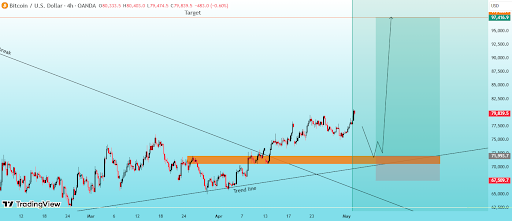
Bitcoin has since pushed above $80,000, its best monthly performance in a year before its recent retracement.
Source: TradingView
The derivatives market is sending a signal that’s easy to misread though. Funding rates across most major exchanges are sitting at minus 5% on a 30-day average, deeply negative against a historical norm of positive 8%. That looks bearish on the surface. It isn’t, and the distinction matters.
Source: The Block
Markus Thielen, founder of 10x Research, broke down what’s actually driving it. The negative funding rate reflects institutional hedging, not bearish conviction from traders betting against Bitcoin. Here’s a useful way to think about it. Imagine a landlord who owns ten properties taking out insurance on all of them at the same time. From the outside it looks like they’re worried. In reality they’re just protecting a position they fully intend to keep. That’s essentially what’s happening in the Bitcoin futures market right now.
Crypto hedge funds that have underperformed Bitcoin by 140% over five years are facing redemptions. While waiting for capital to return to investors, they’re shorting futures to neutralise their price exposure. Funds betting that Strategy shares will outperform Bitcoin directly are doing the same as part of that trade. Others are capturing the 11% yield on Strategy’s preferred shares while shorting futures to strip out crypto price volatility.
Strategy raised $3.5 billion in April alone, scaling both trades at the same time. Bitcoin miners pivoting to AI computing are also in the mix. Funds buying stocks like Hut 8, up 48% since early April, are shorting Bitcoin futures to remove crypto correlation from the trade. None of these are outright bearish positions. They’re structural hedges that happen to push the funding rate negative while the underlying conviction stays intact.
The on-chain picture is more complicated
CryptoQuant has raised a flag worth paying attention to. Despite April’s strong price performance, apparent demand stayed negative across the full rally. Rising price with contracting spot demand is one of the clearest on-chain signals that gains are speculative rather than structural. The price went up without a matching increase in genuine buying from real users and long-term holders.
That’s not a disaster, but it’s worth being honest about. A rally built primarily on short squeezes and institutional hedging flows can reverse quickly if the catalyst fades. The Hormuz ceasefire that unlocked the Bitcoin toll story is temporary. If it collapses, the geopolitical tailwind that helped push Bitcoin through $80,000 goes with it. The on-chain data is basically telling you the foundation isn’t fully built yet.
The institutional picture
The longer-term structural support looks more convincing. BlackRock’s European Bitcoin ETP has surpassed $1.1 billion in assets under management, holding over 4,200 BTC. Nearly $2 billion in aggressive taker buy volume hit Binance within two hours around the $80,000 level.
Source: CryptoQuant
That kind of buying doesn’t come from retail momentum chasers. Institutional capital tends to be less reactive to short-term noise, which creates a support floor that purely speculative rallies don’t have.
The Iran toll story and the $80,000 breakout are really connected by the same idea. Bitcoin is increasingly being treated as an asset that sits outside the reach of governments, whether that’s a sovereign state using it to collect fees that can’t be sanctioned, or institutions accumulating it as a hedge against a financial system under visible strain.
A government choosing Bitcoin for operational payments because dollars can be frozen is a more powerful adoption signal than any ETF filing. It confirms the use case Bitcoin was built for, in the most high-stakes environment imaginable. The spot demand that’s been absent through April still needs to show up to validate what derivatives traders have already priced in. That’s the real question going deeper into May.
Bitcoin technical outlook
Bitcoin continues to grind higher within its recovery structure, with price now holding above the 76,000 level, which has flipped into a key near-term support. The next major resistance sits around 89,200, leaving room for further upside within the current range if momentum holds. For now, price action remains constructive, with higher lows forming since the February bottom.
Bollinger Bands are gradually widening again after a period of compression, pointing to a pickup in volatility as price pushes toward the upper band. This is typically consistent with strengthening momentum, though it can also precede short-term consolidation as price stretches.
RSI is trending higher toward the 70 mark, currently in the low-60s, indicating building bullish momentum without yet reaching overbought conditions. As long as momentum remains supported, the structure favors continuation higher, while a loss of the 76,000 level would shift focus back toward deeper support near 65,800.
Source: TradingView