InterLink Chain Security Vision: Built for a Post-Quantum Future
 InterLink Labs2 min read·Just now
--
The blockchain industry is approaching a critical inflection point—one that many projects are not fully prepared for.
Quantum computing.
While still emerging, its long-term implications for cryptography are profound. The majority of today’s blockchain systems rely on classical cryptographic schemes like ECDSA, which are fundamentally vulnerable to sufficiently advanced quantum algorithms.
This creates a silent but unavoidable deadline.
The Problem Most Chains Ignore
Most blockchains operate under an implicit assumption: that current cryptography will remain secure indefinitely.
That assumption is flawed.
Once quantum computers reach cryptographic relevance, systems built without foresight will face:
Compromised private keys
Broken identity systems
Vulnerable consensus mechanisms
Retrofitting security at that stage is not just difficult—it is potentially catastrophic.
InterLink’s Core Assumption
InterLink approaches this challenge differently.
Instead of asking if quantum threats will emerge, it assumes they will—within the operational lifetime of the network.
This leads to a fundamentally different design philosophy: Build the migration path before the threat exists.
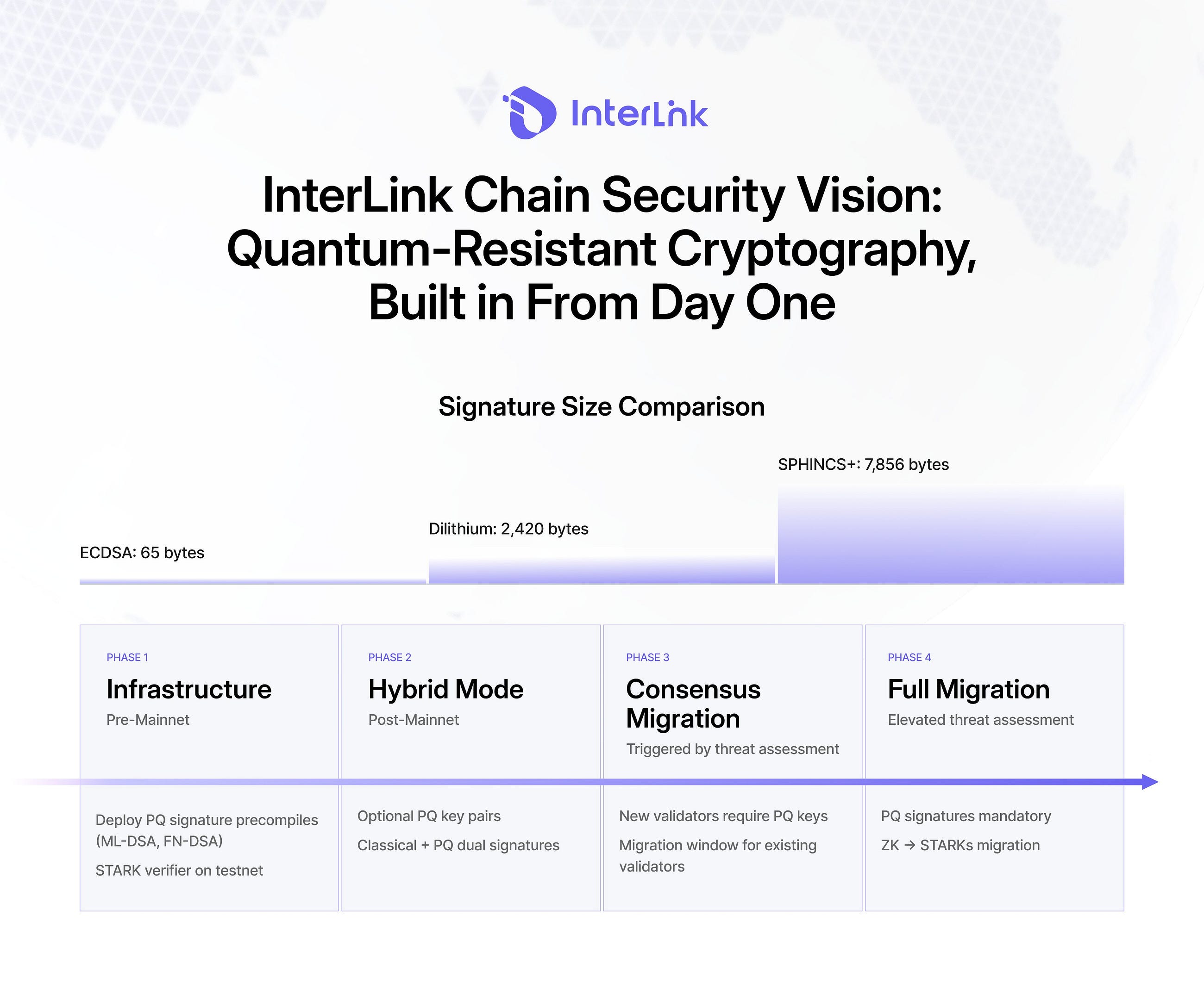
A Structured 4-Phase Migration Strategy
Phase 1: Infrastructure (Pre-Mainnet)
The foundation is laid before launch:
Post-quantum signature precompiles (ML-DSA, FN-DSA)
STARK verifier deployed on testnet
This ensures the system is quantum-aware from inception.
Phase 2: Hybrid Mode (Post-Mainnet)
Adoption begins without disruption:
Optional post-quantum key pairs
Dual signature support (classical + PQ)
This maintains backward compatibility while enabling forward migration.
Phase 3: Consensus Migration
Triggered by real-world threat intelligence:
New validators must use PQ keys
Existing validators transition within a defined window
Security evolves proactively, not reactively.
Phase 4: Full Migration
The final stage:
PQ signatures become mandatory
Transition from ZK-SNARKs to STARKs
At this point, the network achieves full quantum resistance.
The Engineering Challenge: Signature Size
Post-quantum cryptography is not a drop-in replacement.
Signature sizes increase dramatically:
ECDSA: ~65 bytes
Dilithium: ~2,420 bytes
SPHINCS+: ~7,856 bytes
This has direct implications on:
Storage
Bandwidth
Throughput
InterLink addresses this by integrating support at the infrastructure level early, ensuring scalability is preserved during transition.
Why This Matters
This isn’t just about future-proofing.
It’s about protecting:
Economic value
Digital identity
Network trust
A blockchain that cannot survive the next generation of computing cannot claim to be truly decentralized or secure.
Final Thought
InterLink is not reacting to the future.
It is engineering for it.
In a world where trust must endure technological shifts, the networks that survive will be those that planned ahead—not those that rushed to adapt.
#InterLink #ITLG #ITL #Blockchain #QuantumSecurity