INSIDERBREAKFAST — MARKET DEPTH #007 Two Escapes From the Known: SpaceX Goes Public, Japan Leaves Its Decade of Deflation
--
The week when the world’s most anticipated IPO files its prospectus, and the world’s most indebted central bank is forced to tighten…
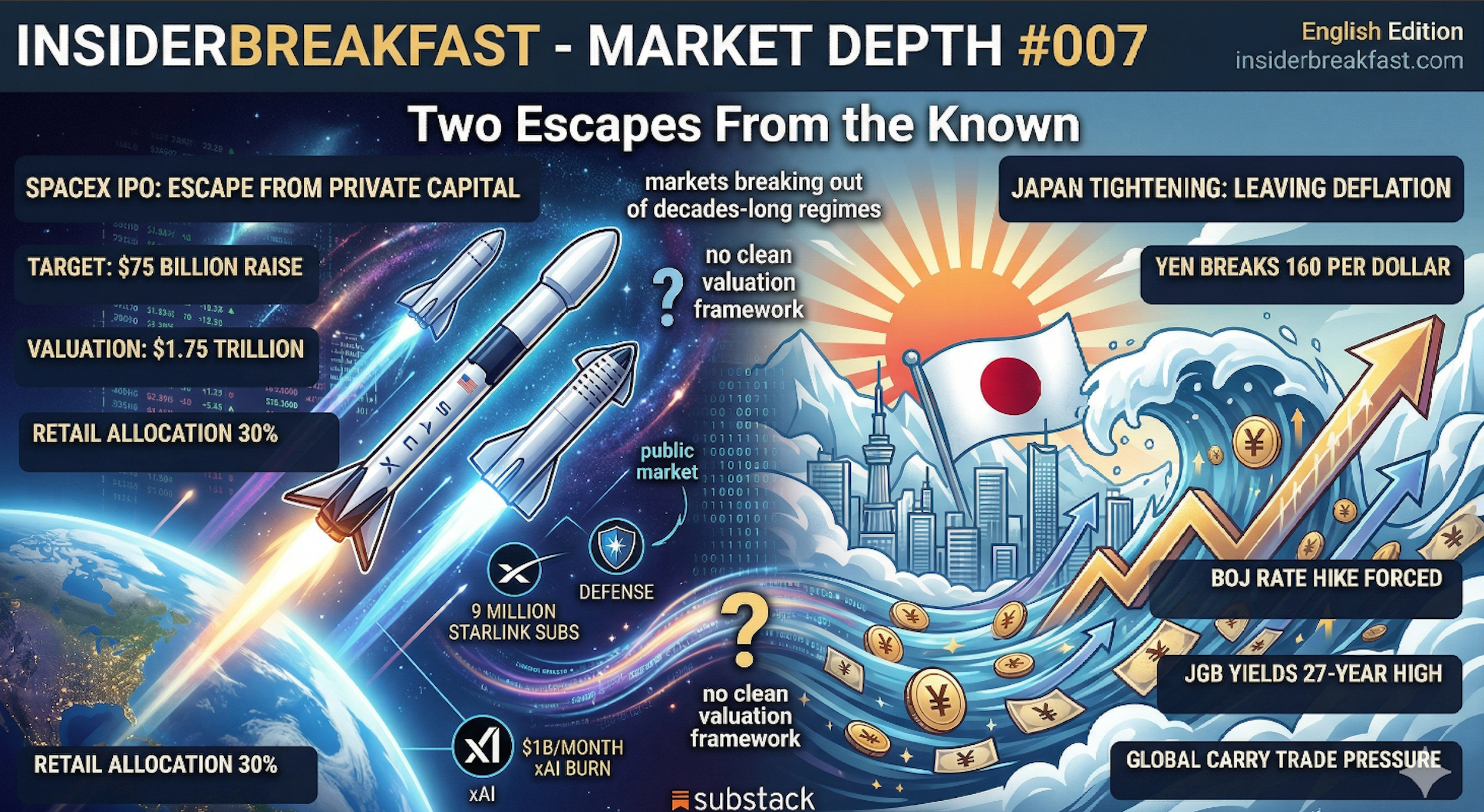
The yen just broke through 160 per dollar. At the same time, SpaceX is days away from filing the most consequential IPO prospectus since Facebook. Two events that seem completely unrelated — and yet they tell the same story: markets breaking out of decades-long regimes, with no clean valuation framework to guide them.
An IPO Without a Category
The numbers are by now widely circulated: SpaceX is targeting $75 billion in proceeds at a $1.75 trillion valuation. That would make it the largest IPO in history — bigger than Saudi Aramco’s $29.4 billion raise in 2019, bigger than Alibaba, bigger than anything public markets have ever been asked to absorb.
But the question that almost nobody is asking properly is: what exactly is being taken public here?
SpaceX is no longer a rocket company. It is a vertically integrated conglomerate spanning orbital launch services (Falcon 9, Starship), a global satellite internet network with 9 million paying subscribers (Starlink), a multi-billion dollar defense business (Starshield), and — since its acquisition of Musk’s xAI in February 2026 — one of the most ambitious AI companies in the world, including Grok models and a stated ambition to build orbital data centers powered by solar energy.
The underlying financials are real. Morningstar estimates 2025 revenue at approximately $16 billion and EBITDA at $7.5 billion, driven almost entirely by explosive Starlink subscriber growth. Starlink alone generates roughly $10 billion in revenue and $8 billion in profit — numbers that any publicly traded telecom would envy. Starlink’s subscriber base has more than doubled in 15 months to 9.2 million users across residential, maritime, aviation and government tiers. Revenue growth is projected to reach $15.9 to $24 billion in 2026.
The problem: xAI reportedly burns approximately $1 billion per month competing with OpenAI, Google, Microsoft and Anthropic. The merger was strategically logical — SpaceX gets AI substance and a narrative pivot, xAI gets access to SpaceX’s cashflow and a liquidity path for its investors. But the S-1 prospectus must now describe a single entity that is simultaneously a profitable satellite telecom, a rocket manufacturer, a defense contractor and a loss-making AI lab.
Which valuation framework applies? None that currently exists.
Boeing and Lockheed Martin trade at roughly 1–2x revenue. Telecom companies at 2–3x. High-growth tech at 10–20x. SpaceX is targeting approximately 110x its 2025 revenue — a premium that only makes sense if you’re willing to simultaneously price in global direct-to-smartphone satellite communications, orbital AI compute infrastructure and Mars colonization. That is not a financial model. It is a bet on a version of the future that no analyst can model with any precision.
The structural red flags are real. Musk retains approximately 42% voting control, meaning the public shareholders will have limited influence over strategic direction. The S-1 will almost certainly reveal a dual-class share structure similar to Tesla. The xAI integration also brings X (formerly Twitter) along as an indirect subsidiary — a platform whose advertising revenue has fallen from $4.4 billion in 2022 to around $2.9 billion in 2025, with $1.2 billion in annual debt service.
And then there is the timing. SpaceX is going public during a global energy shock, with the S&P 500 down 7.4% in March alone, the VIX above 30, and the Federal Reserve frozen between inflation and a collapsing labor market. This is not the window any IPO banker would have designed.
One genuinely unusual structural element: Musk has reportedly decided to allocate 30% of the IPO directly to retail investors — three times the Wall Street norm. The stated rationale is democratization of access. The practical implication is that absorbing $75 billion requires retail demand at a scale the U.S. market has never seen.
What the filing will actually reveal — Starlink’s unit economics per subscriber tier, the mechanics of the xAI integration on the balance sheet, the actual Starship development timeline and capital requirement — will be more valuable to investors than the valuation target. Read the S-1. Not the headline.
Japan: The One Central Bank That Has to Tighten
Today, March 30, 2026, USD/JPY crossed 160. Japan’s top currency official Atsushi Mimura used the word “decisive” in front of reporters — the first time he has used that word in his tenure. For currency traders, this is not background noise. It is a signal: direct intervention is imminent.
At the same time, Bank of Japan Governor Kazuo Ueda told parliament that yen movements could justify a near-term rate hike — possibly as soon as April. The 10-year Japanese government bond (JGB) yield hit a 27-year high.
What is happening here is structurally extraordinary. The Bank of Japan is the only G7 central bank that is being forced to tighten in the middle of a global energy shock, while all others are either on hold or flirting with cuts.
The transmission mechanism is precise. Japan imports approximately 90% of its oil, most of it from the Middle East via the Strait of Hormuz. High oil prices hit Japan twice: once through higher import costs priced in dollars, and again through a weak yen that makes those same imports even more expensive in local currency. Weak yen plus expensive oil creates a self-reinforcing import inflation spiral.
The BOJ raised its policy rate to 0.75% in December 2025 — the highest level in 30 years. That still sounds modest until you consider the context. Japan maintained negative interest rates from 2016 through 2024. The move from -0.1% to 0.75% in two years is structurally equivalent to a western economy absorbing a move from 3% to 10%. For Japan’s highly leveraged corporate and household balance sheets, the adjustment has barely begun.
The consequence: the global yen carry trade is under pressure. Hundreds of billions of dollars in institutional positions have for years been built on the mechanics of borrowing cheaply in yen and investing the proceeds in higher-yielding assets — U.S. Treasuries, global equities, emerging market bonds. A BOJ hike in April, combined with direct FX intervention, would force rapid and potentially disorderly unwinding of those positions.
This is not theoretical. In August 2024, an unexpected BOJ hike to 0.25% triggered a global carry trade unwind that dropped the Nikkei by 12% within three trading days. The positions that need unwinding today are larger than they were then.
What makes 2026 different from 2024: at that point, the BOJ was able to rapidly walk back its language and calm markets. Today, it is simultaneously fighting a weak yen, rising import inflation, a 27-year high in JGB yields, and a global macro shock from the Middle East war. Every direction has a catch. FX intervention without a rate hike fades quickly. A rate hike without intervention risks destabilizing the bond market. Both together could trigger the exact carry trade unwind the BOJ is trying to avoid.
The options market has not fully priced this. Implied volatility on JPY has risen, but the skew on USD/JPY options does not yet reflect a serious tail-risk scenario. That could change quickly this week.
📡 Data Spot: The JGB Yield Surge as a Global Leading Indicator
Japan’s 10-year government bonds are yielding at their highest level in 27 years. This sounds like a local Japanese data point. It is a global signal.
Japan carries the world’s highest debt-to-GDP ratio at approximately 230%. For years, the BOJ suppressed yields through aggressive bond purchases known as Yield Curve Control, effectively keeping the cost of that debt near zero. Since 2024, it has been gradually stepping back from those purchases.
When Japanese government bonds sell off — yields rising, prices falling — two things happen in the global system. First, Japanese insurance companies and pension funds holding trillions in JGBs begin marking losses on their books, reducing their capacity and appetite for other assets. Second, as domestic yields rise, foreign bonds — particularly U.S. Treasuries and European sovereign debt — become relatively less attractive, triggering capital repatriation flows back into Japan. This directly pressures yields globally.
Historically, an aggressive JGB yield surge has been a leading indicator for elevated global bond market volatility, typically with a 4 to 8 week lead time. The current 27-year high is coinciding with U.S. 10-year Treasury yields at an 8-month high of 4.44%. That is not a coincidence.
What this data point implies: the negative correlation between Japanese JGB yields and global equity risk assets in stress periods is well-documented. If JGB yields continue their move higher without the BOJ intervening in the bond market, the pressure on global risk assets intensifies — independent of what the Fed or ECB do.
🔭 What I Am Watching This Week
- SpaceX S-1 Filing: The prospectus could be filed with the SEC at any moment. The first pages will reveal more about xAI’s balance sheet, governance structure, and X’s financial condition than any press release has. Specifically: how will xAI’s monthly cash burn be treated in the consolidated accounts?
- BOJ Intervention: USD/JPY above 160 is the level at which Japan deployed approximately $100 billion in 2024. Direct intervention this week is plausible. Trigger to watch: if Mimura follows “decisive” with “appropriate steps have been taken,” the intervention has begun.
- Powell, Monday 10:30 AM ET: His first public remarks since the March Fed hold. Markets will parse every word for signals on whether an April hike is being considered or whether the Fed is truly paralyzed between inflation and a weakening labor market.
- NFP Friday — Good Friday: The March payrolls report releases on April 3, when most global markets are closed for Easter. Consensus is +56,000 after February’s -92,000 — the third negative print in five months. If the number surprises significantly in either direction, Tuesday’s open could see major gap moves in FX, rates and equities with no ability to trade the reaction over the weekend.
- Eurozone Flash CPI, Tuesday: The first real measure of whether the oil shock from Hormuz is feeding through to European consumer prices. Consensus is 2.5% year-over-year versus 1.9% previously. A beat would put the ECB in the same impossible position as the Fed.
The Territory Ahead
The week starting March 30 carries a density of simultaneous catalysts I have not seen in 2026: Powell on Monday, ECB inflation data on Tuesday, EIA crude inventory data on Wednesday, payrolls on Good Friday — all while the SpaceX S-1 can drop at any moment and the yen sits at an intervention threshold.
SpaceX and Japan share more than timing. Both are escapes from regimes that seemed permanent. For SpaceX, that regime was private capital markets — a company that never needed public equity and is now voluntarily stepping into public scrutiny at a price nobody can definitively justify. For Japan, it is a decade of deflation and zero rates — a central bank that for the first time in a generation is being forced to tighten because the world is forcing it to.
The open question for this week: if SpaceX is valued at 110x revenue while global interest rates are being recalibrated upward — what happens to the risk-free rate as a valuation anchor? Rising real yields are toxic to high-multiple growth assets. The timing of the SpaceX IPO is either very brave or a miscalculation that will only be legible in hindsight.
What I know for certain: when two of the largest financial events of the moment happen simultaneously, pay close attention to the details the noise is drowning out.
This newsletter is not financial advice. All analysis is for informational and educational purposes only.
INSIDERBREAKFAST / MARKET DEPTH is published by Simon Julian Greiner. German edition at insiderbreakfast.com on Substack.