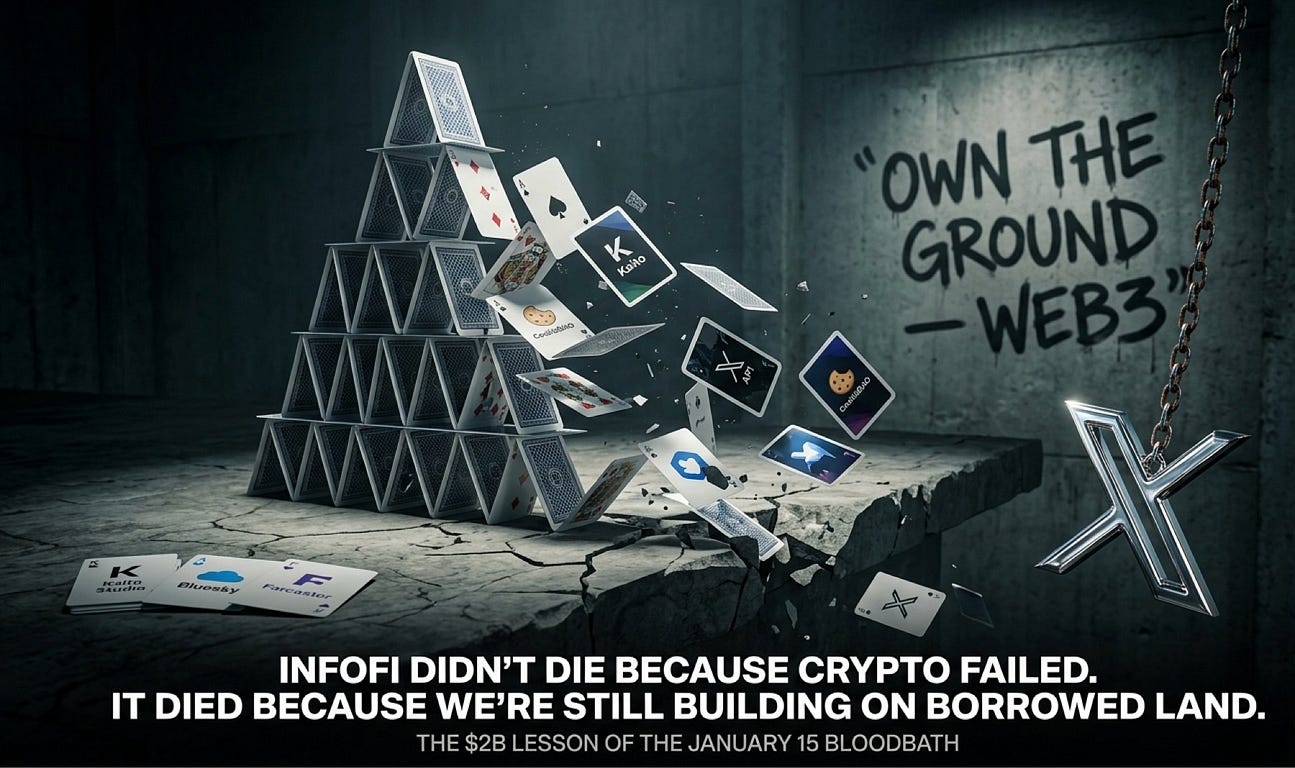
InfoFi didn’t die because crypto failed. It died because we’re still building on borrowed land.
--
The $2 billion lesson of the January 15 bloodbath.
Nobody actually warned them the floor was about to vanish. Not because we didn’t see the red flags. They were everywhere. If you looked at the bot reports or the absolute swamp of spam replies in late 2025, the writing was on the wall. But it’s hard to tell a founder their foundation is rotting when they’re sitting on a $2 billion market cap and half of South Korea is logging in every morning to “yap-to-earn.” A vertical line on a chart is easy to mistake for stability.
The Pitch We All Bought
The reason everyone fell for InfoFi (Kaito, CookieDAO, the whole lot) was because the logic was bulletproof. For a decade, Web2 platforms have been strip-mining creators. You post, they get the ad revenue, and you get a little red notification dot.
InfoFi was supposed to be the “Checkmate” move. Plug into X’s API, track the heat, and actually pay the people moving the needle. At its peak, KAITO was a $2B monster. CookieDAO had brands actually queuing up to pay creators via their Snaps system. For a minute there, it felt like we’d actually cracked the code on digital labor.
Then the Bots Showed Up
But here’s the thing about “paying people to post”: you get exactly what you pay for.
By mid-2025, Crypto Twitter was basically unusable. The “insight” was gone, replaced by a tsunami of low-effort garbage and bot farms gaming the leaderboards. Kaito’s team tried to fix it. They tightened the KYC and built fancy on-chain filters, but you can’t outrun the math. If $1 of posting earns $2 of token, someone is going to automate that process until the sun goes down.
By early January 2026, it hit a breaking point. CryptoQuant clocked 7.75 million crypto posts in 24 hours. Nearly 80% of that was garbage. X wasn’t just watching its platform die. It was watching its infrastructure get hijacked.
The Kill Switch
On January 15 of that same month, Nikita Bier (X’s Head of Product) basically nuked the sector. The announcement was short: no more API access for apps that pay users to post.
The aftermath was a bloodbath. KAITO and COOKIE didn’t just “dip.” They evaporated. The sector lost $367 million in value in a single afternoon. It wasn’t a market correction; it was a platform eviction.
The irony is what really stings. InfoFi was marketed as the “antidote” to Big Tech’s power. It was supposed to be about ownership and autonomy. But when the moment of truth came, these projects had no more leverage than a Zynga-era Facebook game from 2012. The tokens were decentralized, sure, but the pipe was owned by a guy who could flip a switch whenever he got bored or annoyed.
The Lesson (The Hard Way)
If you’re building a “decentralized” app on top of a centralized database, you’re just a tenant. And your landlord doesn’t care about your roadmap.
The InfoFi we saw in January is dead.
Good riddance to the spam-to-earn model.
But the idea isn’t dead. Kaito is pivoting to a “Studio” model with certified creators, and Cookie is trying to build a data layer that doesn’t live or die by a single API. People are flooding into Farcaster and Bluesky because they finally realized that if you don’t own the ground, you don’t own the house.
The next wave won’t be about farming rewards. It’ll be about building the infrastructure first.
The next wave will actually have to build their own rails. Anything else is just asking for a repeat.