In early DeFi, making money was simple.
--
You deposited tokens somewhere.
Watched APY numbers fly upward.
Took screenshots.
Felt like a genius.
Then reality arrived.
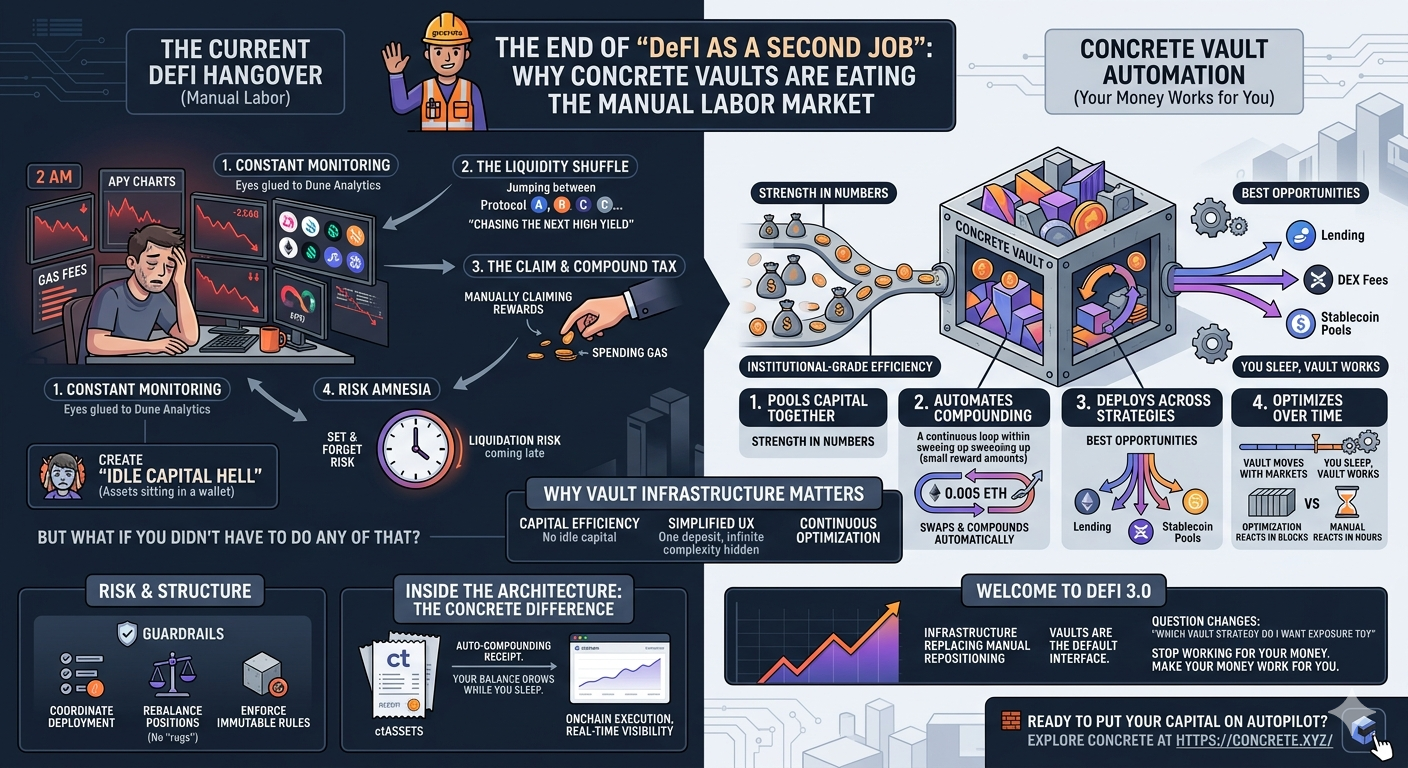
Suddenly every serious DeFi user needed to:
— monitor APYs across multiple protocols
— move liquidity constantly
— claim rewards manually
— compound emissions
— rebalance LP ranges
— manage risk themselves
At first this looked “advanced.”
Now it mostly looks exhausting.
There’s a reason many DeFi users today have:
17 browser tabs open,
3 dashboards bookmarked,
2 wallets connected,
and one emotional support spreadsheet.
Because modern DeFi has a coordination problem.
And that’s exactly the problem vault infrastructure is trying to solve.
🧱 Why manual DeFi management breaks down
Imagine two users in the same liquidity strategy.
User A manually compounds once every few weeks.
User B compounds consistently and rebalances positions efficiently.
Over time, even small differences in execution create major differences in performance.
This is not theoretical.
We already saw this during the rise of concentrated liquidity systems like Uniswap V3.
People quickly realized:
providing liquidity was no longer passive.
If your LP range drifted too far from price action, capital efficiency collapsed.
Some users actively managed positions and performed well.
Others became full-time range babysitters.
Many simply gave up.
That was one of the biggest signals that DeFi was evolving beyond manual participation.
Complex systems require infrastructure.
Not constant clicking.
🧱 What Concrete Vaults actually do
Concrete Vaults simplify how users interact with structured DeFi strategies.
Instead of manually repositioning capital every time markets change, users deposit into a vault system designed to coordinate strategy execution automatically.
Concrete Vaults help users:
— pool capital together
— automate compounding
— deploy across strategies
— optimize positions over time
— reduce operational complexity
The important part is this:
Users stop managing every individual action manually.
The system handles the operational layer.
That changes the entire DeFi experience.
Instead of chasing yield all day, users gain exposure to structured onchain capital deployment.
And honestly, this shift was inevitable.
Because the deeper DeFi grows, the less scalable manual management becomes.
🧱 Why vault infrastructure matters
Most people think vaults are just:
“deposit token → receive yield.”
But real DeFi vaults are infrastructure systems.
A strong vault architecture continuously coordinates capital behind the scenes.
That includes:
— automated compounding
— rebalancing logic
— capital allocation
— strategy execution
— exposure optimization
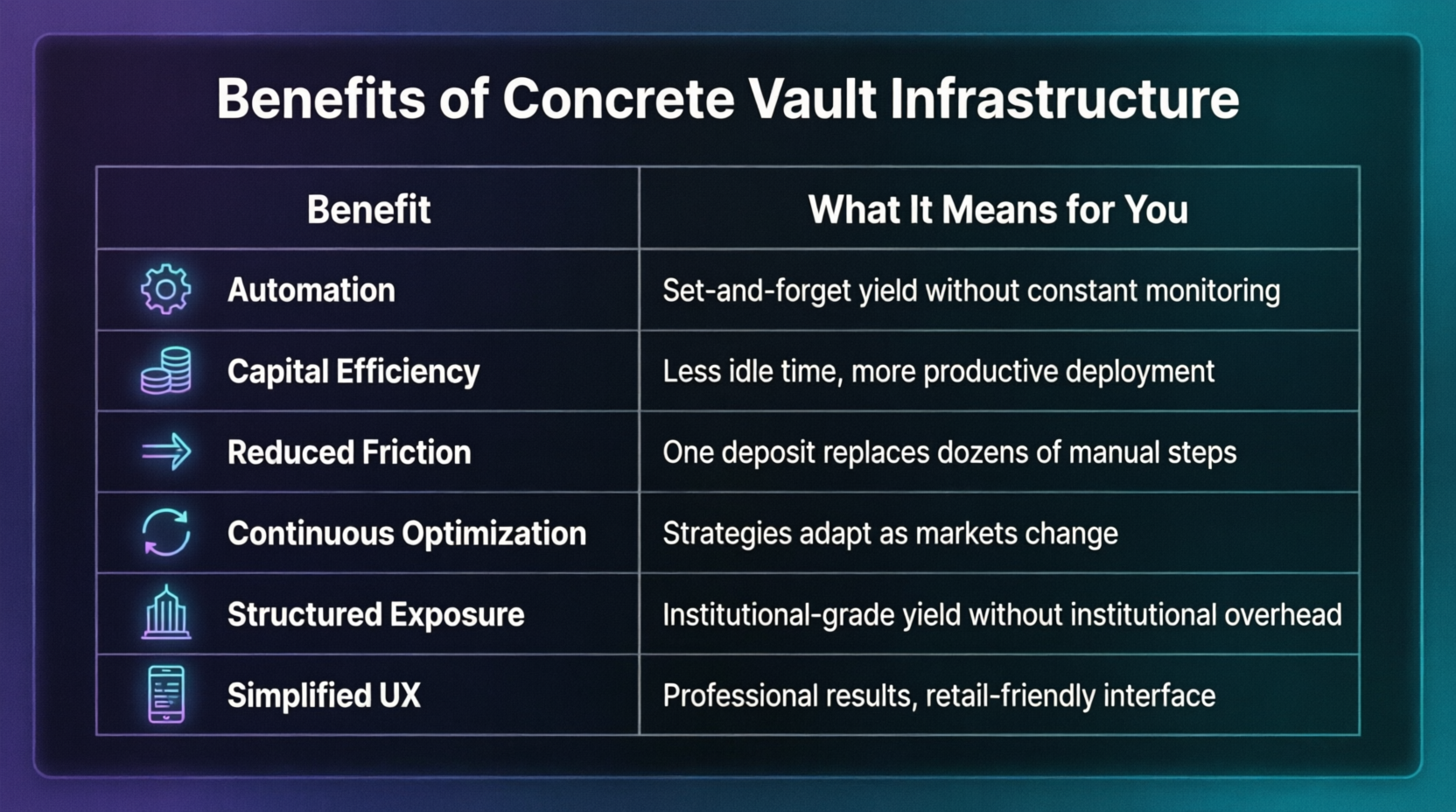
This creates several advantages.
1️⃣ Better capital efficiency
Idle capital is one of the largest hidden inefficiencies in DeFi.
Unclaimed rewards.
Unused liquidity.
Positions sitting inactive.
Vault systems reduce this problem by continuously keeping capital productive.
2️⃣ Reduced operational friction
Most users do not want to micromanage positions every day.
They want exposure to opportunities without spending hours maintaining strategies manually.
Vault infrastructure reduces that friction.
3️⃣ More consistent execution
Humans are emotional.
Vault systems are systematic.
And in volatile markets, consistency matters.
A vault does not panic because ETH moved 12% overnight.
A human definitely might.
🧱 Why structure & risk management matter
Concrete Vaults are not simply “yield wrappers.”
The important part is the structure behind the system.
Vault infrastructure needs mechanisms to:
— coordinate capital deployment
— rebalance positions
— enforce strategy constraints
— adapt to changing market conditions
Without structure, yield strategies eventually become chaotic.
We’ve already seen examples of this throughout DeFi history.
During the high-yield farming era of 2021, many protocols attracted massive liquidity with unsustainable emissions.
Capital entered quickly.
Yield collapsed.
Liquidity disappeared just as fast.
The problem wasn’t only yield.
The problem was coordination.
Sustainable systems require structured execution.
That’s where institutional DeFi thinking starts to matter.
🧱 How Concrete Vault architecture fits into this shift
Concrete Vaults introduce systems designed for more efficient onchain coordination.
Using mechanisms like ctAssets, vault infrastructure can help organize capital deployment across opportunities while maintaining structured execution.
Instead of users manually hopping between protocols every few hours trying to optimize APYs…
Vault systems automate parts of that process directly onchain.
That includes:
— automated compounding
— structured vault systems
— onchain execution
— continuous optimization
The result is a more scalable model for participating in DeFi.
And scalability matters.
Because DeFi is no longer small.
Today billions of dollars move across lending markets, liquidity protocols, derivatives systems, and cross-chain ecosystems every day.
At that scale, infrastructure becomes more important than individual clicks.
🧱 The bigger shift happening now
The future of DeFi probably does not belong to users manually moving funds between protocols forever.
That model becomes harder and harder to sustain as complexity increases.
Instead, DeFi is moving toward:
— structured automation
— coordinated vault systems
— optimized capital deployment
— institutional-grade infrastructure
In other words:
Infrastructure is replacing constant repositioning.
The same way algorithmic systems transformed traditional finance, vault infrastructure is transforming onchain finance.
And eventually, the competitive advantage may no longer come from who works the hardest manually…
…but from who uses the most efficient systems.
That’s the shift Concrete Vaults are building toward.
Explore Concrete at https://concrete.xyz/