If You Can’t Explain Yield, You Are the Yield
--
#Most DeFi users never ask where their yield comes from. That silence is expensive.
There’s a number on the dashboard. It’s big, it’s green, and it updates in real time. You deposit, the interface confirms your position, and yield begins to accumulate. Simple.
But here’s the question most DeFi users never ask: *where is that yield actually coming from?*
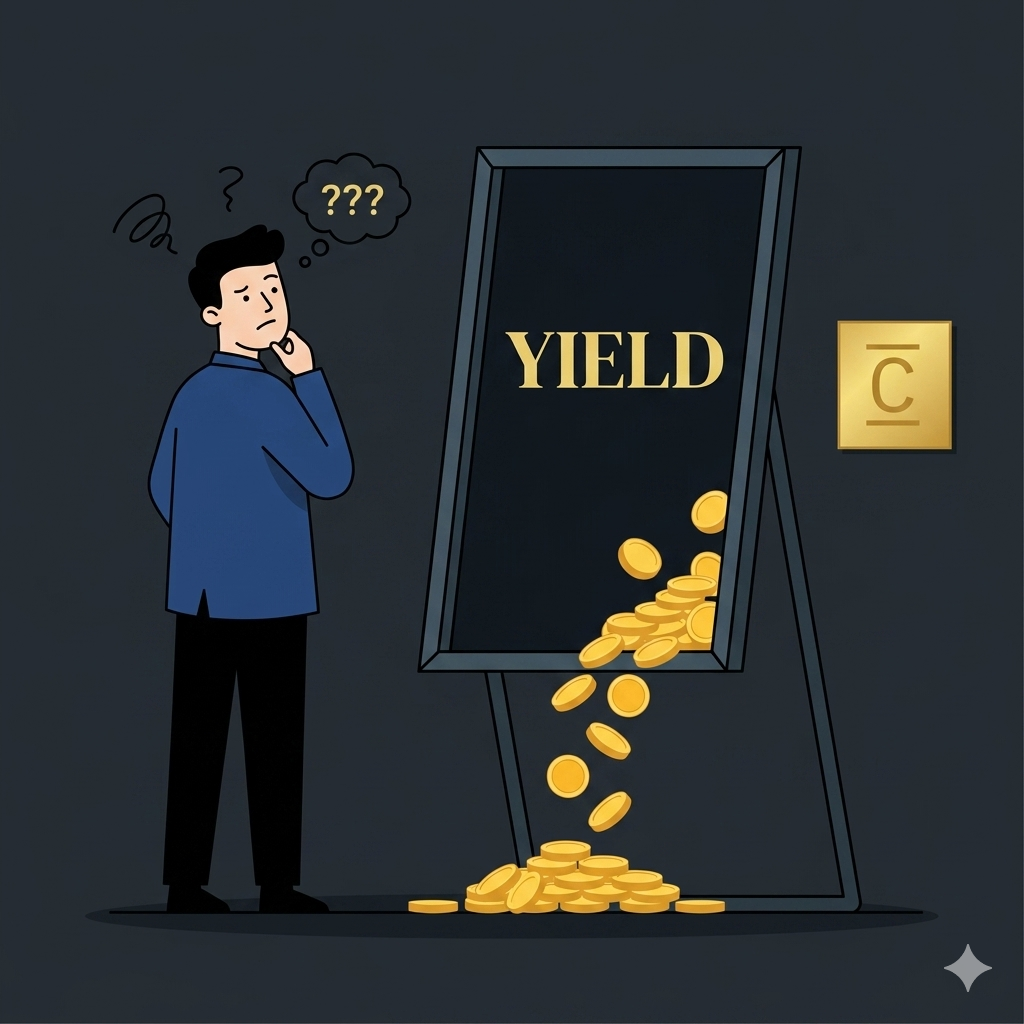
It’s not a trivial question. In markets, return doesn’t appear from nowhere. Every yield has a source and if you don’t understand that source, there’s a good chance you’re not the one capturing value. You’re the one providing it.
# The Illusion of Simple Yield.
DeFi has done something remarkable: it made yield frictionless to access. Deposit flows are clean, interfaces are polished, and APY numbers update in real time to tell you exactly how much you’re earning or at least how much the protocol claims you’re earning.
This simplicity is genuinely valuable. But it comes with a cost. When yield looks easy, it also looks transparent. Users assume that what’s displayed is what’s real, that the number on the dashboard reflects what they’ll actually walk away with.
It rarely does.
The displayed APY is a gross figure a best-case snapshot that doesn’t account for the friction, costs, and risks embedded in the strategy beneath it. The gap between what’s shown and what’s real is where most of DeFi’s hidden losses live.
# The Gap Between Displayed and Real Yield.
Take a strategy showing 30% APY. Sounds compelling. But work through what actually happens to that number.
*Gross vs net return* is the first cut. The displayed figure is before costs gas fees for entering and exiting positions, protocol fees, management fees, and any costs associated with claiming and compounding rewards. Each of these takes a slice. The net return is always lower than the headline.
*Impermanent loss* is the silent killer for liquidity providers. When the prices of assets in a liquidity pool diverge, the pool automatically rebalances which means you end up holding more of the asset that fell and less of the one that rose. The trading fees you earn may not cover this loss. A 30% APY in fees can be entirely wiped out by impermanent loss on volatile pairs.
*Rebalancing costs and execution friction* add up quietly over time. Every time a position is adjusted, there are transaction costs. In volatile markets, slippage on entries and exits erodes returns further. These aren’t dramatic single events they’re a slow, steady compression of the yield you thought you were earning.
*Volatility impact* is the final layer. If the underlying assets in your strategy drop in value, your yield is measured against a shrinking base. A 30% APY on a position that loses 40% of its value isn’t a win.
By the time all of these factors are accounted for, that 30% APY might look much closer to 8% or even negative. The number on the dashboard was never the number that mattered.
# Where Yield Actually Comes From.
To understand whether yield is real, you have to understand its source. Not all yield is created equal, and the difference between sustainable and temporary returns is everything.
*Trading fees* are among the most legitimate sources of DeFi yield. When you provide liquidity to a trading pool, you earn a share of the fees generated by every trade. This yield is real it’s backed by actual economic activity. As long as trading volume exists, fees flow to liquidity providers.
*Lending activity* works similarly. When you lend assets through a protocol, borrowers pay interest. That interest is your yield. It’s sustainable as long as there is genuine borrowing demand which tends to persist across market cycles.
*Arbitrage and liquidations* generate yield for participants sophisticated enough to capture them. These are competitive, technically complex strategies that require infrastructure and speed. For most retail users, they’re not accessible.
*Incentives and emissions* are the most dangerous yield source and the most common. When a protocol pays out its own tokens as yield, it’s not generating revenue. It’s printing incentives to attract liquidity. This yield is temporary by design. When the emissions schedule ends or the token price falls, the yield collapses. Liquidity leaves. The APY that looked sustainable was always a countdown timer.
Understanding which category your yield falls into changes how you evaluate any opportunity. Sustainable, revenue-backed yield is genuinely valuable. Emissions-driven incentives are a clock and someone has to be holding the bag when it runs out.
# If You Don’t Understand the System, You Are Subsidizing It.
This is where the title earns its keep.
Markets are not charitable institutions. Every return has a counterparty someone on the other side of the trade, the liquidity position, or the incentive structure. When you provide liquidity without fully understanding the risks, you’re often transferring value to those who do understand them.
Arbitrageurs profit from the impermanent loss of liquidity providers who don’t model their exposure. Protocols benefit when users hold depreciating emission tokens longer than they should. Sophisticated participants enter and exit incentive programs at optimal times, while retail users arrive late, pay inflated entry prices, and exit into collapsing yields.
This isn’t a conspiracy. It’s just how markets work. Information asymmetry creates value transfer from those who don’t understand the system to those who do. In DeFi, that asymmetry is enormous. The interfaces are simple; the mechanics underneath are not.
If you can’t explain where your yield comes from, you’re not just missing information. You may be the one providing the return that someone else is collecting.
# Why the Same System Produces Different Outcomes.
Two users can participate in identical DeFi strategies and walk away with completely different results. This seems paradoxical same protocol, same APY, different outcomes. But it’s entirely logical once you understand how the gap opens.
A user optimizing for APY sees a big number and deposits. They don’t model impermanent loss, don’t account for gas costs, and don’t track the emissions schedule that’s funding the yield. They exit when things feel uncertain often at the worst moment.
A user analyzing structure, cost, and risk evaluates the yield source before depositing. They understand which portion of the return is sustainable, model their expected net return after costs, and plan their holding period accordingly. They’re not surprised by impermanent loss because they anticipated it.
Institutions take this even further modeling expected outcomes across scenarios, stress-testing against market downturns, and sizing positions based on risk-adjusted return rather than headline APY.
Same system. Radically different outcomes. The only variable is understanding.
# The Shift From Yield Chasing to Yield Engineering.
DeFi is maturing, and with that maturity comes a shift in how sophisticated participants approach returns.
Yield chasing is reactive scanning dashboards for the biggest number, depositing quickly before the APY compresses, and rotating out when something better appears. It’s exhausting, expensive, and structurally disadvantaged.
Yield engineering is different. It starts with modeling expected outcomes not just gross APY, but net return after costs, adjusted for the risks embedded in the strategy. It involves managing risk actively, optimizing allocation over time, and measuring success by what’s actually earned rather than what’s displayed on a dashboard.
This is how institutional capital already operates in traditional finance. It’s how the most sophisticated onchain participants operate in DeFi today. And it’s the direction the entire ecosystem is moving as the infrastructure to support it matures.
The question isn’t which protocol has the highest APY. The question is which strategy produces the best net, risk-adjusted return over a meaningful time horizon.
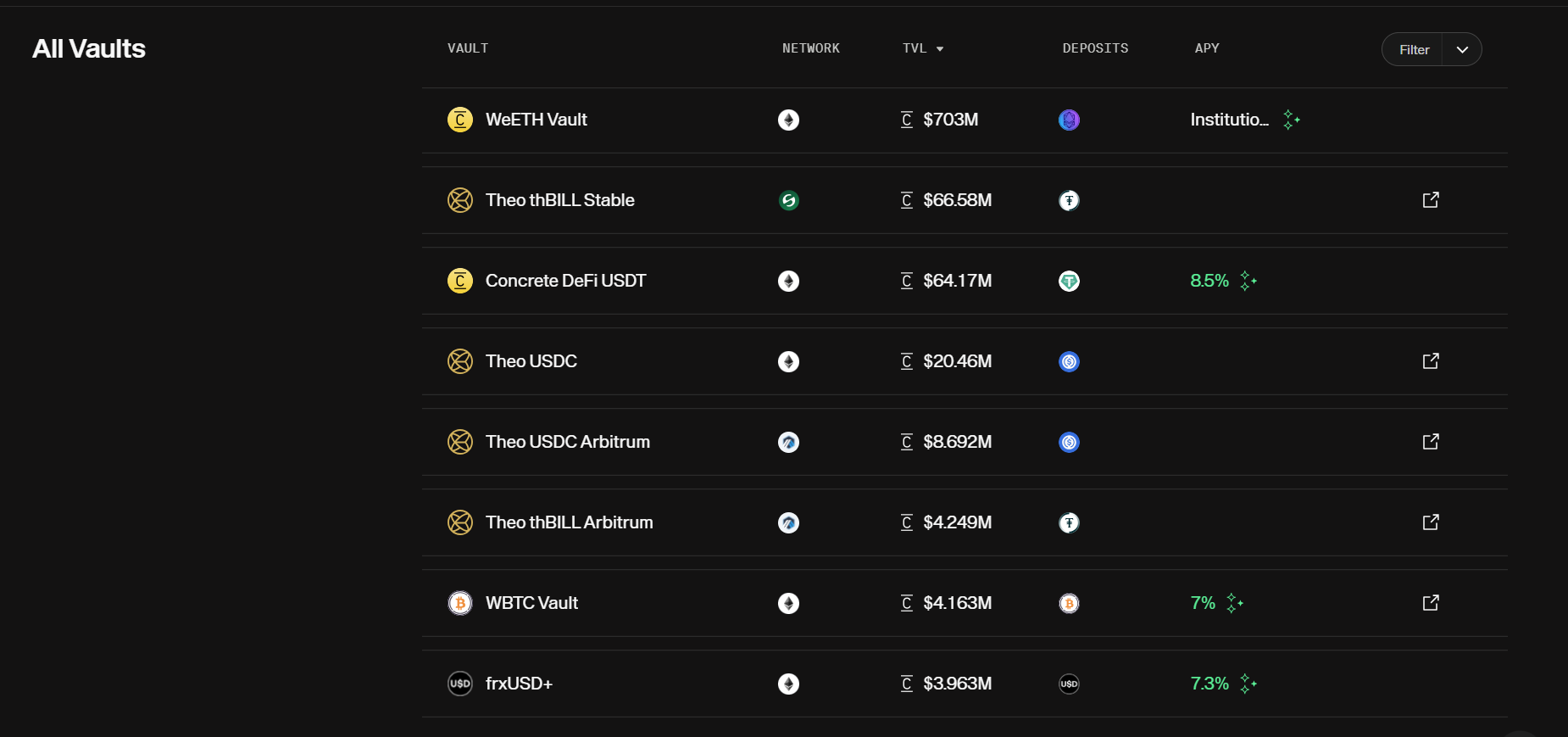
# How Concrete Vaults Help Solve This Problem.
For most users, the gap between yield chasing and yield engineering feels unbridgeable. Modeling outcomes requires data, time, and expertise that most people don’t have. Managing risk across multiple protocols and chains is operationally complex. Optimizing allocation continuously is practically impossible without automation.
This is exactly what Concrete Vaults are built to address.
By automating allocation across a defined universe of vetted strategies, Concrete removes the need for users to manually navigate a fragmented landscape. The Allocator deploys capital continuously and rebalances as conditions change capturing better opportunities without requiring manual intervention. The Strategy Manager ensures that capital only flows into controlled, structured strategies. The Hook Manager enforces risk parameters at the execution layer, making risk management structural rather than optional.
The result is a shift from guessing to structured exposure. Users don’t need to understand every mechanical detail of every underlying strategy. The vault infrastructure manages that complexity, so the yield users receive is already optimized, already risk-managed, and already compounded — without any of the operational burden that normally makes yield engineering inaccessible.
Concrete Vaults don’t just offer yield. They engineer it.
# The Only Definition of Yield That Matters.
Here’s the core insight that changes how you approach DeFi entirely:
Yield is not a number on a dashboard.
Yield is *revenue, minus cost, adjusted for risk.*
Revenue is what the underlying strategy actually generates from real economic activity. Cost is everything that erodes that revenue gas, fees, impermanent loss, slippage, and the opportunity cost of capital that could have been deployed elsewhere. Risk adjustment accounts for the probability that the strategy performs differently than expected in volatile markets, in stress scenarios, or when incentive programs collapse.
When you evaluate yield this way, the leaderboard looks completely different. The 8% that comes from sustainable revenue, with low costs and defined risk, is often worth far more than the 40% that comes from emissions, with hidden costs and unlimited downside.
Understanding that isn’t just an analytical improvement. It’s the difference between being the one who captures value in DeFi and being the one who provides it.
*Explore Concrete at [app.concrete.xyz](https://app.concrete.xyz)*