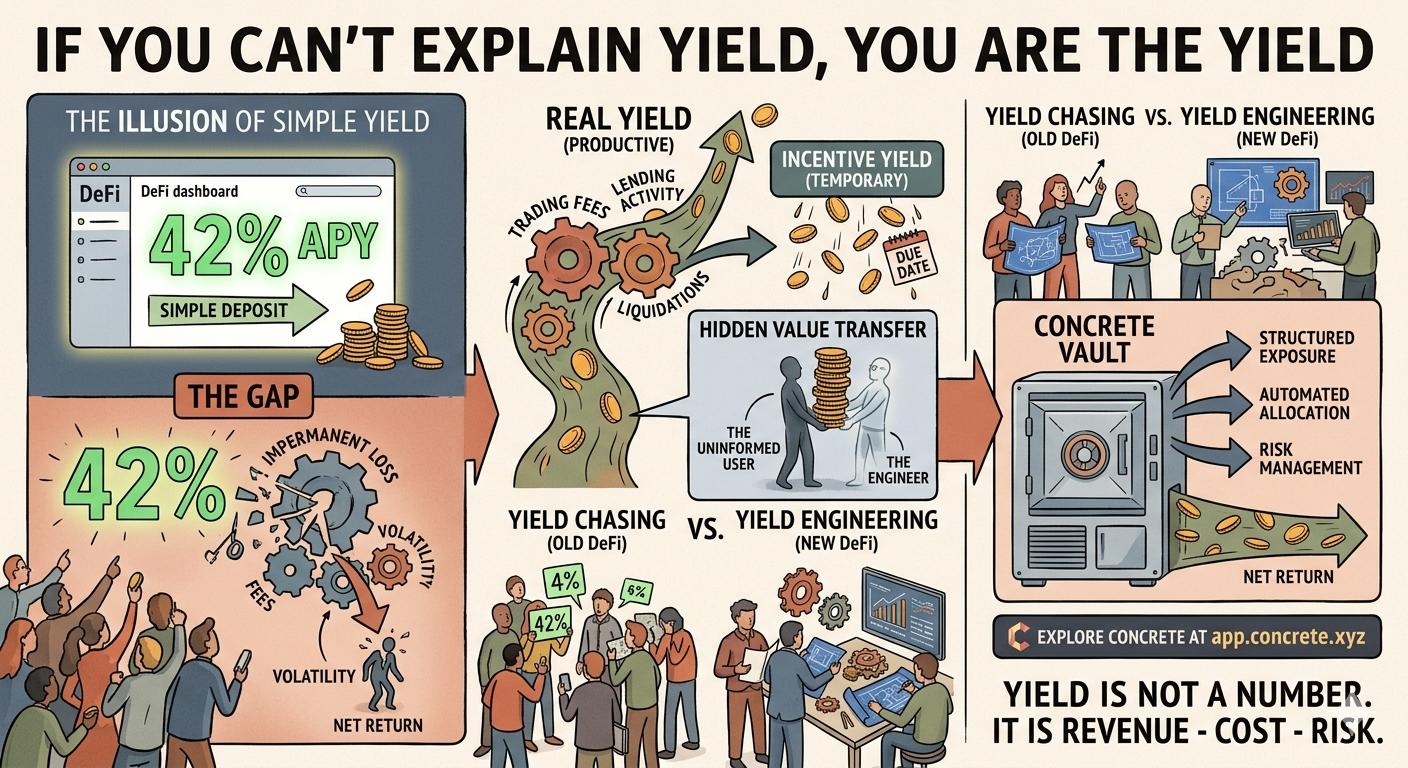
If You Can’t Explain Yield, You Are the Yield
 crypto hunter6 min read·Just now
--
Why the dazzling APYs on DeFi dashboards often hide a more unsettling truth, and how a new generation of “engineered yield” — exemplified by Concrete Vaults — can turn guesswork into disciplined exposure.
1. The Illusion of Easy Yield
When you open any DeFi dashboard today, the story looks almost too good to be true:
- Sky‑high APYs flash across the screen, sometimes topping 100 % or even 300 % in a single view.
- A single button‑click flow — Deposit → Earn — promises instant, passive income.
- The interface gives you a live, real‑time ticker that appears to compound automatically, reinforcing the feeling that you’re simply “earning” without effort.
All of this is presented with minimal context. The user can see a number, push a confirm button, and walk away with the comforting notion that the protocol is “doing the work” for them.
But beneath this polished veneer lies a complex reality. The yield you see is rarely the whole story, and ignoring the underlying mechanics can turn you from a passive earner into an unwitting provider of the very returns you expect.
2. The Gap Between Displayed and Real Yield
Gross vs. Net Return
The dashboard’s APY is typically a gross figure: the sum of all rewards before any costs are taken into account. In practice, you must subtract:
- Transaction fees (gas, bridge costs, slippage)
- Protocol fees (performance or management fees)
- Tax implications (if applicable)
The resulting net yield can be dramatically lower, especially during periods of high network congestion or when the protocol charges sizable performance fees.
Impermanent Loss (IL)
Supplying liquidity to a constant‑product AMM looks straightforward, but price divergence between the paired assets can erode your capital. Even if the APY looks spectacular, the effective return after accounting for IL may be flat or negative.
Rebalancing Costs & Execution Friction
Many vaults and yield aggregators continuously rebalance positions to capture the best rates. Each rebalance incurs gas and potentially price impact, which chips away at the advertised APY.
Volatility Impact
High‑yield strategies often rely on volatile assets. Sharp price swings can trigger liquidation penalties, reduce the pool’s total value, or cause strategy failure — again turning a high headline APY into a modest or even loss‑making outcome.
Bottom line: The “real” yield you pocket is the headline number minus all these hidden drags. A 150 % APY can shrink to 30 % or less once the full picture is considered.
3. Where Yield Actually Comes From
Understanding the source of any return is the first step to evaluating its sustainability.
- Trading fees
- Fees collected from swaps in AMMs or order‑book DEXs (e.g., Uniswap, SushiSwap).
- Generally consistent, but depends on volume and competition.
2. Lending interest
- Borrowers pay interest to lenders on platforms like Aave or Compound.
- Dependent on demand for borrowing; can fluctuate with market cycles.
3. Arbitrage
- Bots capture price differences across markets, feeding a portion of profits back to liquidity providers.
- Often temporary; as markets become efficient, profit margins shrink.
4. Liquidations
- Protocols reward participants who help liquidate under‑collateralized positions.
- Exists as long as leveraged positions are used; risk of sudden spikes.
5. Incentives / Emissions
- Native token rewards (e.g., “XYZ‑Token” emissions) given to liquidity providers.
- Highly variable; many projects cut or alter emissions once distribution goals are met.
Not all yield is created equal. Trading fees and lending interest are rooted in actual economic activity and tend to be more durable. In contrast, token emissions are often a marketing lever — once the token supply curve flattens, the extra “reward” disappears, leaving only the underlying economic return (which may be modest).
4. The Hidden Value Transfer
If you can’t articulate why you’re earning, you may be subsidizing the system instead of being compensated for genuine risk.
- Liquidity without risk awareness — You may lock assets into a pool, unknowingly exposing yourself to IL and sudden market shocks.
- Chasing incentives — By focusing solely on high emission rewards, you might absorb the downside when those rewards stop, effectively paying the protocol’s “advertising budget.”
- Participating without modeling outcomes — Without a clear projection of fees, IL, and costs, you may be providing the very capital that fuels the protocol’s profit while receiving a diluted slice of the pie.
In short: the title is literal. If you can’t explain the yield, you are the “yield” that the protocol needs to sustain its headline numbers.
5. Why Outcomes Differ
The same DeFi product can produce wildly different experiences:
Participant: APY‑chaser
Approach: Deposits based on the highest visible APY, without deeper analysis.
Typical Result: May earn large short‑term rewards that evaporate once fees, IL, or emission cuts hit.
Participant: Strategic analyst
Approach: Breaks down gross vs. net returns, models IL, evaluates fee structures, and monitors tokenomics.
Typical Result: Captures a more reliable, lower but consistent net yield.
Participant: Institutional capital allocator
Approach: Uses risk‑adjusted models, stress‑tests scenarios, and diversifies across multiple strategies.
Typical Result: Achieves stable returns, often by sacrificing the highest headline APYs.
Understanding the mechanics separates the optimist from the engineer — the latter being able to predict whether a strategy will survive beyond the next “promo” cycle.
6. The Shift Toward Engineered Yield
DeFi is moving from a yield‑chasing mindset to a yield‑engineering paradigm. Engineered yield means:
- Modeling Expected Outcomes — Quantifying fee income, IL exposure, and incentive decay before committing capital.
- Risk Management — Setting stop‑loss parameters, diversifying across uncorrelated strategies, and monitoring health factors in real time.
- Dynamic Optimization — Periodically re‑allocating assets to the highest‑net‑return strategy, not the highest‑gross‑APY one.
- Focus on Net Returns — Prioritizing what actually lands in your wallet after all costs and risks.
This transition is analogous to the evolution of traditional finance where “fund managers” replaced “interest‑rate hunting” savers. In DeFi, the tools for that engineering are finally emerging.
7. Concrete Vaults: Turning Guesswork into Structured Exposure
One of the most promising implementations of engineered yield is Concrete Vaults, available at app.concrete.xyz.
How Concrete Vaults Bridge the Gap
a. Automated Allocation
- Smart contracts automatically split your deposit across vetted strategies based on pre‑defined risk‑adjusted metrics.
- Removes the need for manual selection and reduces exposure to sub‑optimal pools.
b. Strategy Management
- Each vault follows a transparent, auditable strategy (e.g., “stable‑coin lending + fee capture”).
- Users can understand exactly where the yield originates.
c. Rebalancing & Optimization
- Built‑in rebalancers execute low‑slippage swaps and adjust positions when net returns diverge from targets.
- Mitigates IL and keeps the vault aligned with its risk profile.
d. Fee Transparency
- All protocol fees and performance fees are displayed in real time, with net APY shown alongside gross APY.
- Eliminates the surprise factor that plagues many dashboards.
e. Risk Controls
- Caps on exposure, liquidation alerts, and optional insurance integrations.
- Gives users confidence that the vault won’t “bleed” their capital in volatile markets.
By encapsulating the entire yield‑engineering workflow — model → allocate → monitor → rebalance — Concrete Vaults let participants move from guessing to structured exposure. The result is a clearer understanding of where returns come from, and a more reliable net yield.
8. Core Insight: Yield Is Not a Number, It’s a Balance Sheet
At the end of the day, yield = revenue — cost, adjusted for risk. The headline APY on a dashboard is just the revenue part of that equation. If you ignore the cost (fees, IL, slippage) and the risk (volatility, liquidation exposure), you end up treating the protocol’s need for capital as a free lunch.
When you can explain every component of your yield, you stop being the hidden “cost” and become a true participant in value creation.
- Think of the APY as a billboard — attention‑grabbing but incomplete.
- Dig into the fine print: fees, token emissions, underlying asset behavior.
- Use engineered tools — like Concrete Vaults — to automate the heavy lifting while keeping the ledger transparent.
Only by doing so can you transform DeFi from a risky gamble into a disciplined, yield‑engineering playground.
Takeaway Checklist
- Question the headline APY. Ask: What fees, IL, and emissions are baked in?
- Identify the source. Is the return coming from real trading fees or temporary token rewards?
- Calculate net yield. Subtract all known costs to see the true number you’ll pocket.
- Assess risk. How would a 20 % price swing affect your position?
- Leverage engineered solutions. Platforms like Concrete Vaults provide transparent, automated, risk‑aware strategies.
By following this framework, you’ll no longer be the yield that the system needs — you’ll be the informed investor who knows exactly why they earn.
Explore Concrete at app.concrete.xyz