If You Can’t Explain Yield, You Are the Yield
 0xPaimin4 min read·Just now
--
In DeFi, returns are visible. Understanding is optional.
Open any DeFi dashboard and the story feels obvious.
Numbers are everywhere.
APYs update in real time.
Returns seem to grow on their own.
With a few clicks, capital starts “working.”
It feels efficient. Almost effortless.
But that simplicity hides something important.
The easier yield becomes to access, the harder it becomes to understand.
And most users never stop to ask the only question that matters:
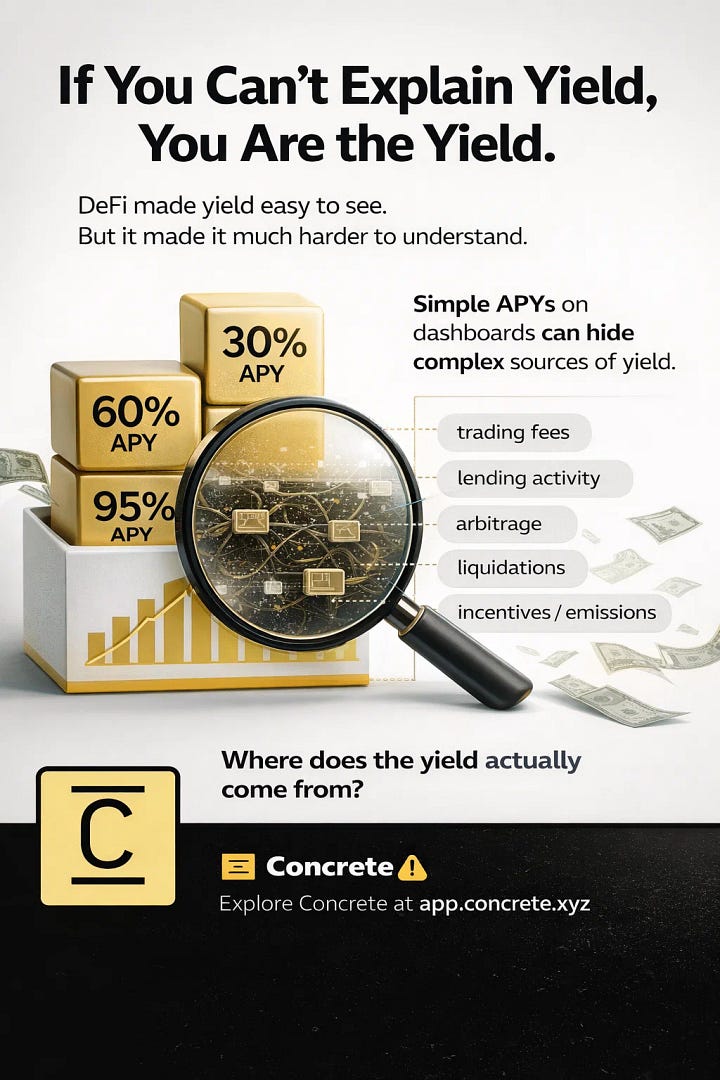
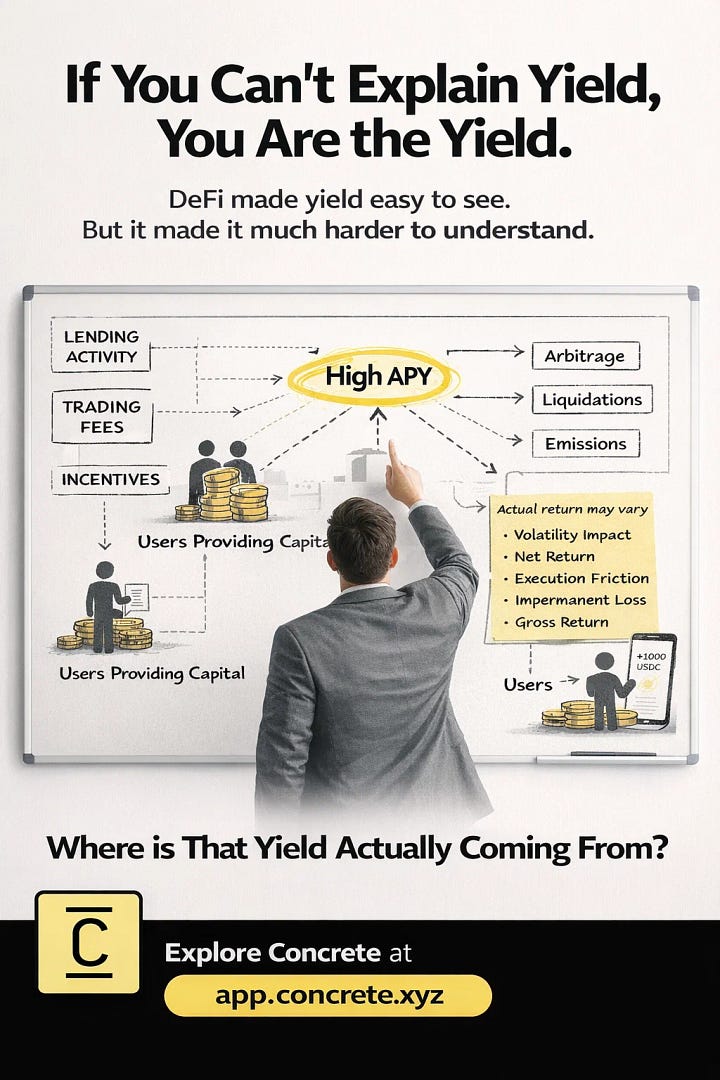
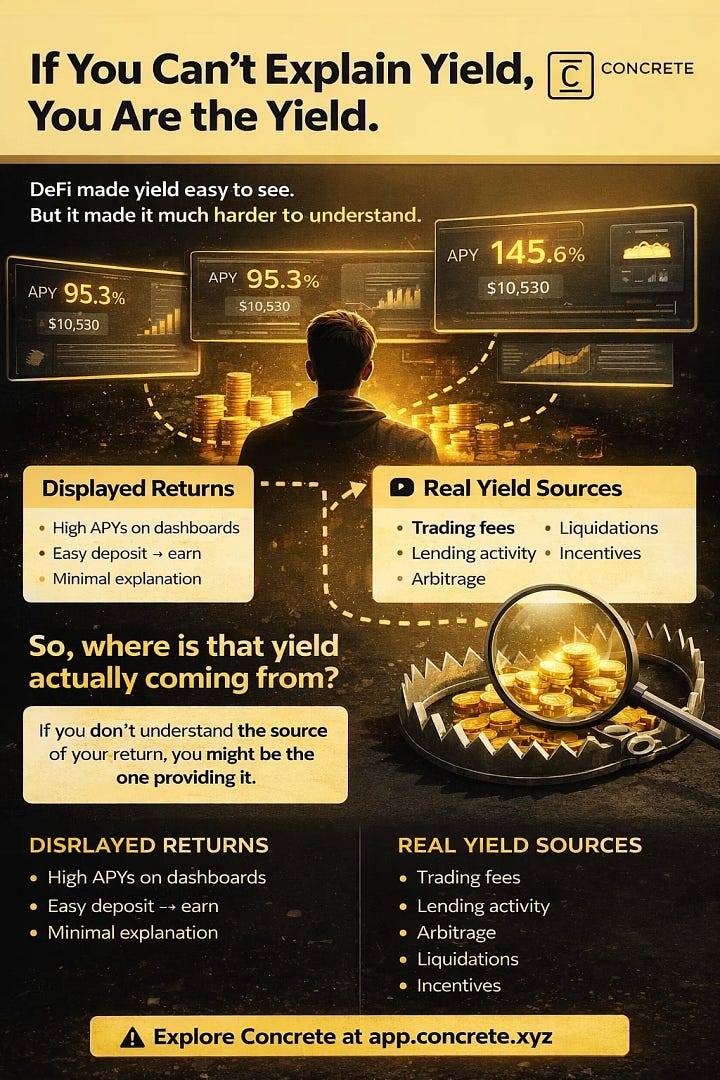
Where is this yield actually coming from?
The Illusion of Clarity
DeFi did something remarkable.
It made yield visible.
But in doing so, it also created an illusion — that visibility equals understanding.
A number on a dashboard feels like truth.
A high APY feels like opportunity.
Yet what you see is often just a surface-level projection.
Not a full picture. Not an outcome.
Just a snapshot of potential.
The Distance Between Displayed and Real Yield
The number you see is rarely the number you keep.
Between deposit and withdrawal, value gets reshaped.
Quietly.
Constantly.
- Fees reduce gross returns
- Slippage affects execution quality
- Volatility changes position dynamics
- Rebalancing introduces hidden costs
- Impermanent loss alters expected outcomes
What begins as a clean percentage often ends as something far less predictable.
A 25% APY can become 12%.
Or 5%.
Or negative.
Not because anything is broken — but because the system is more complex than the interface suggests.
Yield Is Always Paid By Someone
Yield is not generated in isolation.
It flows through systems.
And it always has a source.
In DeFi, that source typically comes from:
- Trading activity generating fees
- Borrowers paying interest
- Arbitrage correcting inefficiencies
- Liquidations redistributing risk
- Incentives designed to attract liquidity
Each of these carries a different profile.
Some are sustainable.
Some are cyclical.
Some are temporary by design.
Understanding yield means understanding its origin.
Because not all yield is created equal.
The Invisible Transfer of Value
Here’s where things become less comfortable.
In many systems, yield is not just created — it is transferred.
From one participant to another.
Often asymmetrically.
- Liquidity providers absorb volatility so traders can execute
- Incentive seekers take on risk in exchange for emissions
- Passive participants unknowingly subsidize active ones
And if you don’t understand where the value is flowing —
There is a real chance you are the one providing it.
This is not a flaw in DeFi.
It is how markets work.
But it changes how you should think about participation.
Same System, Different Outcomes
Two users can enter the same protocol.
Deposit the same asset.
At the same time.
And walk away with completely different results.
Why?
Because they are not interacting with the system in the same way.
One is chasing yield. The other is modeling it.
One sees a number. The other sees a structure.
The difference is not access.
It is interpretation.
The Shift Toward Engineered Yield
As DeFi matures, a shift is already happening.
Quietly.
From:
Yield chasing
To:
Yield engineering
This means:
- Thinking in terms of expected outcomes
- Understanding cost structures
- Managing exposure deliberately
- Optimizing over time, not moments
Yield is no longer something you find on a dashboard.
It is something you construct through decisions.
From Guessing to Structure
This is where better infrastructure begins to matter.
Instead of requiring users to manually navigate complexity, systems can be designed to manage it.
Concrete Vaults represent this shift.
They move the experience away from fragmented decision-making toward structured exposure by:
- Automating capital allocation across strategies
- Continuously rebalancing positions
- Reducing execution friction
- Minimizing manual error
The goal is not just convenience.
It is alignment — between what is displayed and what is actually earned.
Yield, Properly Understood
At its core, yield is not a number.
It is a relationship.
Between revenue, cost, and risk.
Yield = Revenue — Cost — Risk Adjustment
Ignore any part of that equation, and the number loses meaning.
It becomes a signal without context.
And in financial systems, context is everything.
A Better Question
DeFi doesn’t need more yield.
It needs better questions.
Not:
“How much can I earn?”
But:
- Where does this return come from?
- What risks am I absorbing?
- Who benefits from my position?
Because once you start asking those questions —
You stop participating blindly.
And start participating deliberately.
Final Thought
DeFi didn’t remove complexity.
It reorganized it.
Behind cleaner interfaces.
Faster interactions.
Better user flows.
But the underlying systems are still there.
Still moving value. Still redistributing risk.
And still rewarding those who understand them best.
If you can’t explain your yield, you are the yield.
🚨 Explore Concrete: https://app.concrete.xyz/ 🚨