If You Can’t Explain Yield, You Are the Yield: The Reality of DeFi’s Invisible Economy
--
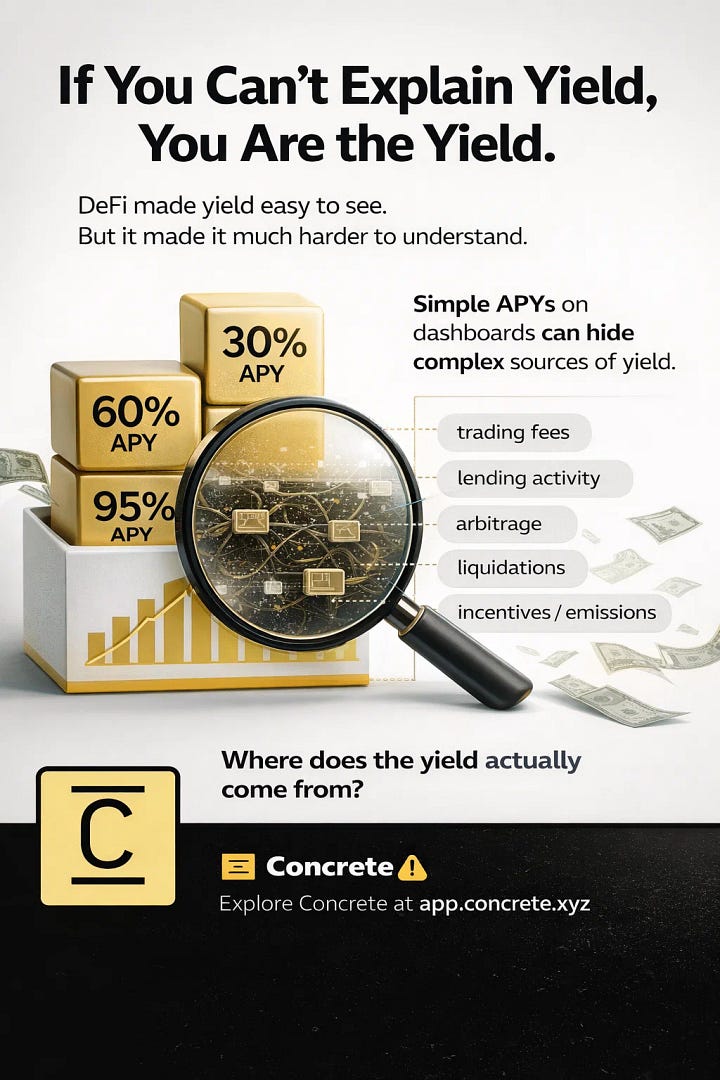
The DeFi dashboard is a masterpiece of modern psychological engineering. You connect your wallet, and immediately, you’re greeted by flashing green numbers: 20%, 50%, 100% APY. The flow is deceptively simple: Deposit → Earn → Repeat.
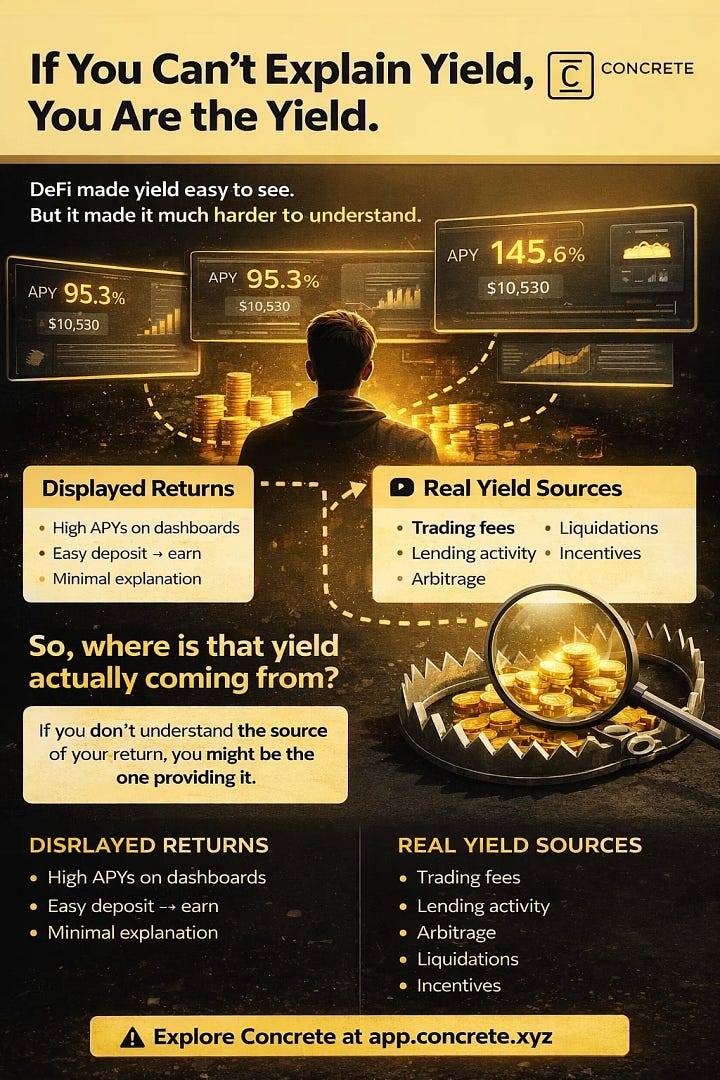
But behind the slick UI and the compounding tickers lies a cold, mathematical reality that most retail users ignore. In the world of finance, there is no such thing as “free” money. If you can’t point to the exact source of where your return is coming from, you aren’t just a participant in the market.
You are the liquidity being harvested.
1. The Great Illusion: Why APY is a Vanity Metric
In DeFi today, yield is presented as a static, guaranteed outcome. We’ve been conditioned to chase the highest number on the screen without looking under the hood.
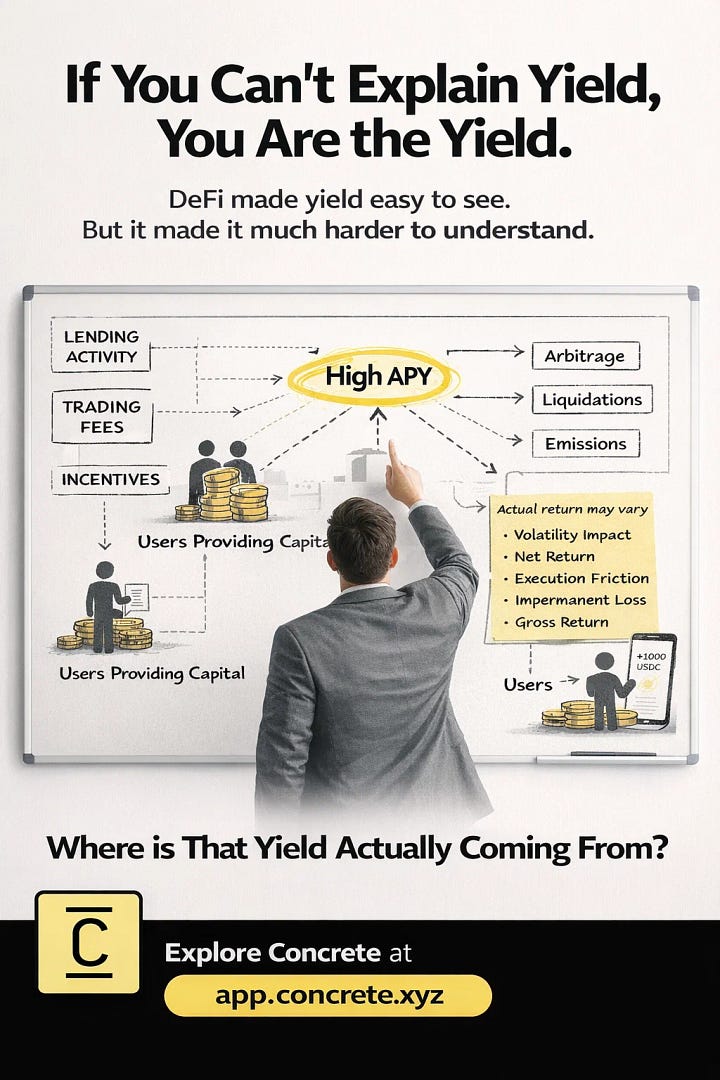
The problem? Displayed Yield is not Real Yield. The gap between what you see and what you actually keep is often a chasm. To truly understand your returns, you have to account for the “Yield Killers”:
- Impermanent Loss (IL): That 40% APY in a liquidity pool means nothing if the price of your assets diverges so much that you end up with less value than if you had just held them in your wallet.
- Execution Friction & Gas: In many L1s, frequent rebalancing to stay “in the money” eats your profits in transaction fees.
- Volatility Impact: High APY in a collapsing token is just a slower way to go to zero.
When you subtract these hidden costs, that “juicy” 80% APY often compresses into a measly 4% — or worse, a net loss.
2. The Anatomy of a Return: Where Does the Money Come From?
To stop being the “yield” for others, you must distinguish between Sustainable Revenue and Temporary Emissions. Real yield typically comes from five sources:
- Trading Fees: Users paying for the service of swapping tokens.
- Lending Activity: Borrowers paying interest to use your capital.
- Arbitrage: Bots and traders closing price gaps between exchanges.
- Liquidations: Fees earned when a borrower’s collateral is sold to protect the protocol.
- Incentives (Emissions): Tokens printed by the protocol to attract users.
The first four are revenue. The fifth is marketing. If a protocol’s yield is 90% incentives and 10% revenue, you aren’t investing in a business; you’re participating in a countdown.
3. The Hidden Value Transfer
Here is the uncomfortable truth: If you don’t understand the system, you are likely subsidizing it.
Whales and institutional players don’t “chase” APY. They model outcomes. They provide liquidity only when they understand the risk of the downside. Retail users, on the other hand, often earn “incentives” while unknowingly absorbing the massive downside risk for the rest of the market. You are essentially selling insurance to the pros and calling it “yield.”
4. The Shift: From Yield Chasing to Yield Engineering
The “Wild West” era of DeFi is ending. We are moving from Yield Chasing (guessing which pool has the highest number) to Yield Engineering (structuring a position for a specific net outcome).
Yield Engineering involves:
- Modeling expected volatility.
- Managing risk through hedging.
- Optimizing for Net Return, not Gross APY.
This is where the difference in outcomes becomes clear. While one user loses 20% to slippage and IL, another user — using the same system — is profitable because they structured their entry and exit with mathematical precision.
5. Concrete Vaults: Moving from Guessing to Structure
This is the problem Concrete was built to solve. The complexity of modern DeFi has reached a point where manual management is no longer viable for the average user.
Concrete Vaults act as the “Engineers” for your capital. Instead of you manually jumping from pool to pool, Concrete infrastructure:
- Automates Allocation: Finding the most efficient source of real revenue.
- Manages Strategies: Executing complex moves that would be too costly or difficult for a human to do 24/7.
- Rebalances Positions: Ensuring you stay within the optimal range to capture fees while minimizing risk.
- Reduces Manual Error: Eliminating the “fat-finger” trades and emotional FOMO that kill portfolios.
With Concrete, you move from guessing what the next big farm is to having structured exposure to the best-engineered yields in the market.
Closing Insight: The New DeFi Paradigm
Yield is not just a random number that appears in your wallet. It is a simple equation:
Yield = Revenue — (Cost + Risk)
If you ignore the “Cost” and “Risk” parts of that equation, the market will eventually collect them from you. Understanding this shift changes everything. You stop looking for the highest number and start looking for the strongest structure.
In the next era of DeFi, the winners won’t be the ones with the fastest fingers — they will be the ones with the best architecture. Don’t be the yield. Build with app.concrete.xyz.