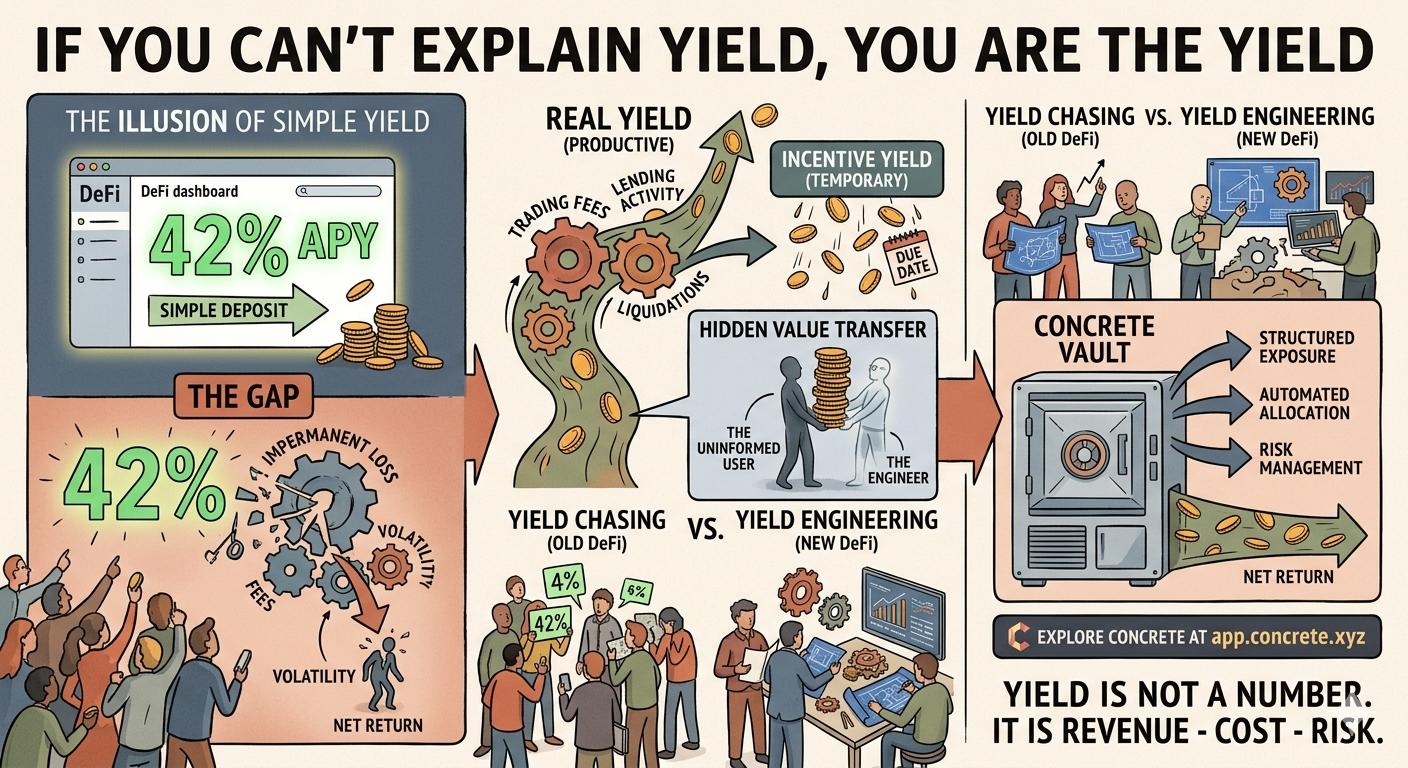
If You Can’t Explain Yield, You Are the Yield
 Asdf Asdf3 min read·Just now
--
gmcrete @everyone!
DeFi promised a financial system where anyone could earn yield transparently. And in many ways, it delivered—dashboards light up with high APYs, returns update in real time, and earning feels as simple as clicking “deposit.”
But that simplicity hides a deeper truth:
Yield in DeFi is easy to see — but much harder to understand.
And if you don’t understand it… you might be the one providing it.
---
1️⃣ The Illusion of Easy Yield
Today’s DeFi experience is designed for clarity on the surface:
- High APYs displayed front and center
- Simple “deposit → earn” flows
- Minimal explanation behind returns
To a new user, it feels almost effortless. Deposit assets, watch numbers grow, and assume the system is working in your favor.
But beneath that clean interface lies a complex machine.
Yield looks simple. Reality isn’t.
---
2️⃣ The Gap Between Displayed and Real Yield
The number you see is rarely the number you actually earn.
Several hidden factors eat into returns:
- Gross vs Net Yield – The displayed APY often doesn’t account for real costs
- Impermanent Loss – Providing liquidity can silently reduce your capital
- Rebalancing Costs – Strategies require adjustments that come with fees
- Execution Friction – Slippage and gas reduce efficiency
- Volatility Impact – Market swings can distort expected outcomes
A flashy 80% APY can compress into something far smaller once reality sets in.
Displayed yield is a headline. Real yield is the fine print.
---
3️⃣ Where Yield Actually Comes From
Yield doesn’t appear out of nowhere. It always has a source.
In DeFi, it typically comes from:
- Trading Fees – Generated by market activity
- Lending Activity – Borrowers paying interest
- Arbitrage – Price inefficiencies being captured
- Liquidations – Risk events in lending protocols
- Incentives / Emissions – Token rewards designed to attract liquidity
But not all yield is created equal.
- Some sources are sustainable (fees, real demand)
- Others are temporary (incentives, emissions)
Understanding the difference is critical.
---
4️⃣ Hidden Value Transfer: The Real Game
Here’s where things get uncomfortable.
If you don’t understand how yield is generated…
You might be the one subsidizing it.
This happens when:
- You provide liquidity without understanding downside risk
- You chase incentives while absorbing volatility
- You participate without modeling outcomes
In these cases, your capital becomes the source of someone else’s profit.
The system doesn’t reward participation. It rewards understanding.
---
5️⃣ Same System, Different Outcomes
Two users can interact with the same protocol and get completely different results.
Why?
Because they approach it differently:
- Some optimize for high APY numbers
- Others analyze structure, cost, and risk
- Institutions model outcomes before deploying capital
The difference isn’t access.
It’s understanding.
---
6️⃣ From Yield Chasing to Yield Engineering
DeFi is evolving.
We’re moving from:
Yield Chasing → Yield Engineering
This shift means:
- Modeling expected outcomes before investing
- Actively managing risk
- Optimizing strategies over time
- Focusing on net returns, not headline APYs
The future belongs to those who treat DeFi like a system to understand—not a casino to chase.
---
7️⃣ The Role of Structured Infrastructure (Concrete Vaults)
This is where structured solutions come in.
Concrete Vaults are designed to bridge the gap between complexity and usability.
They help users:
- Automate capital allocation
- Execute and manage strategies
- Rebalance positions efficiently
- Reduce manual errors and emotional decisions
Instead of guessing, users gain structured exposure.
Instead of chasing yield, they participate in engineered strategies.
👉 Explore Concrete at app.concrete.xyz
---
8️⃣ The Core Insight
At its core, yield is not just a number on a screen.
It is:
- Revenue
- minus Costs
- adjusted for Risk
Once you understand this, everything changes.
You stop asking:
«“How high is the APY?”»
And start asking:
«“Where is this yield coming from—and what am I risking to earn it?”»
---